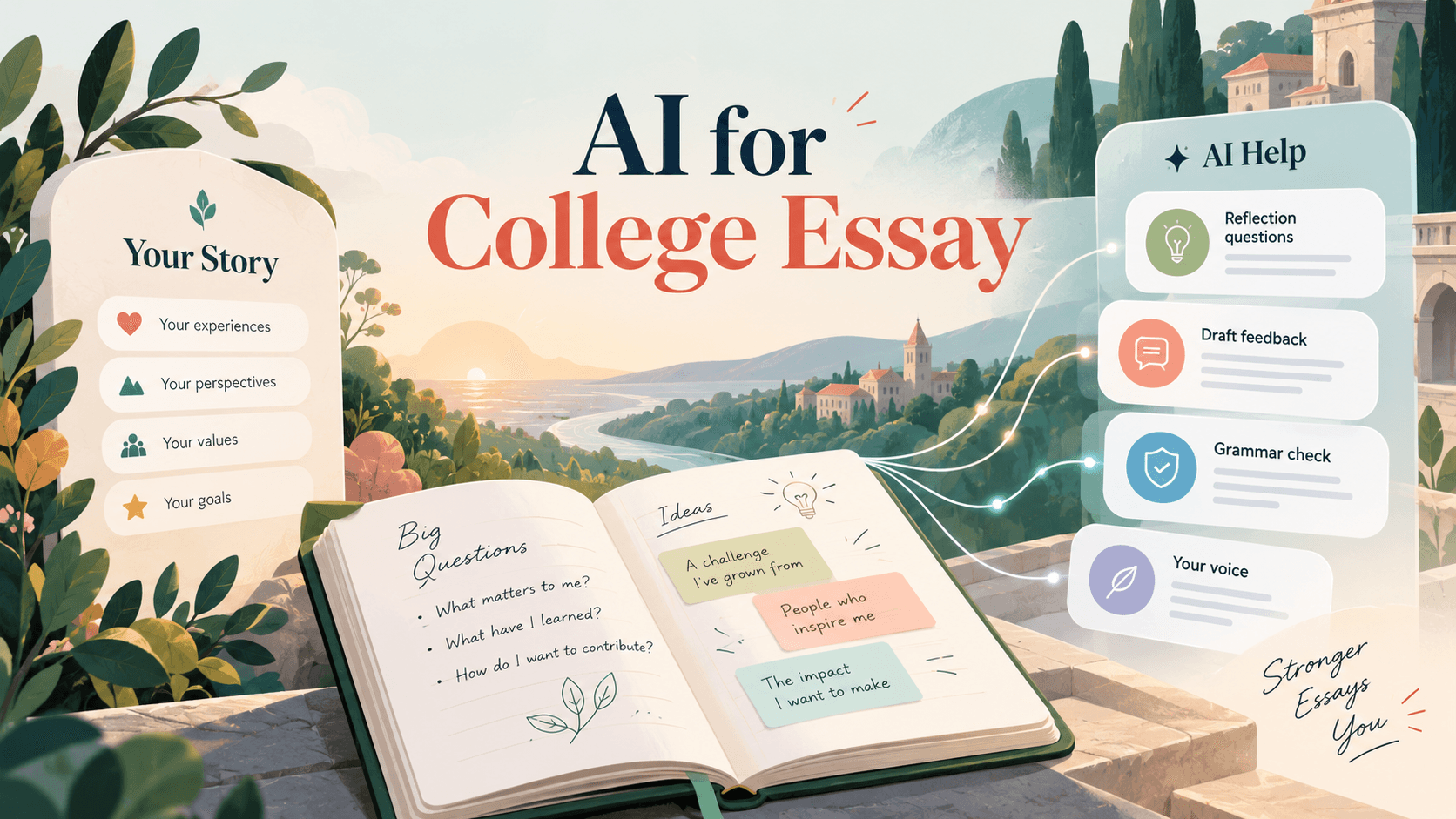
You can list your activities, grades, and awards, yet still struggle to explain what an experience meant to you. That‘s where AI for college essays can help, whether by suggesting reflection questions, identifying unclear passages, or checking grammar. But a personal statement isn‘t an ordinary school assignment. It needs to communicate your own experiences, thoughts, and perspective.
This guide compares six AI tools for college application essays, covering their features, free access, pricing, and limitations. You‘ll also learn how to use AI for brainstorming and feedback without letting it take over your personal story.
Can You Use AI for College Essays?
Yes, but what you‘re allowed to do depends on the institution. Yale, for example, permits AI-assisted grammar checks, spelling corrections, and general topic suggestions. However, submitting substantive AI-generated application content violates its admissions policy.
Before using AI, check the requirements of every college you‘re applying to. It helps to distinguish between three common uses:
Brainstorming: Asking questions that help you recall and reflect on your own experiences.
Feedback: Receiving comments on an essay you‘ve already written, then deciding which suggestions to follow.
Content generation: Using AI to write sentences, outlines, or entire passages, which may violate an institution‘s rules.
Unlike AI tools for writing academic essays, admissions-focused tools should help you communicate your own story rather than produce the story for you.
Do Colleges Check for AI in Application Essays?
Some colleges have strict AI-use policies, but there is no verified universal AI detector used by every admissions office. A school‘s policy doesn‘t necessarily reveal whether it uses detection software or how it evaluates flagged submissions.
If you‘re worried about a college essay flagged as AI, keep your original drafts, revision history, and notes. An AI detection score alone cannot establish authorship, and passing a detector doesn‘t mean your essay complies with an institution‘s rules.
Choosing the Best AI for College Essays by Task
Tool | Best For | Main Limitation | Starting Price |
Verla | Academic writing, AI detection, and revision | Primarily designed for coursework; generation may violate admissions rules | $2.99/7-day Pro trial |
Khanmigo | Guided brainstorming and reflection | Paid personal access; regional restrictions | $4/month |
ESAI | Exploring personal experiences and story ideas | Some writing features generate content | Free tools; paid from $19/week |
GradGPT | Reviewing personal statement drafts | Scores don‘t predict admission outcomes | One free review |
Kolly | Essay feedback and application planning | AI rewrites require policy review | One free full review |
Grammarly | Grammar, spelling, and proofreading | Generative rewriting may go beyond permitted corrections | Free |
These tools serve different stages of the application process. Some focus on personal reflection, while others provide draft feedback or language corrections. The comparison is based on published features and pricing, not independent assessments of essay quality or admission outcomes.
Six Tools to Consider and Their Boundaries
1. Verla: Best for Academic Writing and Revision Support
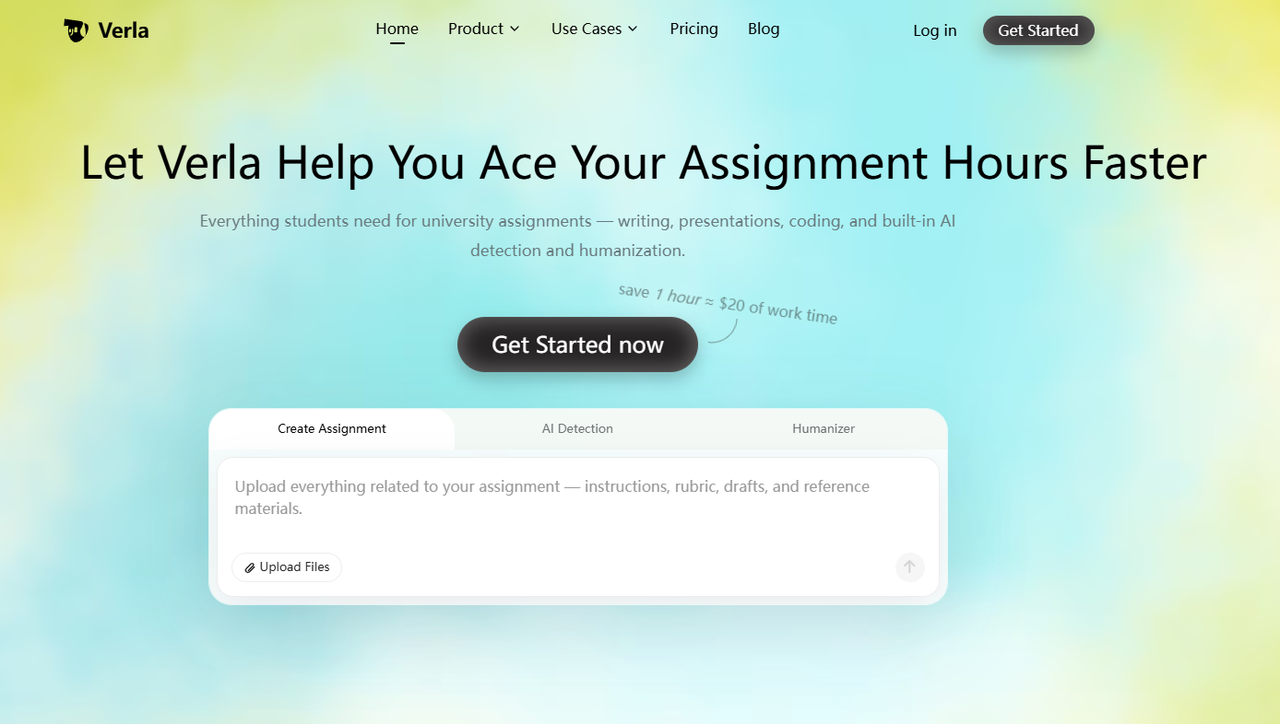
Verla offers a broader academic writing workflow that combines assignment generation, AI Detection, and AI Humanizer. Its Academic Assistant supports course instructions, rubrics, and uploaded materials, making it particularly useful for students managing different academic writing tasks.
For college application essays, however, students need to distinguish between ordinary coursework and personal statements. Verla‘s AI Detection can help identify passages for closer review, while its AI Humanizer supports improvements to clarity and flow. Neither feature guarantees admissions compliance, and AI-generated or rewritten application content may be prohibited.
Students comparing the best AI for school work may find Verla useful beyond the admissions process, particularly for research, assignments, and essay revision during college.
Pros:
Combines academic writing, detection, and revision tools.
Supports instructions, rubrics, and course materials.
Provides separate usage allowances for different features.
Cons:
Primarily designed for academic coursework rather than admissions coaching.
AI-generated or humanized application content may violate college policies.
Price:
Pro Trial: $2.99 for 7 days, then renews at the monthly Pro rate unless canceled.
Basic: $19.99/month.
Plus: $39.99/month.
Pro: $79.99/month.
2. Khanmigo: Best for Guided Reflection Questions
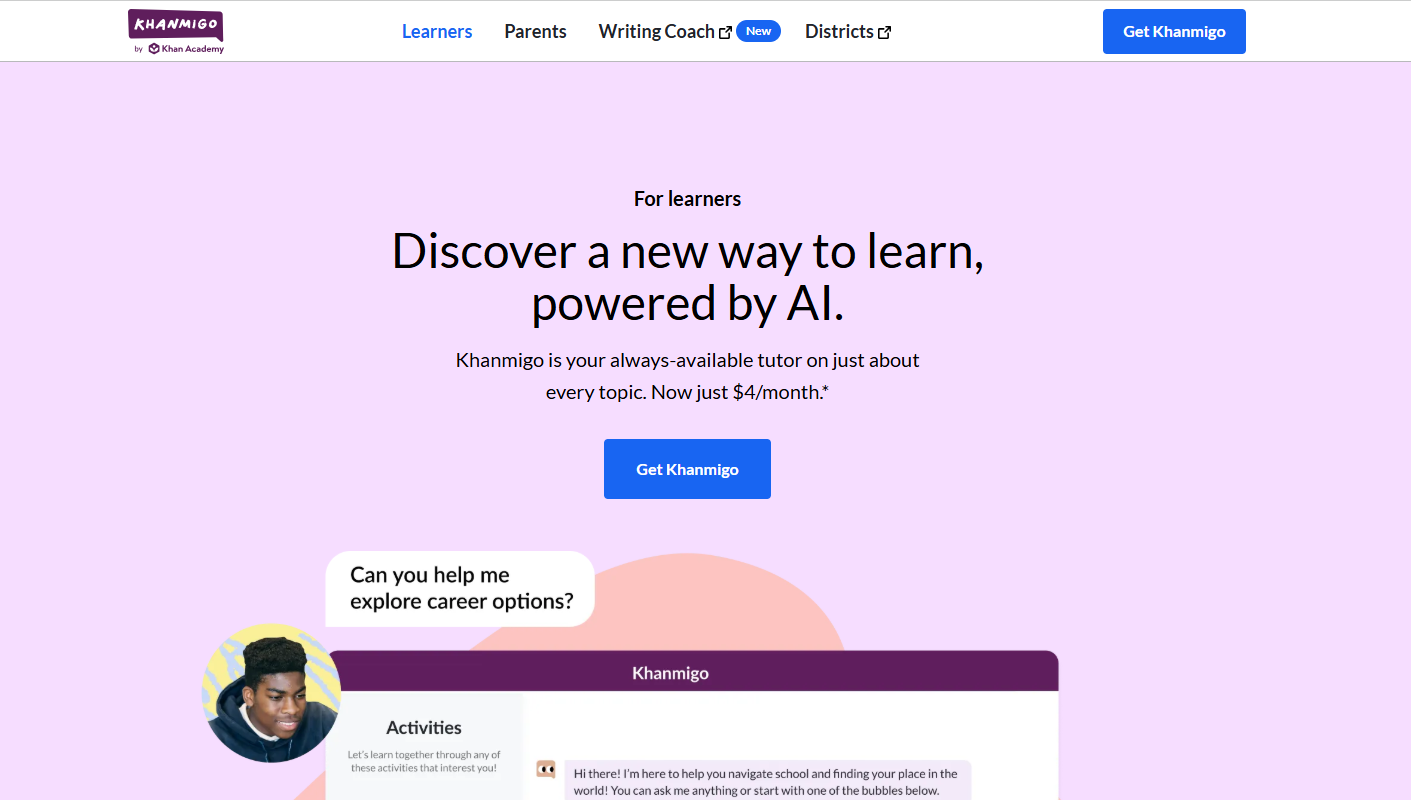
Khanmigo provides guided writing support, including college admissions brainstorming and essay feedback activities. Instead of immediately generating an essay, it encourages students to think through experiences using questions and follow-up prompts.
This approach works well if you have several possible topics but don‘t know which one reveals something meaningful about you. Khanmigo can help you explore details and perspectives, while the actual story and interpretation remain yours.
When developing an introduction, the principles behind writing a strong essay hook can also help you recognize whether an opening is specific and engaging. For an application essay, though, the experience and wording should remain your own.
Pros:
Guided admissions brainstorming.
Encourages reflection through questions.
Offers writing feedback and problem-checking activities.
Family subscriptions include interaction-history features.
Cons:
Individual learner subscriptions are paid.
Personal access is geographically restricted.
General suggestions still need to be grounded in real experiences.
Price:
Individual or Family: $4/month or $44/year, excluding applicable sales tax.
Free Khanmigo teacher tools are a separate offering.
3. ESAI: Best for Talking Through Your Experiences

ESAI focuses on college and career storytelling. Its Brandi voice agent helps students explore their experiences, interests, and goals through conversation. The platform also offers tools for identifying personal statement topics and connecting experiences to broader interests.
This can be useful if talking through an experience feels easier than writing about it immediately. For example, explaining what happened during a volunteer project may help you recognize a specific decision or unexpected moment worth exploring.
However, ESAI also offers outline, hook, and drafting features. These should be evaluated separately because generating application content may go beyond what a college allows.
Pros:
Conversational brainstorming through Brandi.
Free Story Strategist entry point.
Helps connect experiences with interests and goals.
Offers multiple admissions-related tools.
Cons:
Some essay tools require paid access.
Generated outlines and wording may violate application policies.
Price:
Free: Selected tools and the first Brandi call.
Weekly: $19/week.
Monthly: $50/month.
Annual: $500/year, equivalent to approximately $41.67/month.
4. GradGPT: Best for Feedback on Your Own Draft
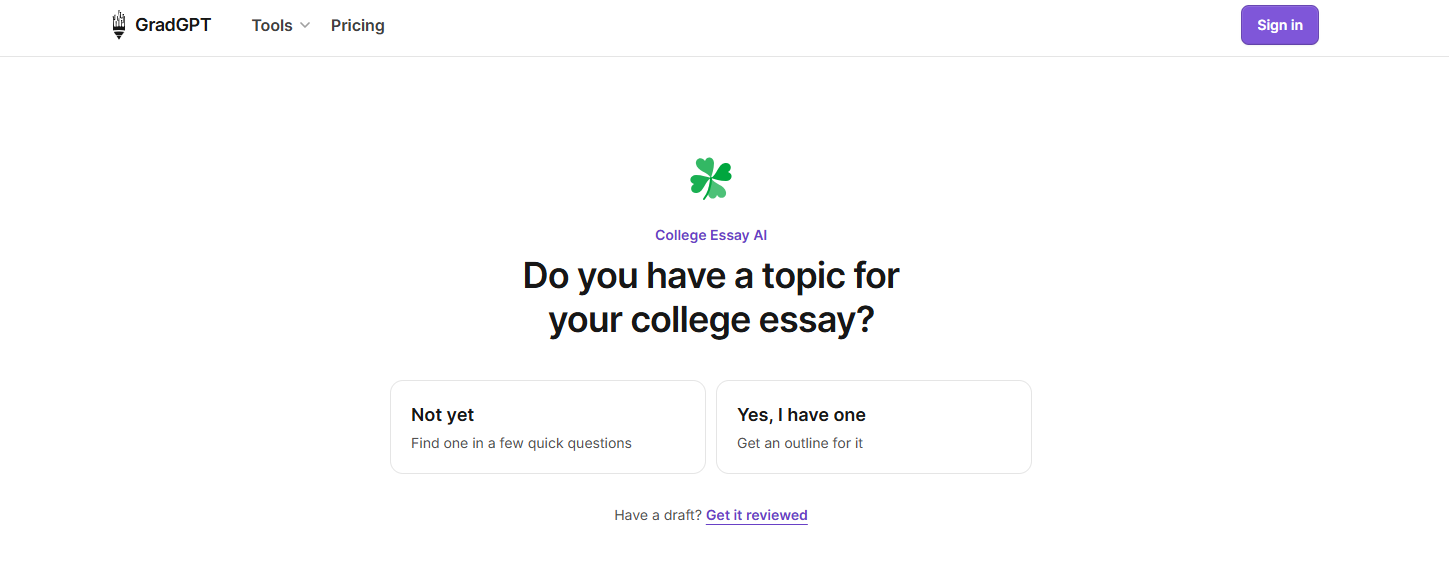
GradGPT is designed for students who already have a personal statement and want feedback before submitting it. Paste your draft into the platform to receive comments, scoring, and suggestions related to narrative, detail, structure, and writing style.
Its feedback-first approach can help you recognize unclear passages or generic explanations. For instance, if a paragraph describes an achievement without explaining why it mattered, the feedback may encourage you to add a more personal reflection.
Still, GradGPT‘s scores are product assessments, not predictions of admission outcomes. Use the comments to evaluate your draft rather than treating a numerical score as proof of quality.
Pros:
Feedback linked to specific passages.
Reviews narrative, structure, and writing style.
Supports repeated revisions.
One free review without a payment card.
Cons:
Free access includes only one essay review.
AI scores cannot predict admission decisions.
Price:
Free: One essay review.
Plus: $36/month, including 50 reviews per month.
Max: $96/month, including unlimited reviews and additional application resources.
5. Kolly: Best for Paragraph Review and Application Planning
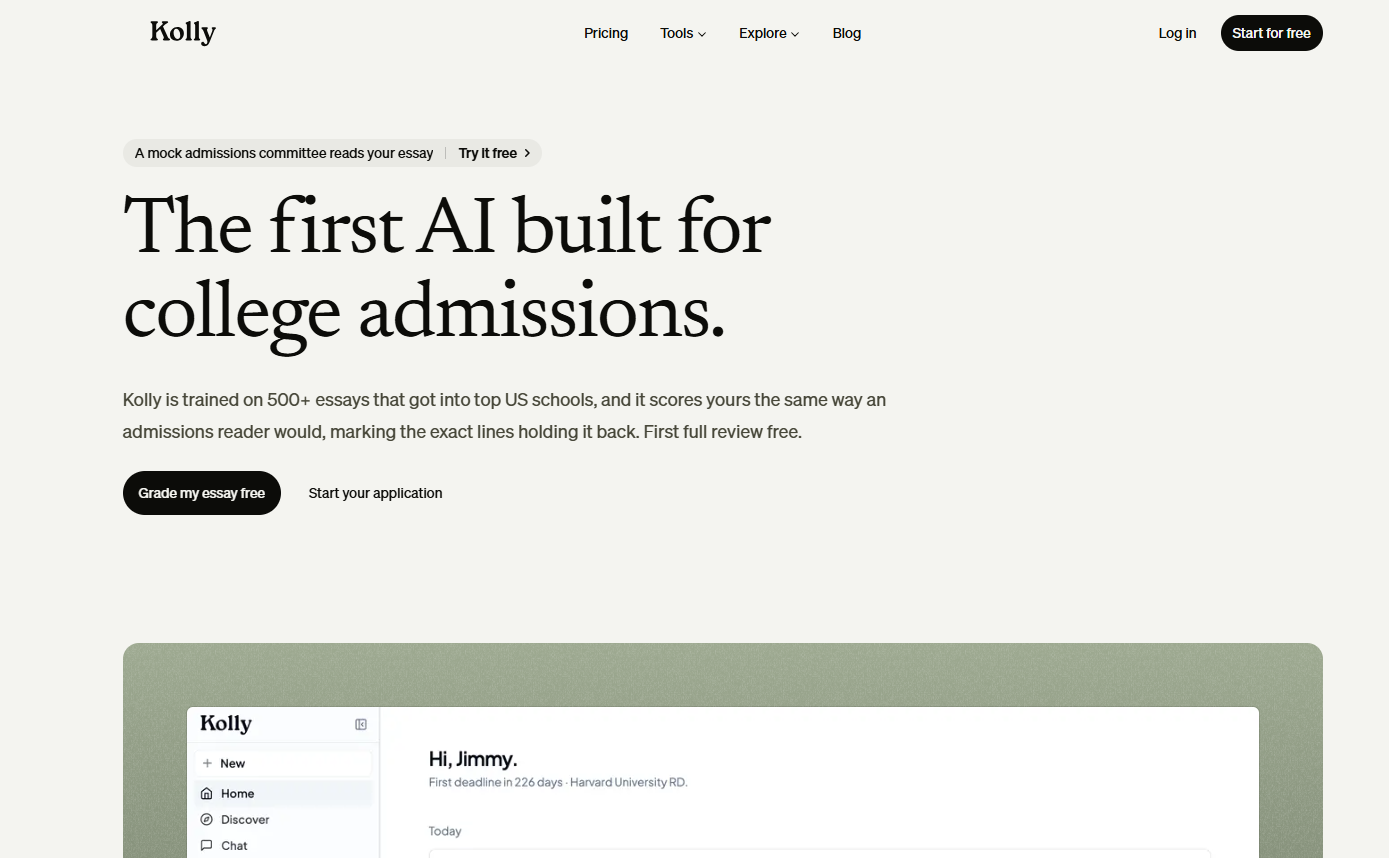
Kolly combines essay feedback with broader college application planning. Alongside reviewing personal statements, students can organize school lists, track deadlines, and explore examples of accepted essays.
Its paragraph-level feedback considers elements such as detail, reflection, theme, and clarity. This may help identify where your draft describes an activity but doesn‘t explain what you learned or how your perspective changed.
For structure-related feedback, understanding the difference between a thesis statement and a topic sentence can be helpful for academic essays. Application essays, however, often follow a more personal narrative structure rather than a formal thesis-driven argument.
Pros:
Paragraph-level essay feedback.
School lists and deadline tracking.
Accepted-essay library.
Sharing and reviewer-comment features.
Cons:
Free plan includes one full review.
Rewrite and drafting features require attention to admissions policies.
Price:
Free: One full essay review and 3,000 starting credits.
Monthly: $29/month.
Season Pass: $149 every six months, approximately $24.83/month, with automatic renewal unless canceled.
6. Grammarly: Best for Grammar and Spelling Checks
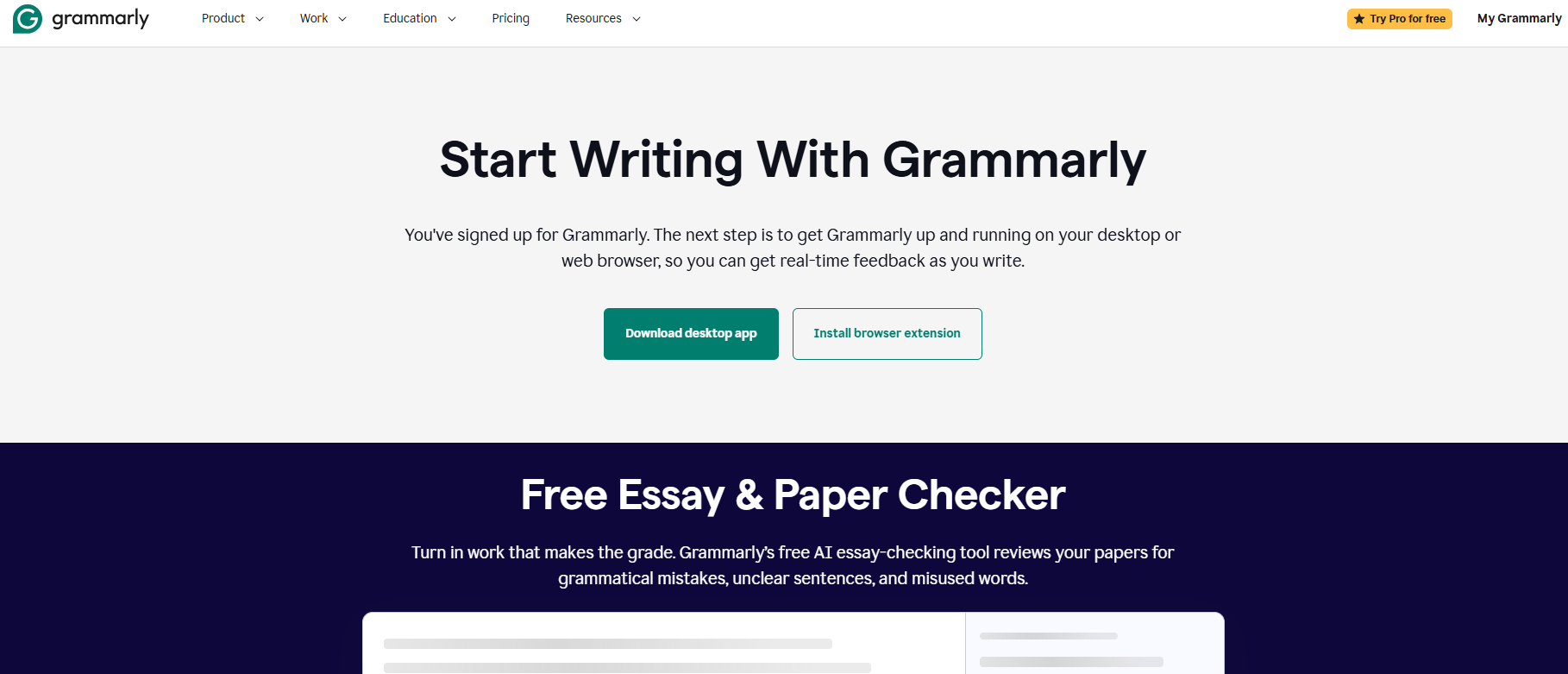
Grammarly is a practical choice for students who have already written their application essay and want to check grammar, punctuation, and spelling. Its free features help identify mechanical errors without requiring a complete rewrite.
For personal statements, the distinction between proofreading and generating text matters. Correcting a typo is different from accepting an AI-generated replacement paragraph. Review each suggestion and preserve wording that accurately reflects your voice.
Some students also worry that polished writing will trigger an AI detector. Understanding AI detection and humanization can help clarify why a detector score is not proof of authorship or compliance with admissions requirements.
Pros:
Free grammar and spelling checks.
Individual corrections to review.
Tone suggestions.
Browser and document integrations.
Cons:
Doesn‘t evaluate the authenticity of your experiences.
Generative rewrites may go beyond permitted proofreading.
Price:
Free: $0/month.
Pro: $30/month.
Pro Annual: $144/year, equivalent to $12/month.
Quarterly billing: $60 every three months.
How to Use AI Without Handing Over Your Story
The safest starting point is to treat AI as a source of questions and feedback, not as the author of your application essay. Your experiences, decisions, and reflections should remain your own.
Here‘s a practical process:
Check each college‘s AI policy. Confirm whether brainstorming, grammar checks, or other assistance is allowed.
List your experiences yourself. Focus on specific moments, decisions, mistakes, and changes in perspective rather than achievements alone.
Use AI for reflection questions. Ask follow-up questions that help you remember details instead of requesting a generated story.
Write your own draft. Use authentic experiences and explanations you can discuss confidently.
Request limited feedback. Ask where a reader needs more context or clarification, rather than requesting replacement paragraphs.
Review the final version. Check facts, voice, prompt requirements, and word limits. Keep earlier drafts and revision history.
During revision, techniques used for humanizing AI content can help you recognize generic or overly formal wording. For application essays, make any changes yourself unless your school‘s policy explicitly permits the assistance you‘re considering.
A Reflection Prompt
Ask me five questions about a small moment when I changed my approach to something. Do not invent experiences, choose a lesson for me, outline the essay, or write sentences I could submit. Ask one question at a time and let my answers guide the next question.
A Feedback Prompt
Read my draft and identify three places where you need more context. Quote the relevant passage and ask a question about it. Do not rewrite, add details, or score my admission chances.
Conclusion
The best AI for college essays depends on the help you actually need. Khanmigo and ESAI are useful for brainstorming and reflection, GradGPT and Kolly focus on draft feedback, and Grammarly supports grammar and spelling checks. Verla offers a broader academic writing workflow with AI Detection and Humanizer, particularly relevant to coursework and revision tasks.
For application essays, keep your experiences and final wording under your control. A strong personal statement doesn‘t need dramatic language or a perfectly packaged life lesson. It needs specific, truthful reflection. Even when concluding an essay, focus on what your experience genuinely means rather than adopting an AI-generated conclusion.