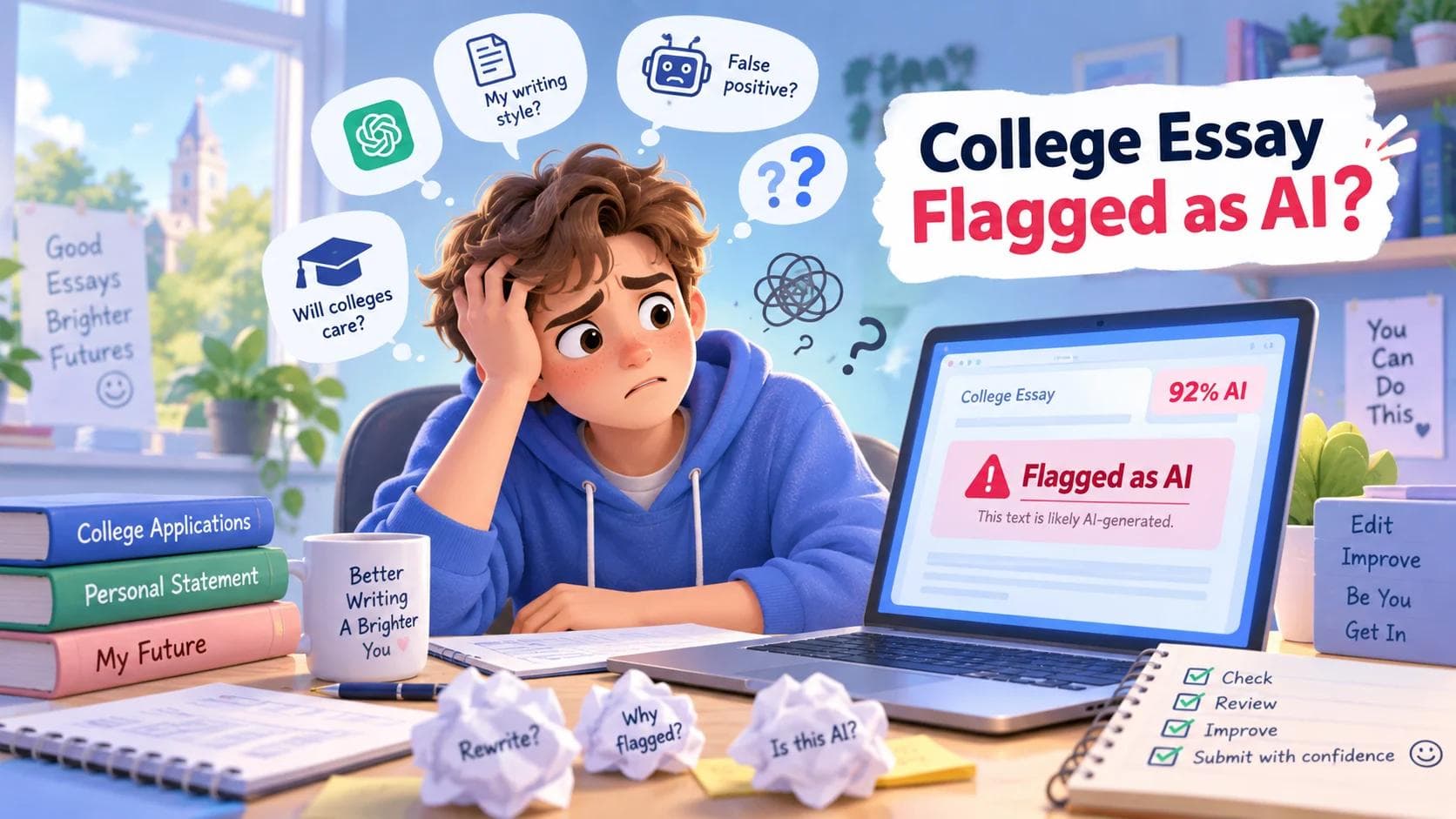
You wrote your college essay yourself, revised it carefully, and finally felt ready to submit. Then an AI checker suddenly labeled it 40%, 80%, or even 100% AI. Now you're wondering: Why is my college essay flagged as AI when I wrote it myself? Will colleges care? Do I have to rewrite everything?
Don't panic and start over. This guide explains why false positives happen, whether colleges check application essays for AI, and what to do if your essay is flagged for AI.
Why Is My College Essay Being Flagged as AI?
If you're asking why AI detectors flag your writing, remember they analyze patterns in the final text. They don't actually know who typed the words. So, can human writing be flagged as AI? Yes.
Common triggers can include:
Possible Trigger | What It May Look Like |
Predictable structure | Similar sentence patterns throughout |
Generic language | Broad statements with few personal details |
Over-polished writing | Every sentence sounds unusually formal |
Repetitive transitions | Reusing the same logical structure |
Formulaic reflections | Perfectly packaged "life lessons" |
Different detectors also use different methods and thresholds. If your college essay says 100% AI, that score alone doesn't prove AI wrote your essay.
Do College Admissions Check for AI in Application Essays?
There is no single answer to doing college admissions checks for AI or doing college checks for AI in application essays. AI policies vary by institution, and there isn't one universal college essay AI detector used by every admissions office.
Before submitting:
Check the current AI policy of each college.
Don't assume an online detector score represents an admissions decision.
Make sure the essay reflects your own experiences and ideas.
Keep records of your writing and revision process.
The same applies if your Common App essay or personal statement is flagged as AI. A detector result and a school's admissions policy are two separate issues.
What to Do If Your College Essay Is Flagged for AI
The goal isn't to keep rewriting until every detector displays a satisfying green "0%." Instead, identify what triggered the result and improve passages that genuinely need attention.
Here's a faster approach:
Step | What to Do | Helpful Tool |
1 | Don't rewrite everything | Your original drafts |
2 | Identify flagged passages | Verla AI Detector |
3 | Review AI-like writing patterns | Manual review |
4 | Make awkward wording more natural | Verla AI Humanizer |
5 | Add personal details | Your own experience |
6 | Read and review again | You |
Step 1. Don't Rewrite Everything Just to Get 0% AI
Students often wonder how much AI is acceptable in a college essay or whether 40% AI detection is bad. There isn't a universal detector percentage that automatically determines whether your essay is acceptable.
Instead of chasing 0%, check:
Did you actually write the content?
Does it sound like you?
Are any sections unusually generic?
Does your AI use comply with the college's policy?
Do you still have your drafts and editing history?
Treat the score as a signal to investigate, not a verdict on authorship.
Step 2. Find Which Parts Are Being Flagged
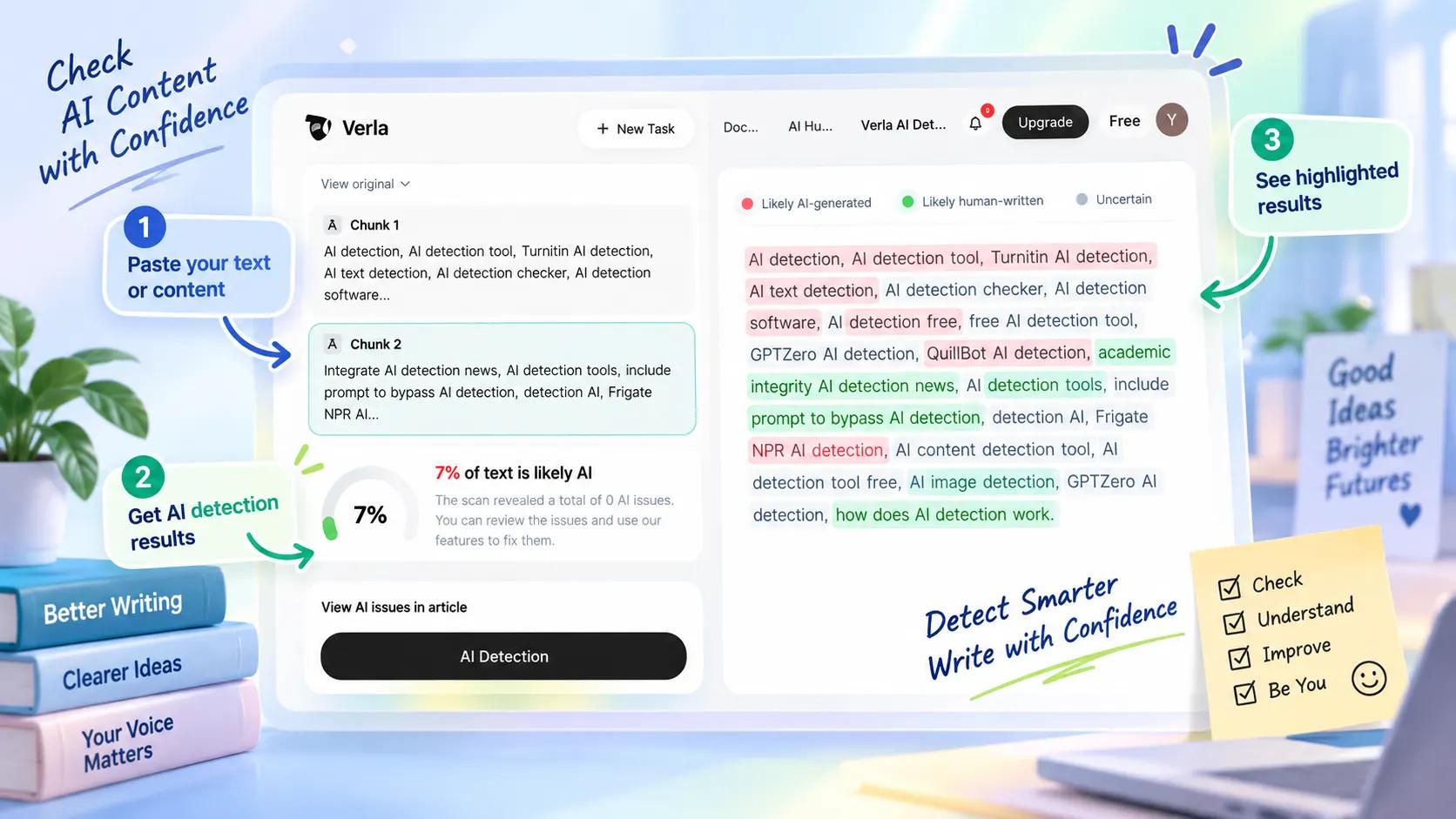
Run the essay through a Turnitin-style Verla AI Detector and look beyond the overall percentage. Focus on specific passages that show AI-like patterns.
For each flagged passage, ask:
Is this sentence too generic?
Is the structure repetitive?
Would I naturally phrase it this way?
Did editing make it sound more formal than I intended?
Could I replace a broad statement with a real detail?
You don't need to change every highlighted sentence. Prioritize passages that genuinely don't sound like you.
Step 3. Fix Generic or Formulaic Writing
A passage can sound generic without being AI-generated. College essays are especially vulnerable when personal experiences get polished into broad statements about "growth," "resilience," or "leadership."
For example:
Generic | More Personal |
This experience taught me the importance of perseverance. | After my second failed attempt, I stopped trying to hide how frustrated I was and asked my teammate for help. |
Volunteering changed my perspective on community. | I still remember Maria correcting my terrible Spanish while we stacked boxes together. |
Don't deliberately add mistakes to "look human." Replace vague writing with details that genuinely belong to you.
Step 4. Humanize Flagged Passages Without Losing Your Voice
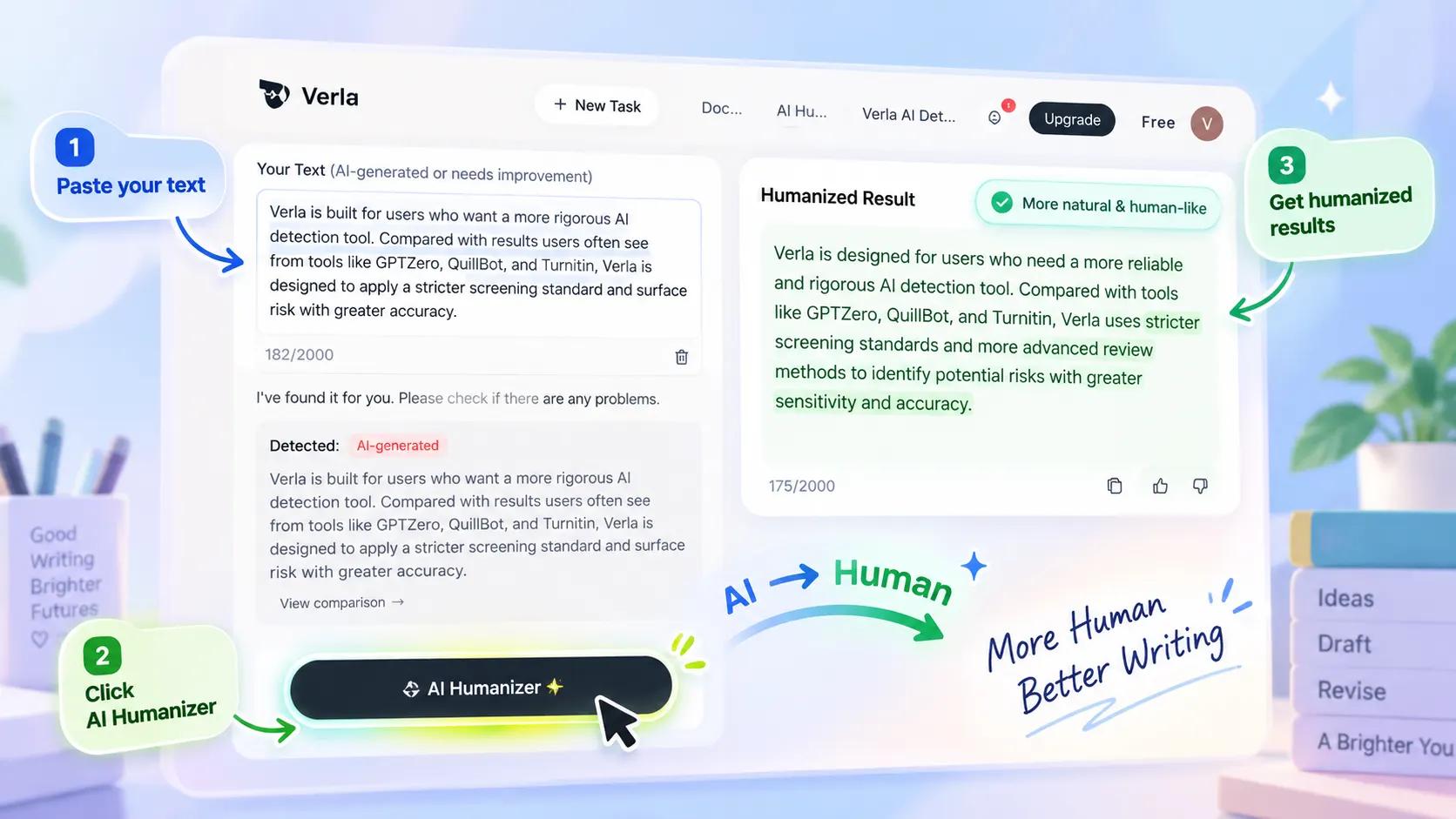
If a sentence communicates the right idea but sounds stiff or mechanical, rewrite it in language closer to how you naturally express yourself.
Verla AI Humanizer can help with this process:
Paste the passage that needs revision.
Humanize overly formal or formulaic phrasing.
Compare the result with your original.
Edit the output until it sounds like you.
Keep all experiences, opinions, and facts accurate.
If you're looking for the best AI humanizer for a college essay, don't judge a tool only by whether it lowers an AI score. The more important question is whether it helps you improve naturalness without replacing your authentic voice.
Step 5. Add Details Only You Could Write
Your college essay should reveal something about you, not just communicate a polished message.
Try adding:
A specific conversation
A small mistake or unexpected moment
Something you noticed
Your actual reaction at the time
A concrete action you took
Details that explain why the experience mattered to you
Specificity improves the essay itself, whether or not an AI detector notices.
Step 6. Read It Aloud Before Submitting
Now stop looking at the detector for a moment and read your essay aloud.
Use this quick check:
Would I actually say this?
Does the vocabulary sound natural to me?
Are the experiences genuinely mine?
Did any editing tool change my meaning?
Are generic claims supported by specific details?
Does the final essay follow the college's AI policy?
Your own judgment should remain the final filter.
How to Avoid Getting Your College Essay Flagged as AI
If you're still drafting, a few habits can reduce unnecessary problems later:
Write the first draft yourself. Focus on getting your ideas down before polishing.
Keep your natural voice. Don't turn every sentence into formal academic prose.
Use concrete details. Real experiences are more useful than generic life lessons.
Avoid excessive rewriting. Too much polishing can erase your original voice.
Keep version history. Save drafts, notes, and revisions.
Use AI responsibly. Check what your target colleges allow before using generative tools.
And can you use AI on college essays? There isn't one policy covering every institution. Some colleges distinguish between limited assistance, such as brainstorming or proofreading, and having AI generate substantive application content. Always check the current rules of the colleges you're applying to.
How Can I Prove I Wrote My College Essay Myself?
If you genuinely wrote the essay, preserve the trail showing how it developed.
Keep | Why It Helps |
Google Docs/Word history | Shows revisions over time |
Early drafts | Shows how the essay developed |
Outline and notes | Documents your planning |
Counselor feedback | Shows the editing process |
Revision records | Helps establish writing history |
Don't create evidence after being questioned. Simply keep the normal records produced while you write.
Conclusion
A college essay flagged as AI doesn't mean you need to panic or rewrite everything. Focus on keeping your experiences authentic, reviewing suspicious passages, adding specific personal details, and following each college's AI policy.
Verla can make the entire process easier by bringing three tools into one workflow: use the College Essay Writer to turn your ideas and experiences into a strong draft, AI Detection to identify passages that may trigger AI flags, and AI Humanizer to refine stiff or formulaic wording while preserving your voice. Together, they can help you create, check, and polish a high-quality college essay faster, so you can submit with greater confidence.