I still remember trying ChatGPT 3.5 for a course blog when it first came out. I had spent half an hour staring at a blank document; then 900 words appeared in seconds. I had no idea what an AI Humanizer was, and for about thirty seconds, I thought I had found a cheat code.
Then I pasted the draft into an AI detector.
Almost the entire thing was flagged.
I spent the next hour throwing prompts at it: “sound more natural,” “write like a college student,” “vary the sentence length.” Each version came back wearing a slightly different outfit, but underneath it was the same stiff essay.
What finally helped was not a cleverer prompt. I read the paper as if I were grading it. The draft was polished, but it had no position. It quoted sources without doing much with them and barely sounded connected to the class I was taking.
That is the real work of humanizing AI content: not making a machine sound casually human, but putting your reasoning back into a draft that skipped it.
This guide is here to save you that hour of trial and error—to show you what to change, what to leave alone, and how to make an AI-assisted draft sound like your own work again.
Why Does AI-Generated Writing Sound Unnatural?
When I first reread that draft, I could not point to one terrible sentence. The grammar was clean. The structure made sense. Every paragraph had a topic sentence and a tidy conclusion.
That was exactly the problem.
Everything had been given the same amount of polish and the same amount of importance. The introduction announced that the topic was “increasingly significant.” The body moved through a row of safe advantages and disadvantages. The conclusion reminded the reader that the issue was “complex and multifaceted.” It sounded like a student who had attended every lecture but remembered none of the discussion.
AI drafts often know the shape of an academic paper better than what it needs to say. They imitate analysis—introduce a source, summarize it, add “however”—without making the judgment that turns information into an argument.
Deleting “delve,” “furthermore,” or “significant” rarely fixes this. The stronger signs are structural: claims broad enough to fit any assignment, evidence without interpretation, and paragraphs that end exactly where the thinking should begin.
The writing feels empty because, somewhere between the prompt and the polished output, the student disappeared.
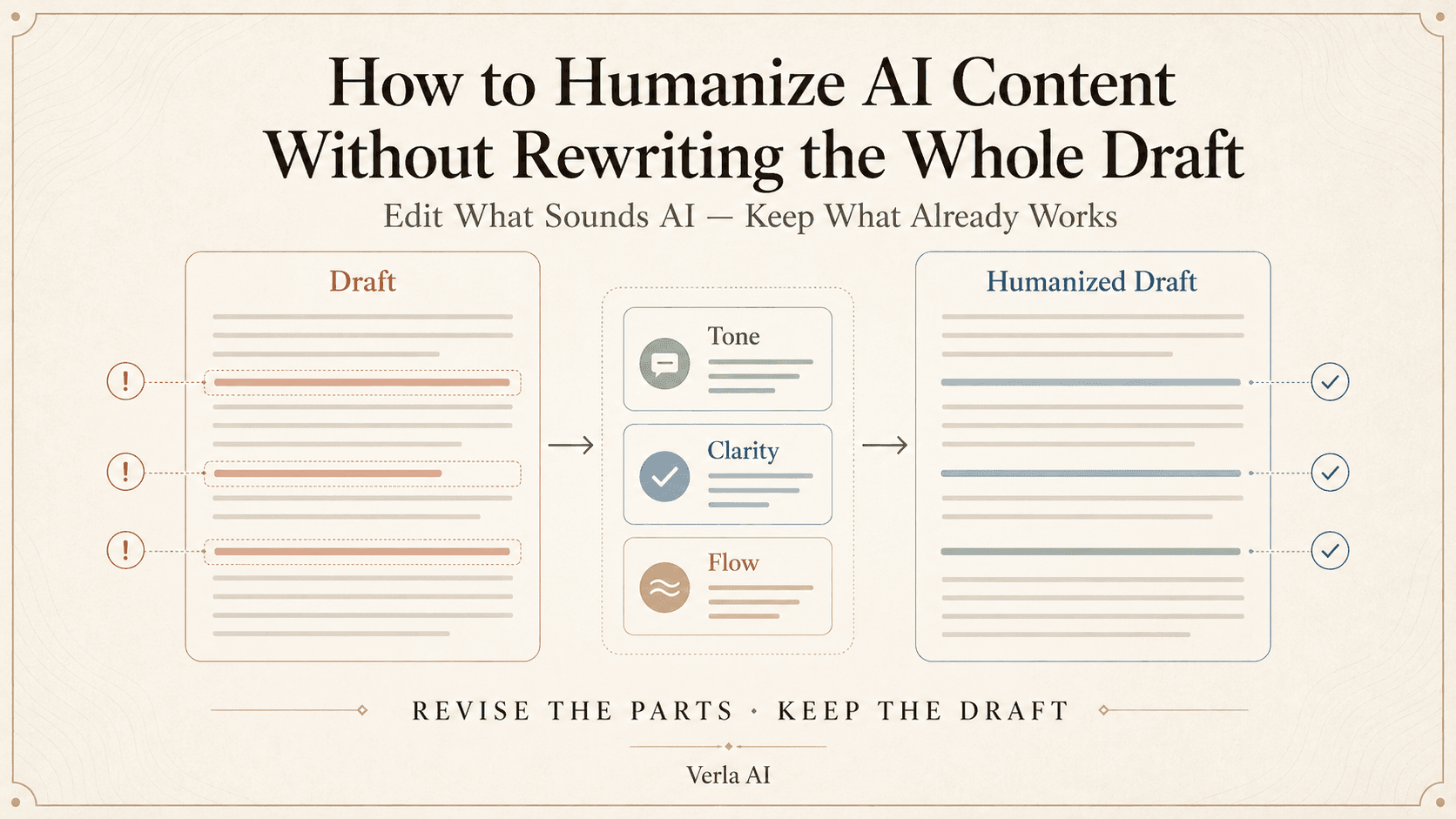
How to Humanize AI Content Without Rewriting the Whole Draft
I used to assume I had to rewrite every flagged sentence. That approach took forever and usually made the paper worse. By the third pass, I was no longer improving the argument; I was rearranging words to please a percentage on another tab.
A better place to begin is the assignment prompt. Keep it open beside the draft. If the question asks you to compare two theories, evaluate a study, or defend a position, check whether each section is actually doing that work. AI loves explaining the general topic because explanation is safer than judgment. Your job is to pull the paper back toward the question.
The weak paragraphs usually reveal themselves quickly. They could be dropped into another essay unnoticed. They introduce “both benefits and challenges” without saying which matters more, or quote a study and rush onward before explaining why it matters.
This is where your thinking belongs. Name the distinction the draft blurred. Explain why one source is more convincing, why correlation is not causation, or why a sample limits the conclusion. A precise academic judgment is already a human voice because someone had to make it.
Once the thinking is sharper, editing gets easier. Cut openings that spend twenty words clearing their throat. Remove conclusions that repeat the previous line. If three sentences march at the same length, combine one and shorten another. Read aloud; your ear catches mechanical rhythm faster than your eyes.
Do not force chaos into the prose. Adding slang, spelling mistakes, or random short sentences does not make an essay sound human. It makes it sound as though the writer is trying to impersonate one.
Ignore rigid AI vocabulary lists. “However” is useful when a real contrast follows; “in conclusion” is unnecessary when the ending is already clear. Keep phrases that perform a job.
Most importantly, leave the parts that are already correct alone. A definition does not need personality. Neither does a formula, an accurate quotation, or an established technical term. Humanizing works best as selective editing, not as a wash cycle for the entire document.
For search content, preserve intent, core keywords, headings, and internal links, then add the experience or analysis the draft lacks. Google does not say a page is penalized merely because AI helped create it; its guidance focuses on people-first content and warns against generating pages at scale without adding value.
What an AI Humanizer Can Accidentally Change
The first time a rewrite returned a sentence that sounded genuinely smooth, I almost kept it without checking. Then I noticed it had changed “was associated with” to “caused.” Two ordinary words had turned a cautious research finding into a much stronger claim.
That kind of mistake is easy to miss because the new sentence often reads better.
An AI Humanizer may replace an established term with a friendlier but inaccurate alternative, paraphrase a quotation without removing its quotation marks, or leave a citation attached to a changed claim. Numbers, dates, populations, and names are vulnerable too.
I now read every rewrite with two questions: does this still say what I meant, and does the source still support it? That check matters more than effortless-sounding prose.
Plagiarism also does not disappear when the wording changes. If an idea came from a source, it still needs attribution. A humanizer can revise expression; it cannot make an uncited idea original or confirm that a reference is real.
This is the limit worth remembering: let the tool work on stiffness, repetition, and flow. Do not quietly hand it control over your evidence.
Can Humanized AI Content Still Be Detected?
Yes. This frustrated me most: a better paragraph could still be flagged, while a weaker one occasionally received a lower score. The number and the writing quality did not always move together.
Different detectors use different models and thresholds, so disagreement is normal. The systems also change. A rewrite that produces a low score in one tool today may be judged differently elsewhere or after an update.
The 2024 RAID benchmark tested 12 detectors across more than six million generations. Performance could fall when the subject, model, or generation method changed. A controlled test still cannot prove who wrote a real submission.
False positives matter too. In one Stanford-led study, seven detectors classified 61.22% of a set of TOEFL essays written by non-native English students as AI-generated. At least one detector flagged 89 of the 91 essays.
Use the score as a reason to look again, not as an order to rewrite everything. If a highlighted paragraph is generic, strangely polished, or unlike the rest of your work, improve it. If it contains an accurate definition or properly cited technical explanation, a flag alone does not make the passage wrong.
A lower score, more natural writing, and a better assignment are three separate outcomes. Aim for the third.
The Best Way to Humanize an Assignment Before Submission
If I were facing that late-night course blog now, I would not spend an hour copying the whole draft between five different tools. I would find the passages causing the problem, revise those, and then return to the assignment itself.
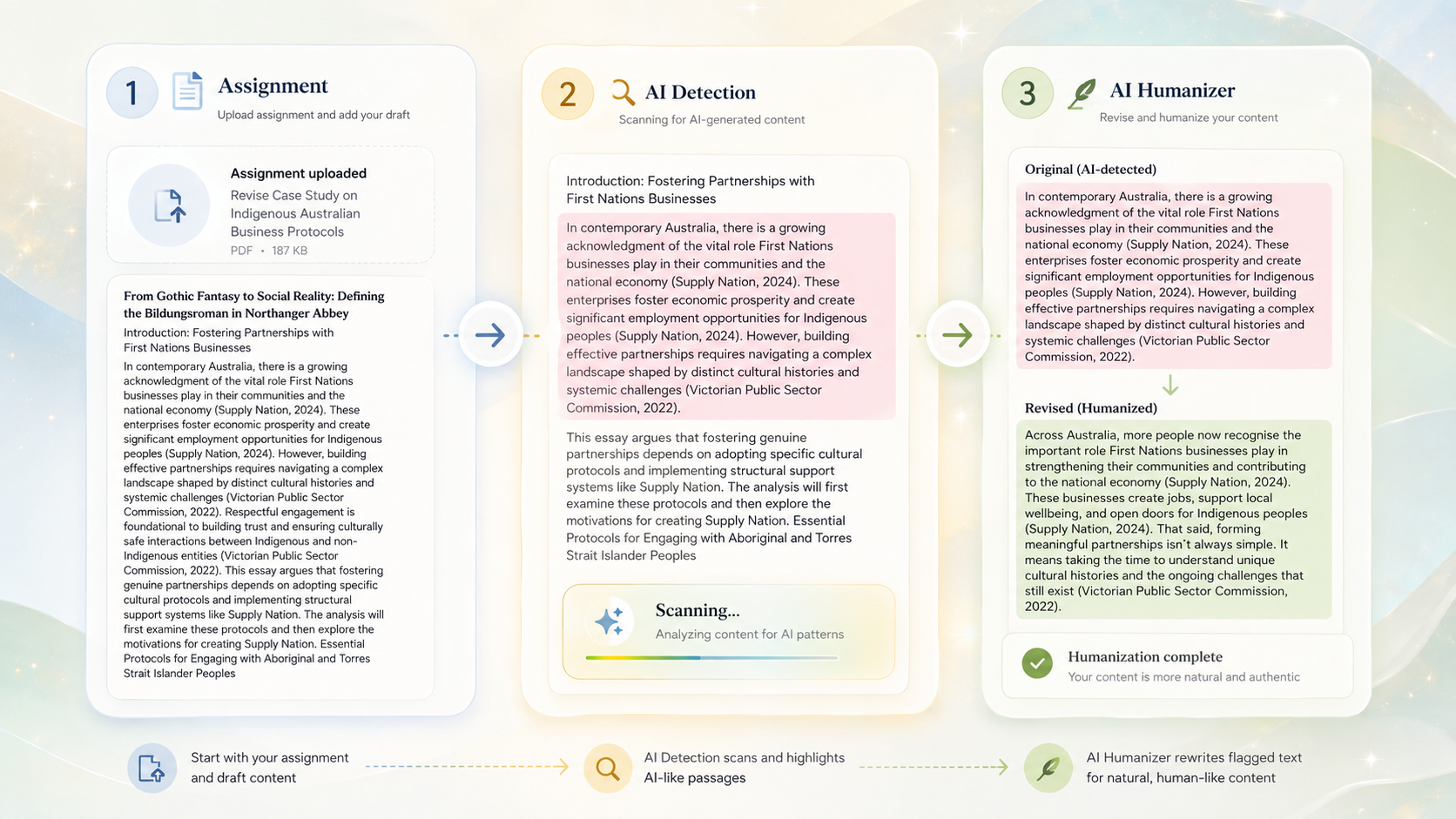
Verla AI Detection makes that first part easier by reviewing the draft paragraph by paragraph. Instead of receiving one alarming number and no direction, you can see where the writing deserves a closer look.
Those passages can then go through Verla AI Humanizer. Compare the rewrite with what you meant, keep the clearer language, and restore any term, qualification, quotation, or citation that should not have moved.
Then step away from the detector. With Verla Assignment, you can add the prompt, rubric, course materials, and sources and check whether the paper still answers the actual task. That final check catches the problem my first ChatGPT draft had all along: it looked like an essay, but it was not really my essay or this assignment.
At the time of writing, Verla Basic costs $7.99 per month when billed annually, including 10,000 detection words, 5,000 humanizer words, three Assignment uses, and five file uploads per assignment. The smaller humanizer allowance is the practical limit; rewriting every draft end to end will use it quickly.
No tool can promise a particular detector score or grade. The value is more ordinary and more useful: less time guessing which paragraph feels wrong, and more time fixing the one that does.