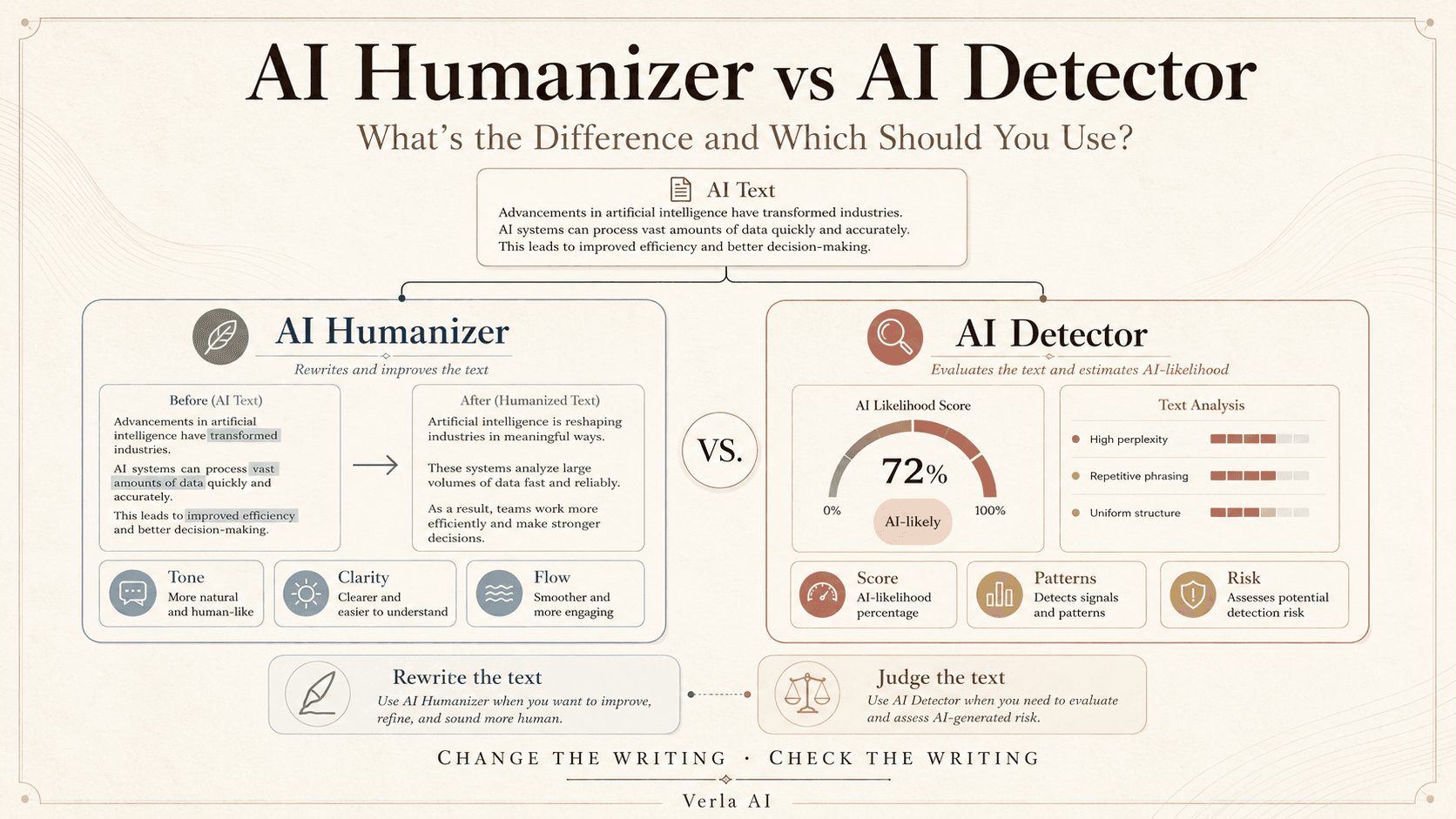
An AI Humanizer and an AI Detector sit on opposite sides of the same writing problem. One rewrites text to sound more natural; the other checks for patterns associated with AI-generated writing. The useful question is not which tool wins, but what each result can—and cannot—tell you.
You finish a draft, paste it into a detector, and several paragraphs light up. Should you humanize the entire document or keep rewriting until the score falls? Usually, neither is the best first move.
A detector is a diagnostic signal, not proof of authorship. A humanizer is an editing tool, not a guaranteed route to a particular score. The practical order is simple: detect, inspect the flagged passages, humanize selectively, and review the finished draft against its real purpose.
AI Humanizer vs AI Detector: The Quick Difference
An AI Detector analyzes text. An AI Humanizer changes it.
That distinction sounds obvious, but it resolves most of the confusion around these tools. A detector is closer to a warning light: it points to language that resembles patterns in AI-generated text. A humanizer is closer to an editor: it rewrites the passage so that its wording, rhythm, and tone feel less mechanical.
AI Detector | AI Humanizer | |
Main job | Analyze writing patterns | Revise wording and structure |
Typical output | A score, label, or highlighted passages | A rewritten version of the text |
Changes your draft | No | Yes |
Best used for | Finding passages that need review | Improving selected passages |
Main limitation | A score is not proof of authorship | A rewrite can change meaning or introduce errors |
Neither tool replaces the other. If your only problem is an awkward paragraph, running a detector will not improve it. If your concern is how a draft might be classified, a humanizer alone gives you no independent signal about the result.
There is no universal price comparison between the categories because products use different subscriptions and word quotas. Ask whether you need occasional analysis, frequent rewriting, or both. A cheap tool is poor value if its result is too vague—or too damaged—to use.
What Does an AI Detector Actually Tell You?
An AI Detector estimates whether a passage resembles text produced by a language model. It may return a percentage, label, sentence-level highlights, or all three. Behind that result is a classifier looking for learned statistical and stylistic signals—such as predictable wording, repetitive construction, and unusually consistent pacing—not an authorship record.
A high score can justify reviewing a passage. It cannot establish who wrote it, which model was used, how much editing took place, or whether the work violates a policy.
The limits are visible in benchmark results. The 2024 RAID benchmark evaluated 12 detectors across more than six million generations and found that performance could drop when the model, domain, or generation method changed. A 2025 shared task found that newer systems could exceed 99% accuracy at a 5% false-positive rate on a large but fixed benchmark whose domains and generators appeared in training. Detection can therefore be strong in defined conditions without becoming universal proof.
False positives matter especially for students. A Stanford-led study reported that seven detectors classified 61.22% of a set of TOEFL essays by non-native English writers as AI-generated; at least one detector flagged 89 of 91 essays. Stanford HAI’s summary shows how a confident-looking percentage can reflect bias in the model or test data.
Even Turnitin says its model may misidentify human, AI-generated, and AI-paraphrased text, so the score should not be the sole basis for action against a student.
Look at the highlighted language before the percentage. Does the passage repeat the same sentence shape? Does it rely on generic transitions such as “furthermore” and “in conclusion” without moving the argument forward? Does it sound unlike the rest of the draft? Those are revision questions you can act on.
Do not average results from several detectors. Different training data, thresholds, and definitions make disagreement normal; several probabilities still do not become proof.
The clearest conclusion is this: an AI Detector can identify review risk and locate suspiciously uniform writing. It cannot verify authorship, check facts, confirm citations, or decide whether your work follows the assignment rules.
What Does an AI Humanizer Actually Change?
An AI Humanizer rewrites text to make it read less like a generic model response and more like deliberate human prose. A good one does more than swap words for synonyms. It varies sentence structure, removes empty transitions, improves pacing, clarifies relationships between ideas, and adjusts tone while trying to preserve the original point.
Consider this sentence:
Furthermore, it is important to note that social media has a significant impact on modern communication.
A more natural revision might be:
Social media has changed how people communicate, but its influence depends on how each platform is used.
The second version is better because it removes a padded opening, makes the claim more specific, and gives the next sentence somewhere to go. That—not a lower detector score—is the standard a useful humanizer should meet.
Adding errors or obscure synonyms may disturb a detector’s signals, but it also damages the writing. “Human” prose is not messy prose; it contains emphasis, evidence, qualification, and a voice suited to the audience.
Precision is the main limitation. A rewrite can weaken a causal claim, replace a technical term, detach a citation from its evidence, or alter a quotation. It also cannot judge a prompt or rubric unless that context is available. Treat “humanized” as a draft, compare it with the original, and recheck every statistic, quotation, term, and citation.
Can an AI Humanizer Bypass an AI Detector?
Sometimes. Not consistently, and not across every detector.
An AI Humanizer changes features a detector may evaluate: predictability, sentence rhythm, repeated phrasing, and structural uniformity. A rewrite may produce a lower score, but the result depends on the text, subject, length, and models behind both tools.
The target also moves. Detectors learn to recognize paraphrased text, while rewriting systems change their output. A screenshot claiming “0% AI” only records one text checked by one version of one detector; it does not establish a repeatable result.
More importantly, three outcomes are often collapsed into one:
A lower AI detection score
More natural, readable prose
A stronger piece of work that meets its requirements
These outcomes can move in different directions. A rewrite may lower a score but distort the argument, or improve clarity while leaving the score unchanged. An AI Humanizer may change an AI Detector result, but no credible tool can guarantee universal bypass.
The Best Way to Use an AI Humanizer and AI Detector Together
The most useful workflow is not an endless contest between two scores. It is a focused revision loop.
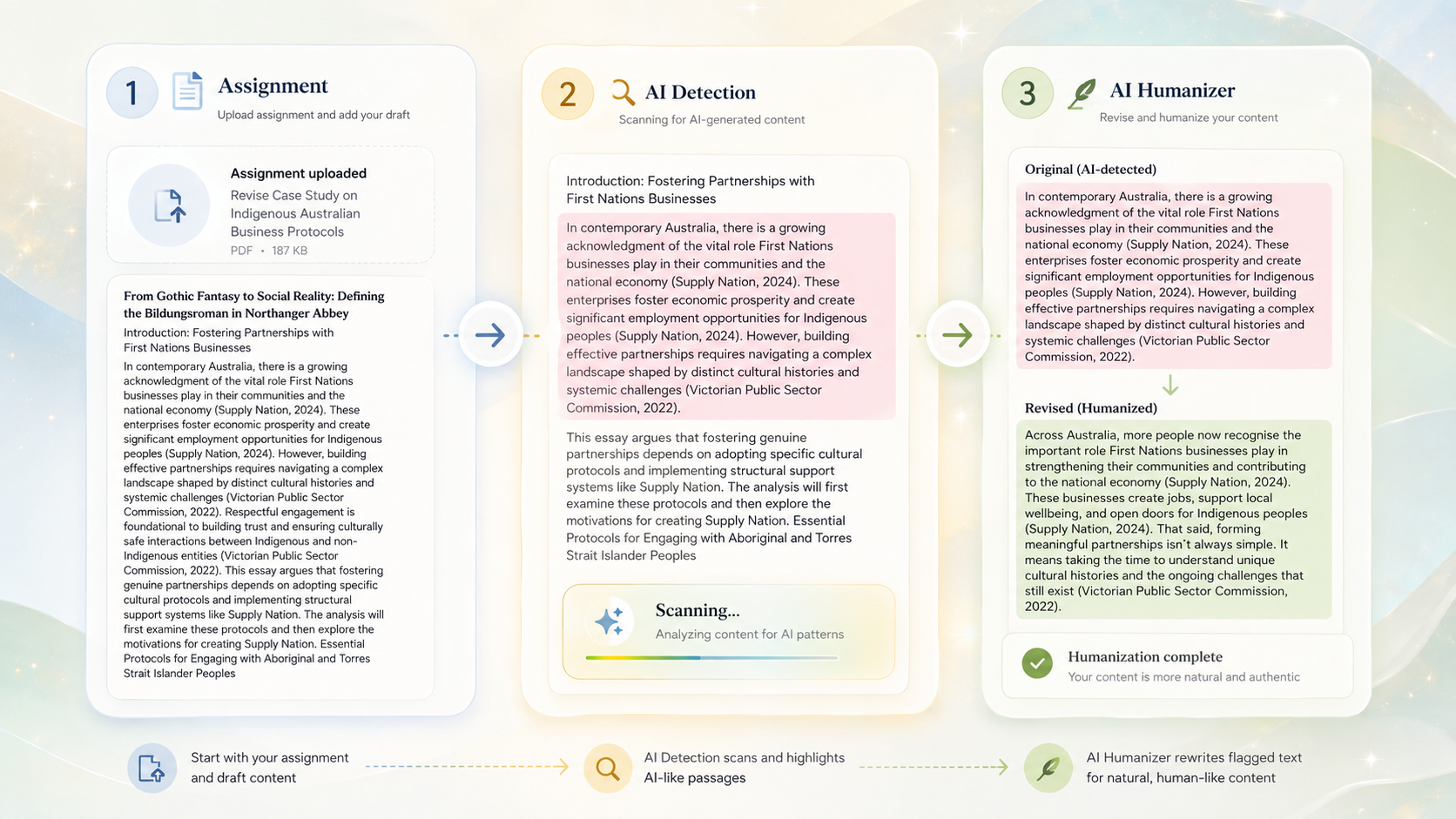
Start with the complete draft. Run it through Verla AI Detection, which reviews the text paragraph by paragraph instead of leaving you with only a document-wide number. Read the highlighted sections and ask why each one stands out. A paragraph may be generic, repetitive, over-polished, or simply different in tone from the surrounding work.
Then revise only what needs revision. Verla AI Humanizer lets you work on those passages and compare the rewritten version with the original. The goal is to improve clarity, flow, and tone while retaining the idea—not to replace the entire draft with a second layer of automated writing.
Run one final check for remaining inconsistencies. Stop when the writing is clear, specific, and recognizably yours; chasing a perfect percentage can move it farther from its meaning.
For academic work, there is one more check that neither category can perform alone: does the draft answer the actual assignment? With Verla Assignment, you can add the prompt, rubric, course materials, and sources so the final review includes structure, evidence, formatting, and citation context. That matters more than polishing an irrelevant answer until it receives a favorable detector score.
Separate tools often mean separate subscriptions and unrelated quotas. At the time of writing, Verla Basic is $7.99 per month when billed annually, including 10,000 detection words, 5,000 humanizer words, three Assignment uses, and up to five file uploads per assignment. Users who rewrite most of every draft may reach the smaller humanizer quota first.
That integrated setup is most useful for students who want one route from diagnosis to revision to assignment review. If you only scan a short passage occasionally, a standalone free detector may be enough. If you already know exactly which paragraph needs editing, you may not need detection at all.
The tool should follow the problem—not the other way around.