You've written a killer introduction. Your body paragraphs are packed with evidence. But now you're staring at a blinking cursor, wondering: how do I actually end this thing?
You're not alone. The conclusion is where most essays fall apart—or come together brilliantly.
This guide breaks down exactly how to write a conclusion that leaves your professor nodding, not yawning. We'll cover the proven frameworks from Harvard and UNC, show you what to avoid, and give you copy-paste templates for every essay type.
What Makes a Good Essay Conclusion?
A conclusion isn't just a summary. It's your last chance to make an impression.
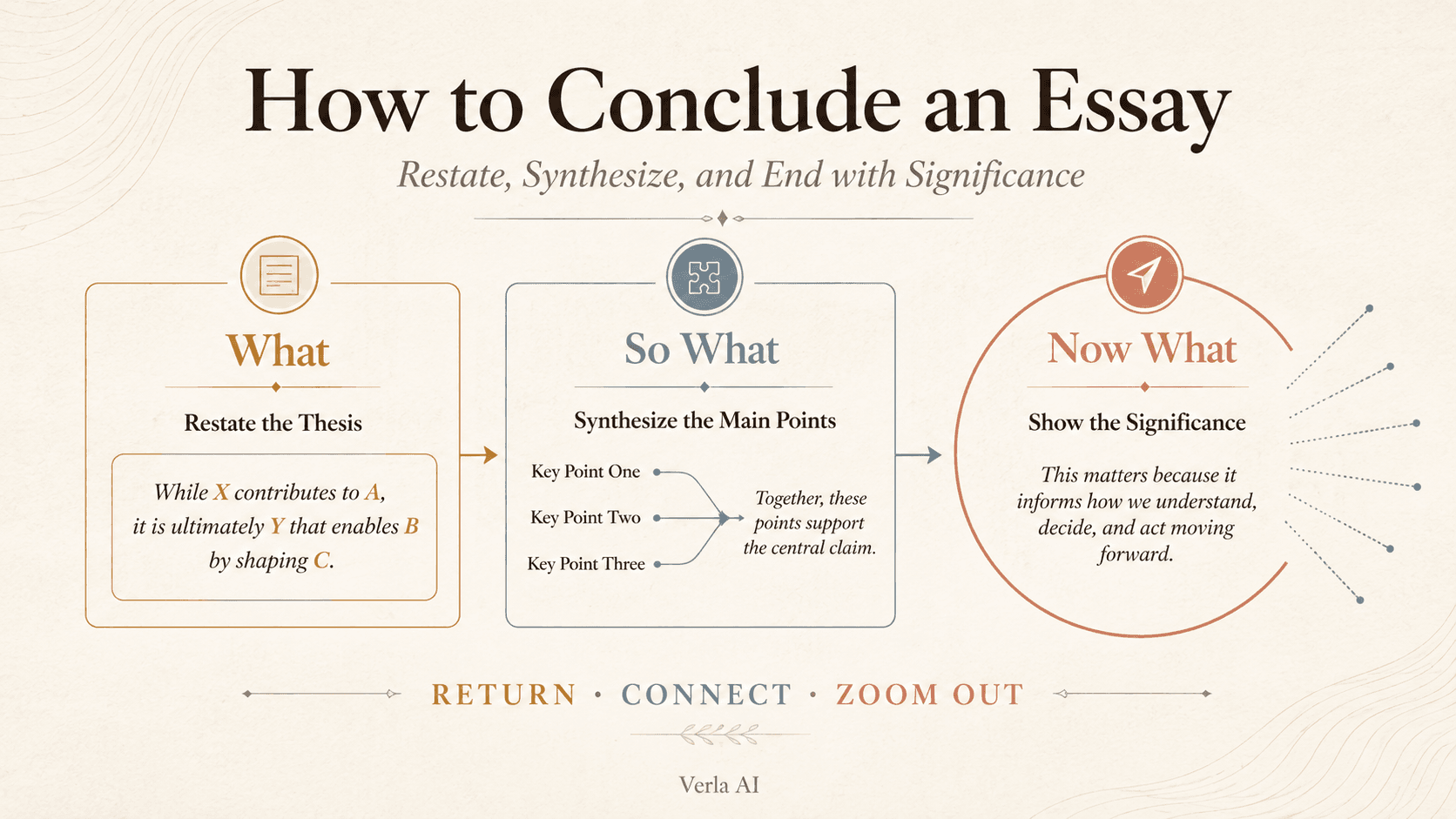
According to the Harvard Writing Center, a strong conclusion does three things:
Restates the "what" — Briefly revisit your main argument
Highlights the "so what" — Show why your argument matters
Leaves readers with the "now what" — Point toward broader implications
Your conclusion should be about 10-15% of your total essay length. For a 1,500-word essay, that's roughly 150-225 words.
The 3-Step Framework for Writing Conclusions
Here's the simplest structure that works for any essay type, from Scribbr's academic writing guide:
Step 1: Return to Your Thesis
Don't just copy-paste your thesis from the introduction. Reframe it to show how your argument has developed.
Step 2: Synthesize Your Main Points
Notice the word: synthesize, not summarize.
Don't just list what you said. Show how your points connect to form a cohesive argument. The UNC Writing Center calls this "playing the 'So What' game"—keep asking yourself why your points matter until you hit something meaningful.
Step 3: End with Significance
Zoom out. What are the broader implications of your argument?
Does this suggest a need for action?
Does it open new questions for research?
Can it apply to other contexts?
6 Strategies for Powerful Conclusions
The University of North Carolina Writing Center outlines these proven strategies:
7 Common Mistakes to Avoid
According to Simon Fraser University's Writing Guide, these are the most common conclusion killers:
Copy-Paste Conclusion Templates
For Argumentative Essays
"The arguments presented in this essay demonstrate the significant importance of [your topic]. While there are strong counterarguments, such as [main opposing view], the evidence overwhelmingly supports [your position]. Moving forward, [action or implication] should be a priority for [relevant stakeholders]."
For Expository Essays
"Overall, this essay has examined the key aspects of [topic]. Through analysis of [main points], it becomes clear that [central insight]. As research in this area continues to develop, [future direction or significance]."
For Compare and Contrast Essays
"While both [subject A] and [subject B] share similarities in [common ground], their differences in [key distinction] reveal [insight]. The choice between them depends on [context or criteria]."
For Persuasive Essays
"On the balance of evidence, there is a compelling case for [your position]. The counterarguments, while worth considering, do not outweigh the benefits of [your solution]. It is therefore essential that [call to action]."
Conclusion Checklist
Before you submit, run through this quick check:
Does it restate your thesis in fresh words?
Does it synthesize (not summarize) your main points?
Does it answer "so what?"
Is it free of new evidence or arguments?
Does it avoid "In conclusion" and similar clichés?
Does it end with a strong, confident sentence?
Is it roughly 10-15% of your total word count?