Question
Identify the products of a reaction under kinetic control.
(a) The most stable product.
(b) The product whose formation requires the smallest free energy of activation.
(c) The product that can be formed in the fewest steps.
(d) The product that is formed at the fastest rate.
(e) None of these.
Answer
Two of the five options describe the products of a kinetically controlled reaction: (b) and (d). They are two ways of stating one criterion.
Why (b) and (d) give the same answer
The product that forms fastest is the one whose pathway crosses the lowest free-energy barrier. “Smallest free energy of activation” and “formed at the fastest rate” therefore pick out the same species; they differ only in whether the criterion is read off an energy diagram or off a rate measurement.
Why the other options do not qualify
| Option | Verdict | Reason |
|---|---|---|
| (a) The most stable product | thermodynamic criterion | Stability decides the outcome only when the competing pathways can interconvert. |
| (b) Smallest free energy of activation | correct | The lowest barrier gives the highest rate of formation. |
| (c) The product formed in the fewest steps | unrelated | Step count says nothing about the height of any barrier, and a one-step route can still be the slower one. |
| (d) The product formed at the fastest rate | correct | This is the literal definition of kinetic control. |
| (e) None of these | ruled out | Options (b) and (d) both hold. |
What kinetic control looks like in a real reaction
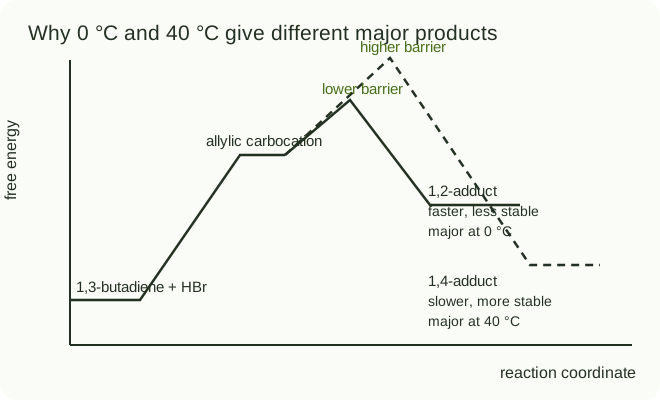
The textbook example is the addition of one equivalent of to 1,3-butadiene:
Protonation at a terminal carbon gives a resonance-stabilised allylic carbocation, and bromide can then bond at either end of the allyl system, so two adducts compete:
| Condition | Which control applies | Major product | 1,2 : 1,4 ratio |
|---|---|---|---|
| 0 °C | kinetic | 3-bromo-1-butene, | 71 : 29 |
| 40 °C | thermodynamic | 1-bromo-2-butene, | 15 : 85 |
At 0 °C the addition is effectively irreversible, so bromide simply attacks the nearer end of the allyl cation and the faster-forming 1,2-adduct accumulates even though it is the less stable of the two. At 40 °C the addition becomes reversible; the mixture equilibrates, and the more stable 1,4-adduct — the one with the more substituted internal double bond — takes over. Heating an isolated 0 °C mixture to 40 °C shifts the ratio towards the 40 °C value, which is the direct evidence that the two adducts interconvert through the shared cation.
The general rule
- Cold and effectively irreversible: the outcome is set by relative rates, so the major products are the kinetic products.
- Hot enough to be reversible: the outcome is set by relative stability, so the major product is the thermodynamic product.
- The two criteria disagree only when the faster-forming product is also the less stable one. When a single product is both the fastest to form and the most stable, changing the conditions changes nothing.
Evidence boundary
The five options are transcribed from the multiple-choice item that the keyword quotes verbatim, as it appears across several independent mirrors; the page establishes that normalised version and does not claim to reproduce an independently verified original examination paper. The located item states the meaning of kinetic control rather than naming a specific reaction, so the reactants, reagent, temperatures, and both products come from the OpenStax treatment of HBr addition to 1,3-butadiene and are presented in the answer, not added to the prompt. The 71:29 and 15:85 ratios are the textbook's reported product distributions, not values measured for this page.
Sources
These references support the concepts and methods used in the explanation above.