When a reaction can give more than one product, the major product depends on which question the conditions let the system answer. Kinetic control asks which product forms fastest. Thermodynamic control asks which product is most stable. The conditions decide which question applies.
Read the energy diagram in four numbers
Picture a profile with reactants on the left, one barrier leading to product B, a second barrier leading to product C, and the two products sitting in separate wells.
| Quantity | What it compares | What it decides |
|---|---|---|
| barrier to B against the reactants | how fast B forms | |
| barrier to C against the reactants | how fast C forms | |
| B against the reactants | how stable B is | |
| C against the reactants | how stable C is |
Suppose, illustratively, that B has the lower barrier but C sits lower in energy. The barrier ordering and the stability ordering disagree, and that disagreement is exactly what makes the choice of conditions matter. Numbers like these are a teaching device, not measured data.
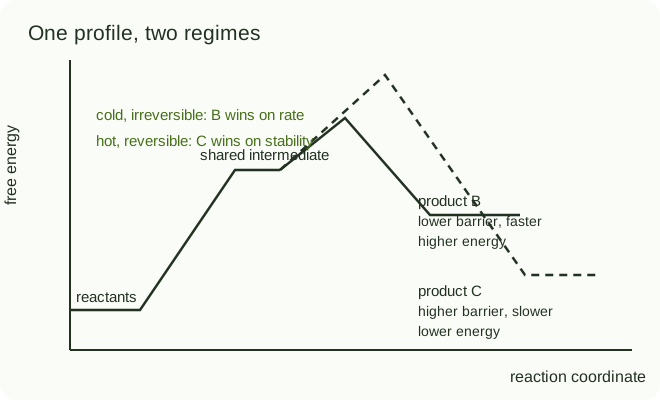
Three regimes, one diagram
- Cold and effectively irreversible. The products do not have enough energy to climb back over their barriers, so whatever forms faster accumulates. The lower-barrier product B dominates even though it is less stable. This is kinetic control, and the ratio reflects the difference between the two barriers.
- Hot enough to be reversible. Both steps can run backwards, so the two products interconvert through the shared intermediate. The mixture drifts until it reflects stability, and the lower-energy product C dominates. This is thermodynamic control, and the ratio now reflects the difference between the two product energies.
- One product wins both. If the lower barrier also leads to the more stable product, the two orderings agree and changing the temperature changes very little. Many textbook reactions sit in this regime, which is why kinetic and thermodynamic products are not always distinct species.
What actually makes a step reversible
Reversibility is not a separate switch. It is what happens when the reverse barrier is small enough to be crossed at the working temperature. Raising the temperature raises the fraction of molecules that can clear that barrier, so a step that was effectively one-way at low temperature becomes two-way. The intermediate does not need to be long-lived; it only needs to be reachable again.
When the intermediate interconverts far faster than the products form, the product ratio is set by the difference between the two transition-state energies rather than by the stability of the intermediate itself. That qualification matters in any mechanism with more than two steps, and it is the reason a ratio can favour a product whose intermediate is never the most abundant species.
A procedure for a new reaction
- Draw both product wells and both barriers on one axis.
- Ask whether the conditions allow the reverse reaction to happen at a useful rate.
- If they do not, compare the barriers and report the kinetic products.
- If they do, compare the product energies and report the thermodynamic product.
- Before finishing, check whether the two orderings actually disagree. If they agree, no change of conditions will switch the major product.
- Keep reaction energy and activation energy separate throughout: a strongly downhill reaction can still have a high barrier, and it is the barrier that governs the rate.
Related question
Apply this knowledge
Use the concept guide to understand the reasoning, then return to the complete question and worked answer.
Identify the Products of a Reaction Under Kinetic ControlSources
These references support the core concepts and interpretation boundaries explained above.