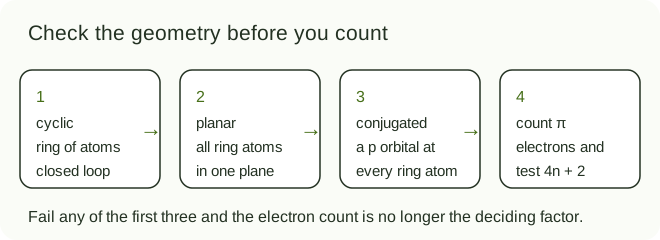
The rule is often quoted as though it were an arithmetic test on the number of electrons. It is not. The rule applies to a cyclic, planar, fully conjugated system, and if the system fails any of those three conditions the electron count is not the deciding factor. A reliable habit is to check the geometry first and count electrons second.
Why planarity is part of the rule
A ring can only delocalise its electrons if every ring atom contributes a p orbital and those p orbitals can overlap continuously around the ring. Overlap requires the p orbitals to be parallel, which in practice means the ring is flat.
Bend or twist the ring far enough and the overlap is lost. The electrons then stay in localised pairs, the molecule behaves like an ordinary open-chain polyene, and no single electron count describes the result. This is why planarity is not a footnote to the rule but part of its statement.
Three rings, three different outcomes
- Benzene, six electrons, is flat and fully conjugated. Six equals with , and the molecule does show the extra stability, equal bond lengths, and ring-current NMR shift associated with aromaticity.
- Cyclobutadiene, four electrons, is the case with . A flat, fully conjugated four-membered ring would place a pair of electrons in a nonbonding level, and the molecule is correspondingly hard to isolate; it distorts away from the flat geometry and reacts readily.
- Cyclopentadienyl anion, six electrons: two double bonds supply four electrons, and the lone pair on the anionic carbon supplies the other two. The ring is flat and the count fits . Notice that the charge is part of the count — the same five-membered ring without that lone pair does not qualify.
Apply the same test to something new
Consider [10]annulene, a ten-membered ring with five double bonds, alongside the cyclooctatetraene dianion, an eight-membered ring with four double bonds and two extra electrons.
| Species | electrons | Fits ? | Planar and conjugated? | Outcome |
|---|---|---|---|---|
| [10]annulene, all-cis | 10 | yes, | the inward-pointing hydrogens force it out of plane | the count alone is not enough |
| Cyclooctatetraene dianion | 10 | yes, | the ring can flatten once the count is favourable | aromatic by the rule |
| Neutral cyclooctatetraene | 8 | no, this is | puckers into a tub to break the p-orbital circuit | non-aromatic |
The dianion and the neutral molecule differ by two electrons and by the geometry those electrons permit. That pair makes the point better than any single example: reaching a favourable count and being able to adopt the geometry it requires are two separate conditions, and both have to hold.
Common misreadings
- Counting electrons before checking planarity, then explaining a non-aromatic molecule by calling it antiaromatic. Non-aromatic and antiaromatic are different diagnoses, and only one of them describes most tub-shaped rings.
- Treating “stable enough to keep in a bottle” as proof of aromaticity. Many non-aromatic compounds are perfectly ordinary bench chemicals.
- Forgetting that lone pairs, charges, and in some cases empty orbitals can all contribute to the count, depending on the ring.
- Assuming that a cyclic molecule drawn with alternating single and double bonds is automatically conjugated around the ring; a saturated or pyramidal ring atom can interrupt the p-orbital circuit entirely.
Related question
Apply this knowledge
Use the concept guide to understand the reasoning, then return to the complete question and worked answer.
Which Statement About Cyclooctatetraene Is Not True? A Tub-Shaped 8π RingSources
These references support the core concepts and interpretation boundaries explained above.