Question
Which of the following statements about cyclooctatetraene is not true?
(a) There are two types of C–C bond in the ring.
(b) The eight-membered ring is nonplanar, and resonance is not observed across the whole ring.
(c) Extensive resonance is found within the molecule, and all of the ring bonds are of the same type.
(d) It is a non-aromatic, tub-shaped molecule.
Answer
Option (c) is the statement that is not true. The other three describe cyclooctatetraene as it actually is.
Check the electron count first
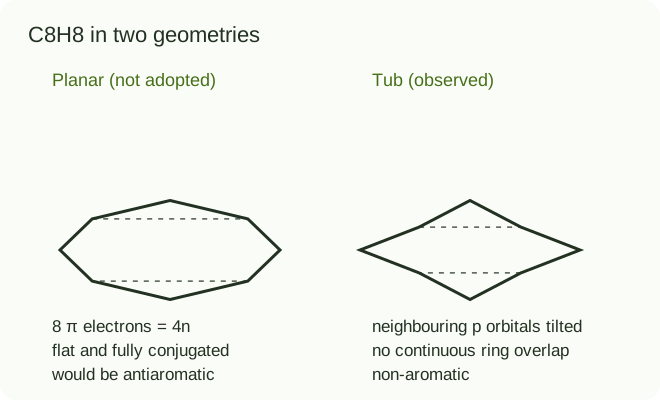
Cyclooctatetraene, , is an eight-membered ring carrying four double bonds. If those four bonds were delocalised around a flat ring, the count would be electrons. Eight is with , not , so a planar fully conjugated octagon would be an antiaromatic arrangement rather than a closed bonding shell. The molecule avoids that outcome.
(a) Two types of C–C bond — true
Crystallographic structures give two distinct distances around the ring: about 147 pm for the formally single bonds and about 134 pm for the formally double bonds. A delocalised aromatic ring would show a single averaged length instead; benzene, for comparison, has all six C–C bonds at about 139 pm. Two lengths mean the double bonds stay where they are drawn.
(b) Nonplanar ring, no ring-wide resonance — true
The ring puckers into a tub shape. In that geometry neighbouring p orbitals are no longer parallel, so they cannot overlap continuously around the ring and the system breaks into four separate double bonds. The spectral signature matches: a single sharp NMR line at 5.78 , which is an alkene-like shift rather than the downfield ring-current shift an aromatic ring produces.
(c) Extensive resonance with identical ring bonds — not true
This statement contradicts (a) and (b) directly. Extended resonance would delocalise all eight electrons and equalise the ring bond lengths. Neither happens: the lengths differ, the p orbitals do not overlap continuously, and the reactivity is that of an open-chain polyene rather than an aromatic ring.
(d) Non-aromatic and tub-shaped — true
The criteria for aromaticity require a planar, cyclic, fully conjugated system with electrons. The tub geometry fails the planarity requirement, so the molecule is classified as non-aromatic.
Two endings to avoid
“Non-aromatic” is not the same as “planar and antiaromatic.” The flat octagon is the arrangement the molecule actively avoids; the tub is what it adopts instead. And “non-aromatic” is not “unreactive” either — the tub keeps four ordinary double bonds, so the molecule still behaves as an unsaturated polyene and adds halogens across those bonds.
Evidence boundary
This exercise is the multiple-choice statement item that the keyword quotes, presented in the widely mirrored “not true” form. The four statements are transcribed from that item and are cross-checked against OpenStax Organic Chemistry §15.3 and §15.2 and the LibreTexts aromaticity page; no statement has been added. The page establishes this normalised version of the item, not an independently verified original examination paper. Bond lengths are crystallographic values rounded to the nearest picometre, and the non-aromatic classification is conditional on the tub geometry rather than a claim about a planar form.
Sources
These references support the concepts and methods used in the explanation above.