Question
Classify each of the following reactions as an addition, elimination, substitution, or rearrangement:
(a)
(b)
(c)
Answer
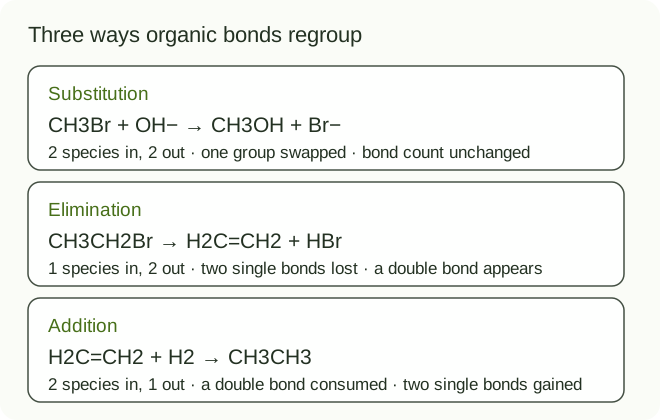
Classify each reaction by counting the species and tracking what happens to the bonds: (a) substitution, (b) elimination, (c) addition.
(a) — substitution
Two reactants give two products. The oxygen of hydroxide forms a bond to carbon while bromide leaves, so has been replaced by on the organic skeleton. That carbon still carries four bonds before and after the swap. Two species in, two species out, with one group traded for another, is the substitution signature.
(b) — elimination
One reactant gives two products. A C–Br bond and a C–H bond on the neighbouring carbon are both removed, and the electron pairs left behind become the C=C bond of ethene. Because the departing fragments leave as separate molecules while the skeleton loses two bonds and gains a bond, this is an elimination.
(c) — addition
Two reactants give one product and no atom is left over. The bond of ethene is consumed, and two new C–H bonds take its place. Two species in, one species out is the addition signature.
The decision table
| Reaction | Species in out | Bond change on the organic skeleton | Class |
|---|---|---|---|
| (a) | 2 2 | C–Br replaced by C–OH; count unchanged | substitution |
| (b) | 1 2 | C–H and C–Br removed; a C=C bond appears | elimination |
| (c) | 2 1 | C=C bond removed; two C–H bonds appear | addition |
Why the classification stops there
Those four labels describe structural change only. They say nothing about how the bonds actually break — whether the electron pair departs with bromide or with hydroxide, whether the pathway is polar or radical, or how fast either reaction runs. Those are mechanistic questions, and one structural label can cover several mechanisms.
One common trap: some reactions look like a substitution but are an addition followed by an elimination. When a problem supplies only the starting and final structures, classify by the overall change you were actually given.
Evidence boundary
This page treats OpenStax Organic Chemistry Problem 6-1 as a complete representative exercise for the course shorthand “orgo.” Orgo is an informal name for organic chemistry, and the page does not claim the search phrase corresponds to one specific original exam item. The three equations and their order are taken from that textbook problem without adding or removing any part. Classification here follows structural change only; no mechanism, rate, yield, or stereochemical conclusion is drawn.
Sources
These references support the concepts and methods used in the explanation above.