Question
Draw a line-bond structure for propane, . Predict the value of each bond angle, and indicate the overall shape of the molecule.
Answer
1. The line-bond structure
Propane has the molecular formula . Counting valence electrons, , gives ten bonding pairs — and every one of them is used, so there are no lone pairs anywhere in the molecule. Eight pairs form C–H bonds and two form C–C bonds.
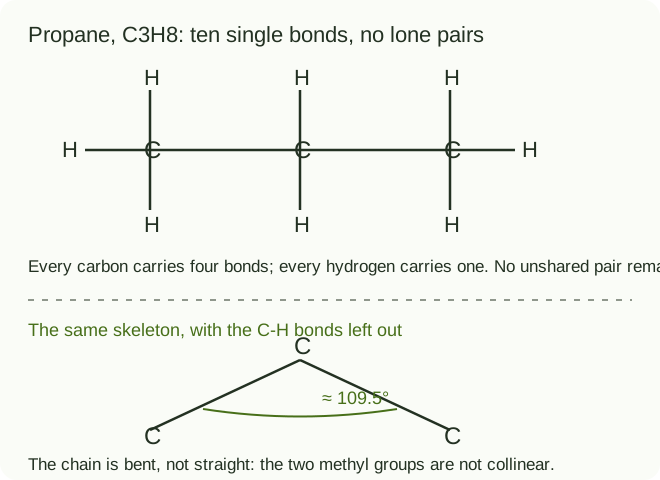
The condensed formula already supplies the connectivity: a central flanked by two groups. Every carbon ends with exactly four bonds, every hydrogen has its single bond, and the formal charge on every atom is zero. Drawn as a line-bond (skeletal) structure, the hydrogens attached to carbon are omitted and each vertex is understood to be a carbon carrying as many hydrogens as its four bonds require.
2. The bond angles
Each carbon uses four hybrid orbitals that point towards the corners of a tetrahedron, so the angles around carbon are all close to the tetrahedral value of 109.5°:
| Angle | Where it sits | Value |
|---|---|---|
| H–C–H | between two hydrogens on the same carbon | about 109.5° |
| H–C–C | between a hydrogen and the chain direction | about 109.5° |
| C–C–C | across the central carbon | about 109.5° |
The C–C–C angle is worth stating explicitly because it is not 180°: the two methyl groups are not collinear. The value 109.5° is the ideal tetrahedral angle, and measured angles in propane depart from it slightly, so an approximate answer is the accurate one.
3. The overall shape
The three carbons do not lie in a straight line. They meet at the central carbon at roughly 109.5°, so the carbon skeleton is a bent, zigzag chain. A flat two-dimensional drawing shows which atoms are bonded to which but hides this geometry, which is why organic structures are frequently drawn with wedged and dashed bonds, or as a zigzag whose vertices represent the carbons.
Rotation about a C–C single bond is also essentially free at room temperature, so propane is not locked into one rigid three-dimensional arrangement. “Overall shape” therefore describes the local geometry at each carbon — four bonds arranged tetrahedrally — rather than one fixed picture of the whole molecule.
What the structure already tells you
- With only single bonds, propane is a saturated hydrocarbon: no bonds and no resonance forms.
- Every carbon is , so there is no flat trigonal or linear carbon to compare with an alkene or an alkyne.
- With no lone pairs, the carbon skeleton offers no basic or hydrogen-bond-accepting site of its own.
Evidence boundary
The three parts, their order, and the wording of the drawing request follow OpenStax Organic Chemistry Problem 1-8, which asks for a line-bond structure for propane, a prediction of each bond angle, and the overall shape. This page keeps the Lewis-structure framing used by the search keyword while drawing the same condensed formula, so the exercise asked does not change. Bond angles are quoted as approximate tetrahedral values rather than measured numbers, and the shape answer is limited to the local geometry at each carbon rather than a claim about one fixed conformation.
Sources
These references support the concepts and methods used in the explanation above.