Question
Consider the chloride-capture step of electrophilic HCl addition to an alkene: a chloride ion combines with the carbocation intermediate.
- Classify this step as exergonic or endergonic.
- Decide whether its transition state is more like the carbocation reactant or the alkyl chloride product.
- Sketch an approximate structure for this transition state.
Answer
Chloride capture is exergonic, and its transition state is early and carbocation-like. The Hammond postulate relates structural resemblance to closeness in energy along an elementary step.
1. Energy change
The chloride ion supplies an electron pair to the electron-deficient carbon, forming the C–Cl bond of the alkyl chloride. In the textbook mechanism, this capture step goes downhill in free energy: .
2. Which structure does the transition state resemble?
The transition state lies closer in energy to the carbocation plus chloride reactants than to the lower-energy product. Hammond reasoning therefore predicts a reactant-like structure. The carbon retains substantial positive charge, and chloride retains substantial negative charge. This is the second step only; do not substitute the product-like transition state of the preceding alkene-protonation step.
3. Approximate transition-state sketch
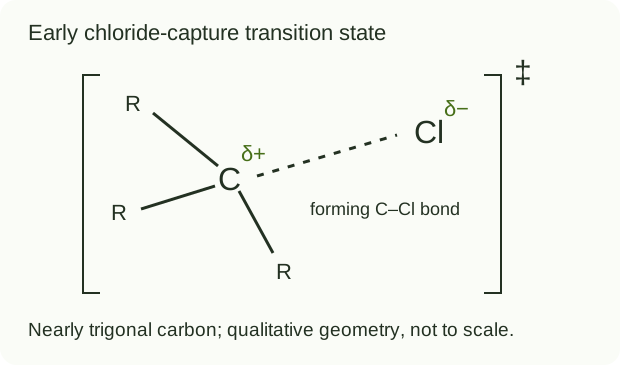
The sketch represents . Each R denotes an existing carbon substituent or hydrogen; no particular alkene was specified. The long dashed contact is a partly formed C–Cl bond, not a completed single bond. Carbon is still closer to the trigonal carbocation geometry than to the tetrahedral product, and chloride approaches an available face. This is a qualitative drawing, not a calculated geometry or a numerical activation barrier.
Evidence boundary
This is a normalized presentation of OpenStax Organic Chemistry Problem 7-20, selected as a complete representative exercise for the truncated Hammond keyword. It is not a reconstruction of the truncated search post. The conclusion concerns chloride capture in the textbook mechanism; the sketch is qualitative and does not specify bond lengths, a barrier height, or an experimental transition-state structure.
Sources
These references support the concepts and methods used in the explanation above.