Question
Assess whether the cycloheptatrienyl anion is aromatic from the occupancy of its molecular orbitals. Draw the anion's structure, then justify your assessment with both a polygon-in-circle diagram and a written explanation.
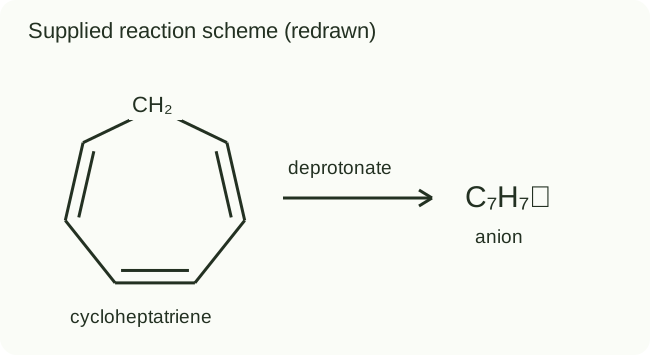
The supplied reaction scheme is deprotonation of cycloheptatriene to . Cycloheptatriene is a seven-carbon ring with three alternating double bonds and one carbon; that carbon loses a proton.
Answer
The ordinary Hückel model of the cycloheptatrienyl anion is not aromatic; eight electrons do not by themselves make it Möbius aromatic. The exam asks for a structure and a polygon/circle explanation, which are given below. The Möbius distinction addresses the search question separately.
1. Draw the anion and count its electrons
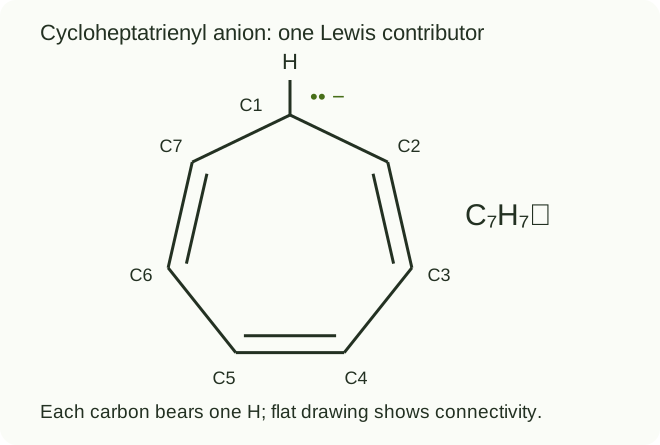
One Lewis contributor has ring connectivity C1–C2=C3–C4=C5–C6=C7–C1. Every carbon bears one H. The proton is removed from the original carbon, leaving its C–H bonding pair on C1 as a lone pair. This gives , not the positively charged tropylium ion.
If that lone pair participates in a continuous ring of p orbitals, the count is π electrons.
2. Polygon/circle diagram and occupancy
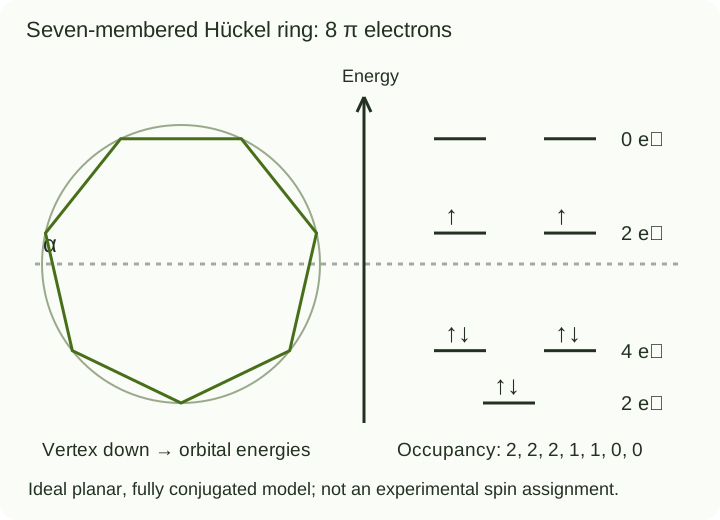
For the ideal regular planar ring, one orbital is lowest, followed by three degenerate pairs. The horizontal circle diameter marks the nonbonding reference . The lowest orbital and the next pair lie below it; the other four orbitals lie above it.
The first six electrons fill the three bonding orbitals. The remaining two occupy the lower antibonding pair, one per orbital in this elementary filling picture. There is no closed shell containing only the three bonding orbitals. The planar, fully conjugated Hückel model has with , so it is antiaromatic, rather than Hückel aromatic.
The drawing is an orbital model, not a measurement of the free ion's equilibrium geometry or spin state. Distortion, bond-length alternation or reduced cyclic overlap can relieve the idealized destabilization. If cyclic conjugation is broken, the Hückel antiaromatic classification no longer applies; it is then nonaromatic in that model. A flat structural drawing alone cannot establish which geometry a real sample adopts.
3. Why this is not automatically Möbius aromatic
Möbius aromaticity requires a different cyclic orbital topology: an odd number of phase inversions around the overlap circuit. In the ground-state Möbius model, a electron count can be aromatic, but the topology must first be established. Merely bending a ring or counting eight electrons does not establish it.
The 2024 Organic Letters study concerns cycloheptatrienide-containing zwitterions and a cycloheptatetraene intermediate. Its Möbius assignment belongs to that intermediate; it is not a blanket assignment to . The cycloheptatrienyl cation, by contrast, has six π electrons and is Hückel aromatic. These are distinct species.
Evidence boundary
The representative exercise is Question 1 on page 2 of the University of San Diego CHEM 302 exam dated 20 February 2009. Its structure, drawing request and polygon/circle argument are retained. The Frost diagram assumes a regular planar, fully conjugated Hückel ring; it does not establish the isolated anion’s actual geometry or spin state. Möbius aromaticity is an additional clarification, and the cited research intermediate is not identified as the parent anion.
Sources
These references support the concepts and methods used in the explanation above.