Writing an informative essay sounds simple: choose a topic, explain it clearly, and support your points with facts. But many students get stuck before they even write the first sentence. Others know what they want to say but end up with a draft that feels overloaded, too formal, or strangely similar to a Wikipedia page.
If you are trying to figure out how to write an informative essay, this guide breaks the process into a few practical steps. You will learn how to choose a topic, organize your ideas, write each section, and keep the final essay clear and natural.
What Is an Informative Essay?
An informative essay explains a topic using facts, examples, evidence, and clear reasoning. Its main goal is to help the reader understand something, not convince them to agree with a particular opinion.
For example, an argumentative essay might try to prove that social media harms students. An informative essay would instead explain how social media affects student learning, attention, communication, or study habits from an objective point of view.
If you want to understand that difference in more detail, see our guide on how to write an argumentative essay.
A good informative essay should usually be:
Focused on one clear topic
Based on reliable information
Easy to follow
Objective rather than opinion-heavy
Detailed enough to explain the subject without overwhelming the reader
Informative Essay Structure and Format
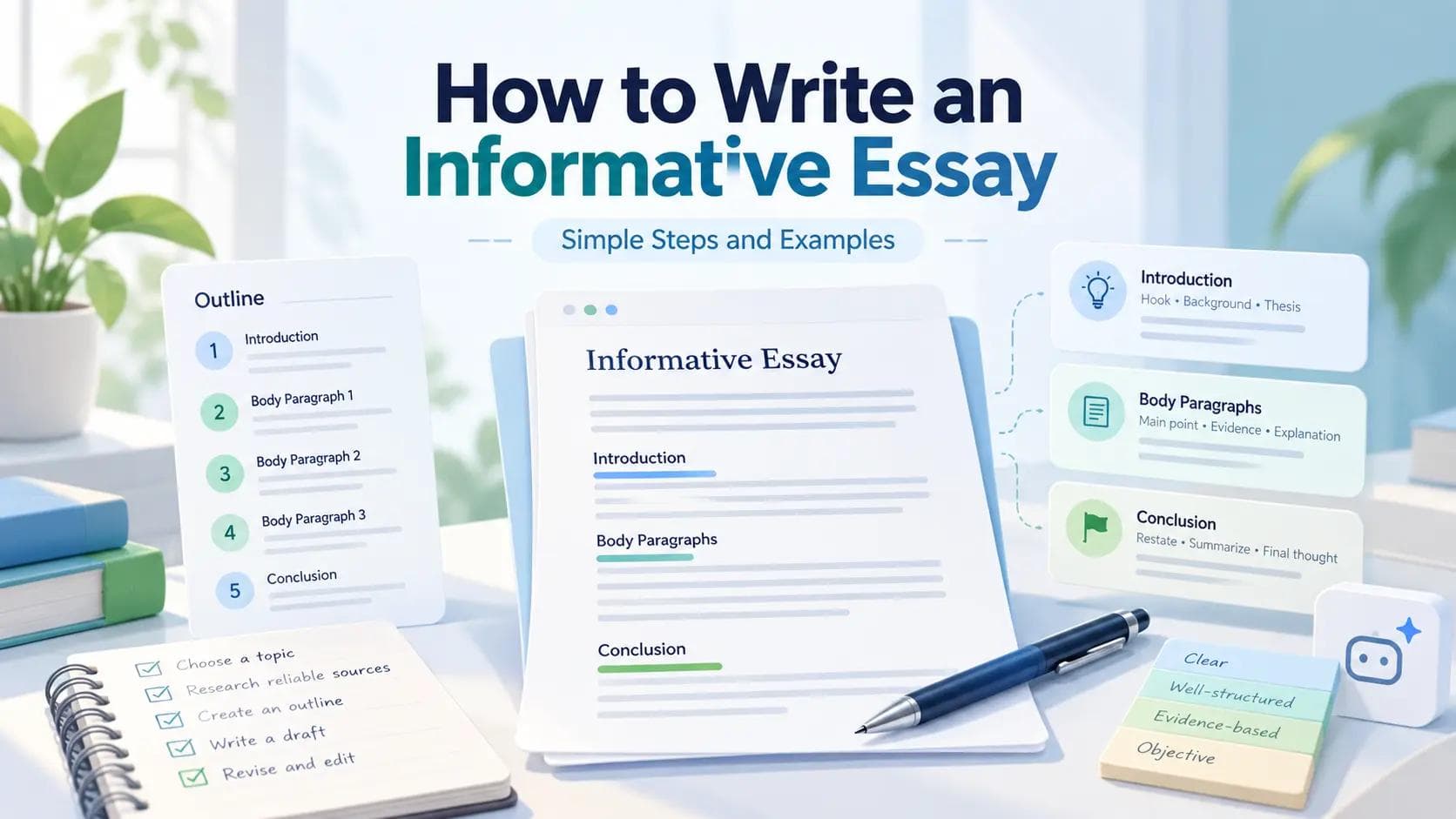
A basic informative essay structure usually includes an introduction, body paragraphs, and a conclusion.
Section | What to Include |
Introduction | Hook, brief background information, and thesis statement |
Body | Main points, supporting facts, examples, and explanations |
Conclusion | Summary of the key ideas and a final takeaway |
The exact informative essay format depends on the assignment. A short school essay may use three body paragraphs, while a longer college paper may need several sections.
When thinking about how to start an informative essay, focus on giving the reader a reason to continue. A surprising fact, short question, contrast, or real-world example can work well as a hook.
After the hook, give just enough context for the reader to understand the topic. When learning how to write background information in an essay, the key is not to explain everything at once. Save the details for the body.
Your introduction should end with a clear thesis. When learning how to write a thesis statement for an informative essay, remember that the thesis should explain what the essay will cover rather than argue for one side.
For the body, each paragraph should focus on one main point. A simple approach to how to write a body paragraph for an informative essay is:
Start with a topic sentence
Add a relevant fact, example, or statistic
Explain what that information means
Connect the paragraph to the next idea
If you need to present several points or examples clearly, how to enumerate in essay can help you organize them without turning the paragraph into a messy list.
Finally, when learning how to write a conclusion for an informative essay, avoid simply repeating the introduction word for word. Restate the main idea in fresh language, connect the key points, and finish with a broader takeaway.
How to Write an Informative Essay Step by Step
Step 1: Choose a Topic and Research Reliable Information
Good informative essay topics should be specific enough to explain clearly but broad enough to support with reliable information.
Instead of choosing a huge topic such as:
Artificial intelligence
Narrow it to something more manageable:
How AI tools are changing the way college students research assignments
Choose a topic you are genuinely interested in when possible. A boring or overly broad topic often makes the whole essay harder to write.
Once you have a topic, gather information from reliable sources such as:
Academic journals
Books
Government or university websites
Reputable reports
Trusted news organizations
Avoid collecting facts randomly. Group your research by subtopic so you already know which information belongs together.
If research is slowing you down, our guide to the best AI for research covers tools that can help students find and organize useful information more efficiently.
Step 2: Create an Informative Essay Outline
A simple informative essay outline can prevent two common problems: writing without direction and stuffing too much information into one paragraph.
You do not need to write a detailed script. A basic informative essay template can be as simple as:
Introduction
Hook
Background
Thesis
Body Paragraph 1
Main idea
Evidence
Explanation
Body Paragraph 2
Main idea
Evidence
Explanation
Body Paragraph 3
Main idea
Evidence
Explanation
Conclusion
Restated thesis
Main takeaway
The outline should make the essay easier to write, not make you feel like you have already written it once.
Step 3: Write the First Draft
Now turn each outline point into complete paragraphs.
Start with the introduction, then move through the body one idea at a time. Do not try to make every sentence perfect while drafting. The first goal is to get your information into a clear order.
This process also applies if your assignment uses the term informational essay. Students searching how to write an informational essay are usually trying to solve the same core problems: choosing a topic, researching facts, organizing ideas, and explaining them clearly.
When writing the body, avoid stacking fact after fact without explanation. Readers need to understand why each example matters.
Instead of writing:
Social media distracts students. Students use phones during class. Many students also use study apps.
Try connecting the information:
Social media can distract students when notifications interrupt focused study. At the same time, many students use the same devices to access study groups, flashcards, and educational videos.
The second version explains the relationship between the facts rather than simply listing them.
Step 4: Revise for Clarity and Natural Flow
Revision is where an informative essay often improves the most.
Check whether:
Each paragraph has one clear purpose
Your facts directly support the main idea
You explain information instead of dumping it
Paragraphs are not unnecessarily long
Transitions connect ideas smoothly
The tone sounds clear rather than overly formal
Your facts and citations are accurate
One of the biggest problems students report is writing something that feels technically correct but sounds like a textbook or Wikipedia entry.
You do not need complicated vocabulary to sound academic. Clear writing is usually stronger than writing that tries too hard to sound impressive.
Reading your draft aloud can also help. If a sentence feels awkward to say, it may be awkward to read too.
Informative Essay Outline and Example
Here is a simple informative essay outline example using the topic:
How Social Media Changes the Way College Students Study
Introduction
Hook: Students can switch from lecture notes to TikTok in seconds.
Background: Social media is now part of everyday student life.
Thesis: Social media affects studying through distraction, access to learning communities, and changing study habits.
Body 1
Distraction and attention
Body 2
Online learning communities and resources
Body 3
Study trends and digital productivity habits
Conclusion
Summarize how social media can both help and interrupt studying depending on how it is used.
A short informative essay example based on that outline might begin like this:
Social media is often treated as the enemy of productive studying, but its role in student life is more complicated. Platforms designed for entertainment can interrupt concentration, yet those same platforms also provide tutorials, study communities, and educational content. Looking at both sides helps explain why social media can either support or weaken study habits depending on how students use it.
The paragraph stays informative without sounding like a list of definitions.
Write an Informative Essay Faster with Verla
If you already know the assignment but are stuck on the blank page, Verla’s AI Essay Writer can help turn a topic or prompt into a structured informative essay draft. It is especially useful when you need help organizing ideas, building a clear structure, or getting a workable first version quickly.
Verla also combines several parts of the writing process in one place:
AI Essay Writer: Helps generate and structure an informative essay draft.
AI Detection: Lets you review whether parts of the draft may appear heavily AI-generated.
AI Humanizer: Helps improve stiff or robotic wording and make the text read more naturally.
If you want to compare more tools for assignments, see best AI for writing essays and best AI for school work.
Conclusion
Learning how to write an informative essay becomes much easier when you break the task into a few clear steps: choose a focused topic, research reliable information, build a simple outline, write the draft, and revise for clarity.
The goal is not to sound like an encyclopedia. It is to explain something clearly enough that the reader understands it.
If starting from scratch is still the hardest part, Verla can help you move from assignment to first draft with AI Essay Writer, then review and polish the result with AI Detection and AI Humanizer.