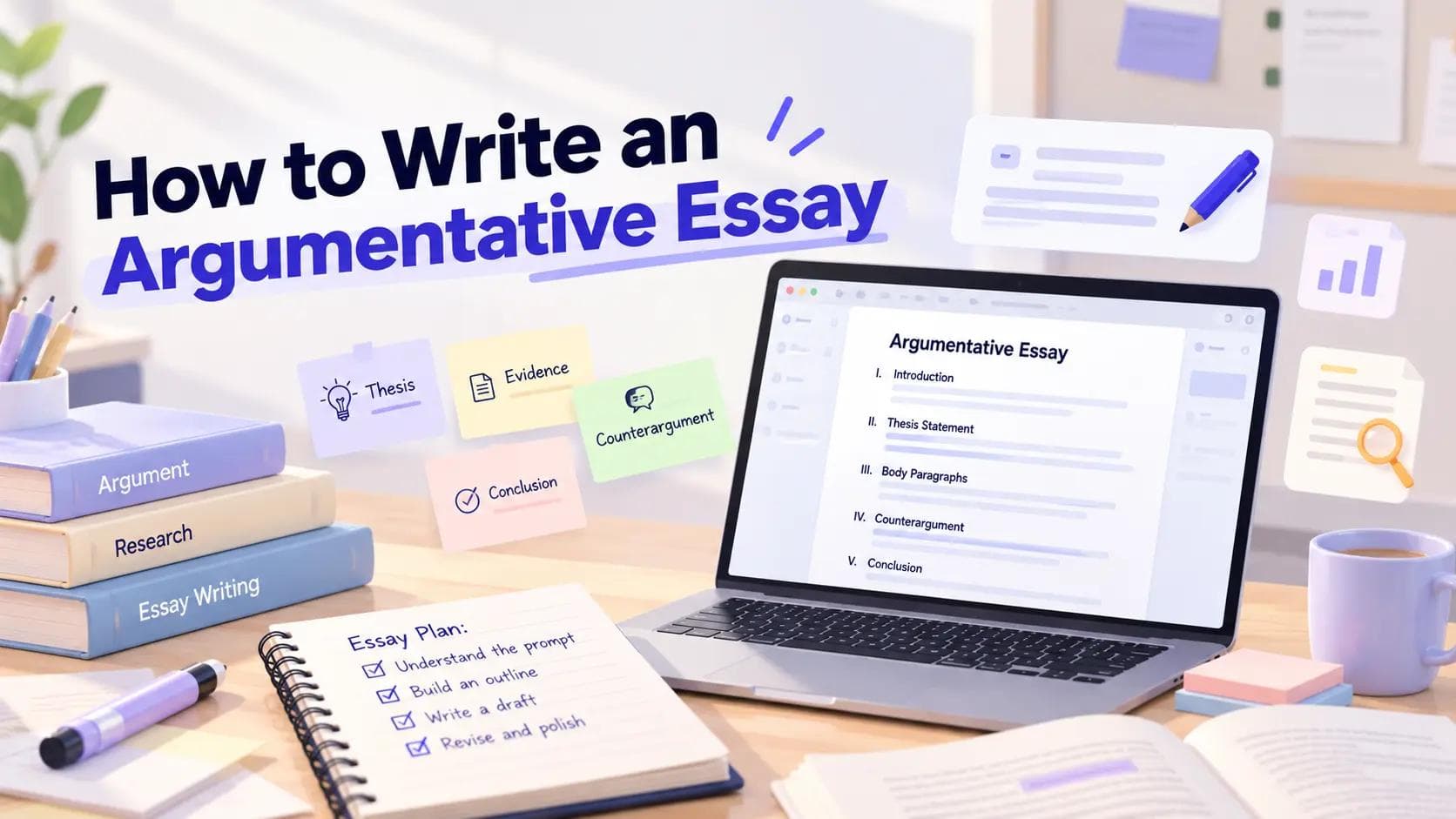
You have an essay prompt, a deadline, and maybe a few opinions in your head, but turning all of that into a clear argument can be surprisingly difficult. Many students get stuck on the same questions: What should come before the thesis? How much evidence is enough? Where does the counterargument go?
If you are wondering how to write an argumentative essay, this guide walks you through the process from understanding the prompt to writing the conclusion. You will also see a simple outline, thesis formula, paragraph structure, and example you can follow.
What Is an Argumentative Essay?
An argumentative essay takes a clear position on a debatable question and supports that position with evidence and reasoning.
The goal is not simply to show how much you know about a topic. You need to use what you know to build an argument, support individual claims, and explain why your evidence matters.
A strong argumentative essay normally includes:
A clear thesis
Supporting claims
Relevant evidence
Analysis of that evidence
A counterargument and rebuttal
A conclusion that brings the argument together
So, how do you write an argumentative essay without losing track of all those pieces? Start with the structure.
Argumentative Essay Structure and Format: What Parts Should You Include?
A basic argumentative essay structure is easier to understand when you see the whole thing at once.
Part | What It Does |
Introduction | Introduces the issue and states your position |
Thesis | Clearly states the main argument |
Body Paragraphs | Develop individual claims with evidence and analysis |
Counterargument | Addresses a strong opposing view |
Rebuttal | Explains why your position still holds |
Conclusion | Restates the argument and brings the main points together |
Argumentative Essay Outline at a Glance
A simple argumentative essay outline can look like this:
Introduction: hook → background → thesis
Body 1: claim → evidence → analysis
Body 2: claim → evidence → analysis
Counterargument → rebuttal
Conclusion: restated thesis → key points → final thought
This argumentative essay format is flexible. A longer university paper may need several body paragraphs, while a short classroom essay may only need two or three. What matters is that every paragraph contributes to the same central argument.
How to Write an Argumentative Essay in 5 Steps
Step 1: Understand the Prompt, Choose a Position, and Research Evidence
Before writing, slow down long enough to understand what the prompt is actually asking.
Underline important terms and ask:
What issue am I being asked to debate?
Is the question asking me to agree, disagree, evaluate, or compare?
What assumptions are built into the prompt?
What position can I realistically support with evidence?
Then gather reliable sources. Statistics, studies, expert opinions, primary sources, and relevant examples are usually more useful than collecting random quotations.
If research is the part slowing you down, our guide to the best AI for research can help you compare tools for finding and organizing useful sources.
Do not choose your position only because it sounds interesting. Choose one you can actually defend.
Step 2: How to Write an Argumentative Thesis
Your argumentative essay thesis is the sentence that gives the rest of the paper direction.
A weak thesis only announces the topic:
“Social media has advantages and disadvantages.”
A stronger thesis makes a specific, debatable claim:
“Universities should teach social media literacy because students need practical skills to evaluate misinformation, protect their privacy, and communicate responsibly online.”
If you are learning how to write an argumentative thesis, this simple formula can help:
Although [opposing position], [your position] because [reason 1] and [reason 2].
For example:
“Although online classes give students greater flexibility, colleges should continue offering in-person classes because face-to-face learning encourages participation and provides stronger academic support.”
Your thesis does not need to sound dramatic. It needs to be specific enough that a reader understands what you are arguing.
Step 3: How to Write a Good Introduction to an Argumentative Essay
Students often know the thesis belongs near the end of the introduction but get stuck on everything before it.
A useful argumentative essay introduction has three parts:
1. Hook
Start with a relevant question, surprising fact, brief scenario, or strong observation.
2. Background
Give the reader just enough context to understand the debate. Avoid turning the introduction into a history lesson.
3. Thesis
Narrow the introduction toward your position and finish with the main claim.
That gives you a simple answer to how to start an argumentative essay:
Hook → Context → Thesis
The introduction opens the door. The body paragraphs do the heavy lifting.
Step 4: Build Each Body Paragraph Around One Argumentative Claim
One of the easiest ways to lose clarity is to put too many ideas in one paragraph.
Instead, build each paragraph around one argumentative claim:
Claim → Evidence → Analysis → Link
For example:
Claim: In-person classes can make students more likely to participate.
Evidence: Add a relevant study, statistic, classroom example, or source.
Analysis: Explain why that evidence supports your argument. This is the part students often skip.
Link: Connect the paragraph back to your thesis or smoothly move into the next point.
Evidence should never be left sitting on the page by itself. After every important quotation, statistic, or example, ask:
So what does this prove?
Do Not Ignore the Counterargument
A convincing argumentative essay also acknowledges a reasonable opposing view.
For example:
“Supporters of fully online learning argue that it offers students greater flexibility.”
Then respond:
“However, flexibility alone does not solve problems such as limited classroom interaction and reduced access to immediate academic support.”
Treat the opposing side seriously before explaining why your argument remains stronger. This makes your reasoning more credible.
Step 5: How to Write a Conclusion for an Argumentative Essay
Your argumentative essay conclusion should close the argument, not restart it.
A good conclusion usually does three things:
Restates the thesis in different words
Connects the main arguments
Ends with a broader implication, recommendation, or final thought
Do not copy your introduction word for word, and avoid suddenly adding a new source or argument.
When learning how to write a conclusion for an argumentative essay, think of the conclusion as answering one final question:
After reading all this evidence, what should the reader understand or care about?
Argumentative Essay Example: How the Parts Work Together
Suppose the prompt is:
Should colleges require students to attend some classes in person?
Here is a shortened argumentative essay example:
Hook: Online learning has made college more flexible than ever, but convenience does not always lead to better learning.
Background: Many colleges now offer courses that can be completed almost entirely online.
Thesis: Although online learning gives students more flexibility, colleges should require some in-person classes because classroom interaction improves participation and gives students easier access to academic support.
Body claim: Face-to-face classes create more opportunities for active discussion.
Evidence: A student could introduce relevant research comparing classroom engagement in online and in-person courses.
Analysis: The paragraph should then explain how increased interaction supports learning rather than simply presenting the statistic.
Counterargument: Online courses may be easier for students balancing work or family responsibilities.
Rebuttal: Colleges can preserve flexibility through hybrid schedules while still maintaining meaningful in-person learning.
Conclusion: A balanced model can give students flexibility without removing the academic and social benefits of the classroom.
Use examples like this as an argumentative essay template, not as text to copy. Your own argument still needs to reflect your prompt and evidence.
How to Write a Good Argumentative Essay: 6 Tips Before You Submit
Knowing the structure is only half the job. These final checks can make a noticeable difference.
1. Make Sure Every Paragraph Supports the Thesis
If a paragraph is interesting but does not help prove your central argument, revise it or remove it.
2. Use Evidence, but Always Explain It
A source cannot make the argument for you. After presenting evidence, explain its relevance.
3. Improve the Flow Between Ideas
Use clear transitions and topic sentences so the reader knows why one point follows another.
Words such as “however,” “in contrast,” “for example,” and “therefore” can help, but logical connections matter more than transition words themselves.
4. Keep the Writing Clear
Formal academic writing does not require the longest word you can find. Clear reasoning usually sounds stronger than inflated vocabulary.
5. Read the Essay Out Loud
If a sentence feels awkward when spoken, it will probably feel awkward to read too.
Reading aloud is particularly useful for spotting long sentences, repeated wording, and rough transitions.
6. Check the Assignment Rubric
Before submitting, check:
Did I answer the exact prompt?
Is my thesis clear?
Does each body paragraph support it?
Did I provide enough evidence?
Did I address an opposing view?
Are citations and formatting correct?
If you want extra help during the drafting process, Verla can help you build an argumentative essay from your assignment requirements instead of staring at a blank page. Afterward, its AI Detection feature can identify sections that may read as overly AI-like, while AI Humanizer can help rewrite stiff wording into more natural language.
You can also compare other options in our guides to the best AI for writing essays and best AI for school work.
Conclusion
Learning how to write a good argumentative essay becomes much easier once you stop thinking of it as one giant assignment. Break it into a thesis, claims, evidence, analysis, counterargument, and conclusion, then make sure every part supports the same position.
And if getting from the prompt to the first draft is still the hardest part, Verla can help you build the essay faster, then use AI Detection and AI Humanizer to review and polish the final version before you submit it.