Maya has finished her 2,500-word research paper on late-night smartphone use and student sleep. Her argument is clear, her sources are cited, and the reference list is finally formatted.
One task remains:
Write a 200-word abstract.
She copies several sentences from her Introduction, adds “This paper will discuss,” and ends with “The implications are considered.” The result sounds academic, but it tells the reader almost nothing about what her paper actually concludes.
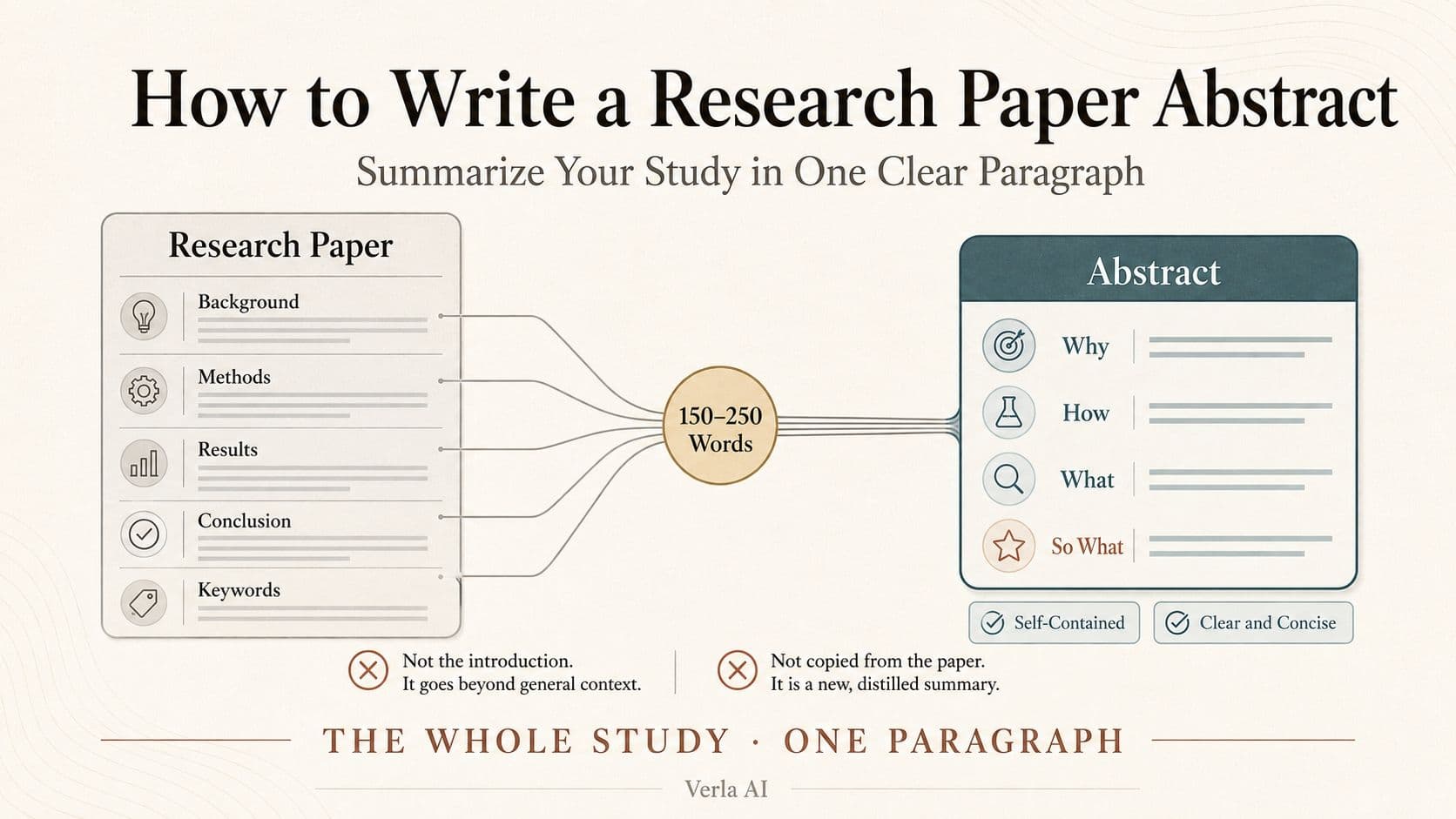
An abstract is not a miniature Introduction or a promise about what the paper will eventually cover. It is a compressed account of a completed paper: the problem it addresses, the approach it takes, the answer it reaches, and why that answer matters.
TL;DR: What Should a Research Paper Abstract Include?
Most abstracts answer four questions:
What problem or question does the paper address?
What did the writer examine or do?
What did the paper find or argue?
Why does that answer matter?
Write the abstract after completing the paper. Follow the word limit and format specified by your instructor, department, conference, or journal. Include only information that appears in the paper, and usually leave out citations, extended background, undefined abbreviations, and references to tables or figures.
For an original empirical study, briefly report the method and main results. For a source-based research paper, describe the scope or analytical approach and state the central argument instead of inventing participants, procedures, or data.
First, Find Out Which Abstract You Need
Before Maya starts cutting words, she checks her assignment. It asks for “an unstructured informative abstract of no more than 200 words.”
Those two adjectives describe different things.
Structured and unstructured refer to presentation. A structured abstract separates information under headings such as Background, Methods, Results, and Conclusion. An unstructured abstract presents the information in one continuous paragraph.
Informative and descriptive refer to content. An informative abstract gives the reader the paper's main answer, findings, or conclusion. A descriptive abstract explains what the paper covers but does not fully report its results or argument.
These categories can overlap. An abstract can be structured and informative, or unstructured and informative. Treating all four labels as mutually exclusive “types” makes the choice seem more complicated than it is.
Informative abstracts are the most common choice for research papers because they can stand alone as a meaningful summary. Descriptive abstracts are shorter and may appear in some humanities, theoretical, or overview assignments where the aim is to describe the scope rather than report empirical results.
Do not choose a format simply because one example looks better. Requirements differ across disciplines and publications. The USC research guide describes an abstract as a brief summary that generally follows the paper's sequence, but your assignment or target journal may specify different headings, lengths, and content.
The type of paper also matters. Maya's paper builds an argument from published research. She therefore needs to summarize her analytical focus and central conclusion. If she had conducted an experiment or collected survey data, her abstract would need to report the method and findings.
If you are unsure whether the assignment asks you to report an experiment or develop a broader research argument, first review how experimental reports differ from research papers .
Start With the Finished Paper and Answer Four Questions
Although the abstract appears near the beginning, it is usually written last. Until the full paper is complete, the thesis may change, sections may move, and apparently important evidence may disappear during revision.
If your argument, evidence, or conclusion is still unfinished, return to How to Write a Research Paper before trying to summarize it.
Maya does not begin her abstract by staring at another blank page. She returns to the completed paper and extracts four pieces of information.
What problem does the paper address?
Her Introduction explains that research often treats nighttime smartphone use as a single measure of total screen time. This may hide meaningful differences between passive exposure, notification-related checking, and psychologically engaging content.
She compresses that problem into one sentence:
Late-night smartphone use is frequently associated with poorer sleep among university students, yet total screen time may not capture the behaviors most likely to cause disruption.
This gives the reader enough context to understand the paper without turning the abstract into a second literature review.
What did the paper examine?
Maya did not recruit participants or conduct an experiment. She compared published research on several possible explanations for the relationship between phone use and sleep.
Her approach becomes:
This paper compares research on screen exposure, notification-related interruptions, bedtime checking, and psychologically engaging content among first-year university students.
Words such as “reviews,” “examines,” “compares,” and “analyzes” can describe a source-based paper accurately. They should not be used to disguise the absence of a clear approach.
What did the paper conclude?
The body of Maya's paper argues that duration alone is an incomplete measure. The type and timing of phone use may be more revealing.
She writes:
The evidence suggests that notification-driven checking and engaging content may delay bedtime and disrupt the transition to sleep even when total usage is moderate.
Notice the caution in “suggests” and “may.” If the underlying studies cannot establish causation, the abstract should not suddenly claim that they do.
Why does the conclusion matter?
The final section of the paper argues for more precise measurement and more practical student guidance.
Maya condenses that implication into:
Distinguishing between different forms of nighttime use could improve both future research and sleep guidance for students.
She now has the substance of the abstract. The remaining work is to connect and compress it.
Build the Abstract Instead of Writing a Vague Preview
Maya's first attempt looked like this:
This paper discusses smartphone use and sleep among university students. Several studies are examined to explore different factors affecting sleep. The paper considers the findings and discusses their implications.
The paragraph is grammatically acceptable, but almost every phrase could describe hundreds of papers. “Discusses,” “different factors,” and “the findings” hide the information readers need.
Her revised version is more specific:
Late-night smartphone use is frequently associated with poorer sleep among university students, yet total screen time may not capture the behaviors most likely to cause disruption. This paper compares research on screen exposure, notification-related interruptions, bedtime checking, and psychologically engaging content among first-year university students. The evidence suggests that notification-driven checking and engaging content may delay bedtime and disrupt the transition to sleep even when total usage is moderate. However, the widespread use of self-reported behavior and cross-sectional designs limits causal conclusions. Distinguishing between the timing, purpose, and interruptive nature of smartphone use could support more precise research and more practical sleep guidance for students.
The revision tells the reader what the problem is, what evidence the paper considers, what argument it makes, what limitation affects that argument, and why the conclusion matters.
It also stands alone. A reader does not need to consult the Introduction to understand what “the issue” or “these findings” refers to.
An effective abstract does not need a dramatic hook. Its first sentence earns attention by presenting a specific problem. It also does not need to mention every source, subsection, and qualification in the paper. The purpose is to preserve the paper's central logic, not reproduce its table of contents.
What Changes for an Empirical Research Paper?
The four-question approach still works for empirical research, but the second and third answers become more concrete.
Suppose Maya had conducted a hypothetical survey of 320 first-year students and analyzed the relationship between bedtime phone behaviors and self-reported sleep quality. Her abstract would need to identify the design, participants, measurements, and main results:
This cross-sectional study surveyed 320 first-year university students about nighttime smartphone behavior and sleep quality. Notification-related checking was more strongly associated with delayed sleep than total daily screen time, although the design could not establish causation.
The method sentence tells readers where the evidence came from. The results sentence reports the main outcome rather than saying only that a relationship was “significant” or that “interesting results were found.”
For a source-based paper, writing “participants were surveyed” would be false. For an empirical paper, omitting participants and major results would make the abstract incomplete.
This is why a universal template can be risky. Use the structure that reflects the paper you actually completed:
Empirical paper: problem → method → results → conclusion
Source-based paper: problem → scope or approach → central argument → implication
A literature review, theoretical paper, qualitative study, systematic review, and laboratory investigation may each require different information. Follow disciplinary guidance instead of forcing every abstract into the same sentence pattern.
Cut Words Without Cutting the Argument
Maya's assignment allows 200 words, but her first complete draft reaches 247. She does not solve the problem by deleting the conclusion—the part readers most need. She removes wording that takes up space without adding meaning.
For example:
Due to the fact that → Because
A large number of → Many
The purpose of this paper is to examine → This paper examines
It is important to note that → Delete it and state the point
The results of the analysis suggest that → The analysis suggests that
Background is usually the first place to cut. Readers need enough context to understand the question, not a history of the entire field. Detailed literature comparisons, secondary findings, procedural details, examples, and extended definitions normally belong in the paper.
Be careful with abbreviations. A familiar abbreviation may save space, but an undefined or highly specialized abbreviation makes a short abstract harder to understand. Define it the first time unless the relevant guidelines treat it as universally recognized.
Most abstracts also omit citations because they must work as self-contained summaries of the paper. If a reference is essential, check the required style rather than assuming it is allowed. Do not refer readers to “Table 2,” “Figure 1,” or a footnote they cannot see alongside the abstract.
Keywords, when required, normally appear after the abstract. Choose terms that accurately represent the paper's topic, population, method, or central concepts. Do not repeat the same keyword unnaturally throughout the paragraph merely for discoverability.
The final question is not “Have I used every available word?” It is:
If I delete this phrase, does the reader lose part of the paper's problem, approach, answer, or significance?
If not, it can probably go.
Check the Abstract Against the Paper
A polished abstract can still be inaccurate.
Maya compares every sentence with the completed paper. Her statement about self-reported data appears in the limitations section. Her conclusion about notification-driven checking reflects the body of the paper. She has not introduced a new population, stronger causal language, or a recommendation that the paper never develops.
Before submitting, check:
Every claim in the abstract also appears in the paper.
The main argument or result has not been replaced by a more exciting secondary point.
Numerical results match the Results section exactly.
The conclusion does not overstate what the evidence can establish.
The terminology is consistent with the full paper.
The paragraph follows the required word limit and format.
A reader can understand it without opening the paper.
Paperpal's abstract guide similarly emphasizes writing the abstract last, keeping it consistent with the manuscript, and avoiding new information.
This is where using the complete document matters. A generic generator working from a title may produce a fluent paragraph, but it cannot know which argument survived revision or which limitations appear in the final draft.
With Verla's research paper generator , you can upload the finished paper together with the assignment or journal requirements. Verla can help identify the research question, approach, main result or argument, and implication, then check whether the proposed abstract reflects the material already in the document.
You should still compare every sentence with the original paper. Verla helps compress and review the work; it should not become the source of new results, invented methods, or unsupported conclusions.
An abstract succeeds when it makes the complete paper visible in a small space. Write it last, preserve the central argument, match the level of certainty in the evidence, and remove everything the reader does not need to decide what the paper contributes.
Your paper is already written. Now make sure its most visible paragraph represents it accurately. Upload the paper and abstract requirements to Verla and turn the full draft into a concise summary without losing the argument that matters.