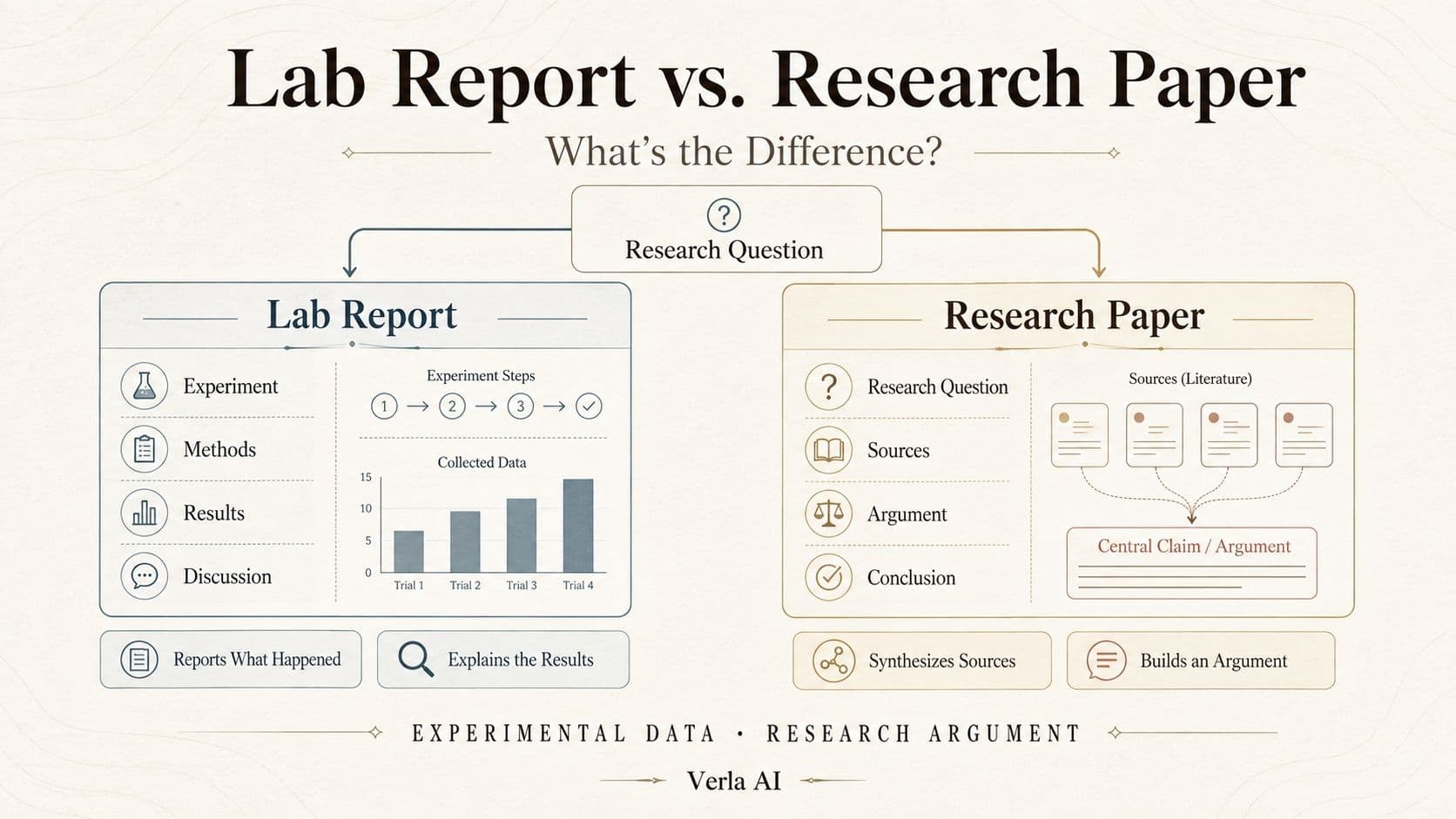
On Monday, Maya submits a catalase lab report with an abstract, introduction, method, results, and discussion. On Thursday, another professor assigns a research paper with exactly the same headings.
Maya opens Monday's document, changes the title, and adds more citations. The structure already looks right. Has she turned a lab report into a research paper?
Not quite. The two often share a skeleton because student lab reports introduce scientific-writing conventions. What changes is who shaped the question, where the evidence came from, and what the reader is supposed to learn.
TL;DR
A lab report explains and evaluates a particular experiment, often completed as part of a course. Its evidence centers on that experiment's data, usually for an instructor assessing scientific understanding.
A research paper answers a broader or more independent question by synthesizing published studies, presenting original research, or both. It develops a larger scholarly argument or knowledge claim.
The short version is:
A lab report shows what happened in this investigation. A research paper shows what the research allows us to understand more broadly.
Length and headings can offer clues, but they do not define the difference. A lab report and an empirical research paper may both use IMRaD—Introduction, Methods, Results, and Discussion.
Why Lab Reports and Research Papers Can Look Almost Identical
Maya's confusion is reasonable. University lab reports imitate professional scientific articles. Saint Mary's University notes that they follow the format researchers use to share scientific work. Both may introduce a question, describe a method, present results, and interpret them.
A genre analysis of university lab reports found the same overlap in structure, methods, and findings. The purpose differs: a student report is shaped by teaching, while a research article makes a claim for disciplinary readers.
This is why identifying the document by its headings often fails. Adding an abstract does not turn a report into a research paper. Including a Methods section does not make a paper a lab report. Even the presence of original data is not decisive, because empirical research papers also use data collected by their authors.
They share a skeleton because they belong to the same family of scientific writing. They differ in what that skeleton is carrying.
“Research Paper” Can Mean Two Different Things
The phrase research paper creates part of the problem because instructors use it for two different assignments.
A literature-based research paper develops a thesis by comparing published scholarship. A student could study catalase activity across organisms without performing an experiment. Journal articles, not one laboratory data set, provide the main evidence.
An empirical research paper presents an original study and may contain the same sections as Maya's report. The writer usually has more responsibility for defining the question, designing the study, placing it in the literature, and establishing its contribution.
Scribbr's comparison contrasts a hands-on lab report with a source-based paper. That fits many assignments, but scientific research papers can involve experiments and lab reports can contain substantial research.
Before deciding on a structure, Maya therefore needs to know which meaning of research paper her instructor intends.
One Experiment, Three Different Assignments
The catalase topic shows how the same subject can lead to three genuinely different documents.
For Maya's lab report, the question is narrow: How did temperature affect catalase activity in this lab session? Oxygen production at each temperature is central. Background sources explain the pattern, while failed trials and measurement problems remain part of what happened.
In a literature-based research paper, the question expands: How does temperature influence catalase activity across organisms and conditions? Maya compares studies, explains conflicting results, and builds a conclusion no single source provides.
An empirical research paper might ask: Does long-term cold exposure shift catalase activity in a particular organism? It needs a justified design, sufficient observations, and a discussion relating new findings to prior research—not merely a longer classroom report.
The topic has not changed. What changed is the ownership of the question and the work the evidence must perform.
Lab Report vs. Research Paper at a Glance
These are tendencies, not universal rules. An advanced lab course may require students to design their own investigation. A short research paper may have fewer sources than a detailed report. The assignment brief always outranks the label.
The Difference Appears Most Clearly in the Introduction and Discussion
Suppose both of Maya's documents use IMRaD. The Introduction and Discussion reveal why copying one into the other does not work.
In the lab report, the Introduction provides enough theory to justify the class experiment and narrows toward the assigned objective. Maya must show why the experiment makes sense, not prove that the question is unprecedented.
A research-paper Introduction has a larger burden. It establishes the problem and argument or places a new study inside scholarship and explains why it is needed. More citations only help when they build that logic.
The Discussion changes too. A lab report interprets Maya's results and uncertainty. A research paper asks what the findings or synthesis contribute beyond this exercise, perhaps by comparing studies or revising an explanation.
Both documents make arguments. The difference is the distance those arguments are expected to travel. If an instructor specifically asks for claim–evidence–reasoning inside the Discussion, see how CER fits into a lab report .
How to Tell What Your Assignment Actually Requires
Maya should begin with the brief, not a generic template. A supplied procedure, a fixed practical session, a class data set, and prompts about error or replication usually signal a lab report. A requirement to develop a thesis, search scholarly databases, compare sources, or justify an original research design points toward a research paper.
Wording can be messy. An instructor may call a lab report a “scientific paper,” or say “research report” while expecting source synthesis. The rubric is decisive: what must be submitted, where evidence comes from, and what is graded.
If the brief expects a complete experimental write-up, move to How to Write a Lab Report rather than repeating the process here. If the document type remains unclear, upload the brief, rubric, lab instructions, data, and source requirements to Verla's Lab Report Generator . Verla can help determine whether the assignment centers on reporting one experiment, synthesizing scholarship, or developing an empirical study, then organize the supplied materials around that purpose. It should not invent results, sources, or a research contribution that the evidence cannot support.
Could Maya turn her report into a research paper? Possibly—but not by adding pages. She would need a stronger question and evidence, deeper engagement with prior research, and a clear contribution. A class experiment is only a starting point.
Maya's first instinct was understandable: the two documents looked almost identical. But scientific genres are defined by more than their headings. Once she knows who owns the question, where the evidence comes from, and what the conclusion is expected to contribute, the right structure becomes much easier to see.
Start with the assignment you actually received. Upload the brief, rubric, data, and approved sources to Verla, then build the document around what the evidence—and the instructor—really require.