The experiment is over. Three test tubes sit in the rack, and one result is obvious: the enzyme reacted fastest at 37°C. Then you read the final instruction:
Write a CER response using your results.
Do you submit one paragraph? Do you need a Method section? Should you include every measurement, or only the numbers that support your answer?
Science teachers also debate whether CER belongs inside a lab report or can replace one. The confusion comes from treating them as two versions of the same document. They are not.
CER is a framework for building a scientific argument. A lab report is a complete account of an investigation. CER can sit inside one or stand alone as a short assignment, but it does not automatically include everything a report requires.
What Is CER in Science?
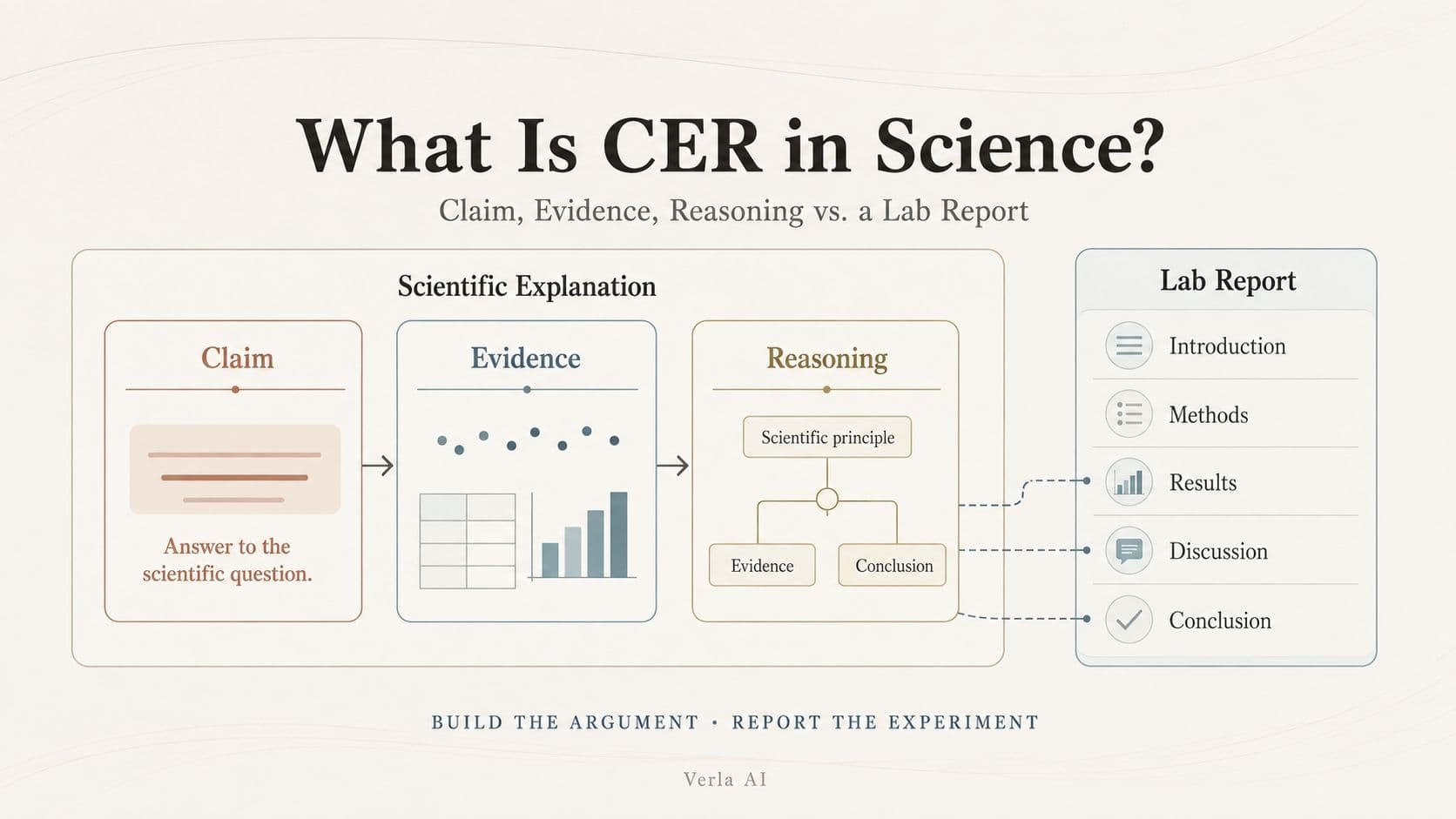
CER stands for Claim, Evidence, and Reasoning. It gives a scientific explanation three jobs: answer the question, show the relevant proof, and explain why that proof supports the answer.
The claim is a specific conclusion. “Temperature affected the enzyme” is technically a claim, but it leaves the reader unsure what happened.
The evidence is the measured data or observation supporting the claim—not everything recorded. Actual values are more convincing than “the result was higher.”
The reasoning supplies the scientific bridge, using a principle or model to explain why the evidence counts as support.
CER is often introduced as a classroom strategy, but its logic is fundamental to scientific writing: What are you concluding? What supports it? Why should that evidence lead there? The EduFirst CER guide applies it to science answers, data questions, and lab reports.
One Experiment, One CER Response
Return to the enzyme experiment. In 60 seconds, catalase produced 12 mL of oxygen at 20°C, 25 mL at 37°C, and 4 mL at 60°C.
A complete CER response could read:
Claim: Catalase was most active at 37°C and lost much of its activity at 60°C. Evidence: In 60 seconds, the 37°C sample produced 25 mL of oxygen, compared with 12 mL at 20°C and 4 mL at 60°C. Reasoning: Increasing temperature initially raises molecular motion, creating more frequent collisions between enzyme and substrate. However, high temperatures can change the enzyme's structure and reduce the effectiveness of its active site. This explains why activity increased between 20°C and 37°C but fell sharply at 60°C.
The response selects the result that matters instead of retelling the procedure. Test-tube labels only matter if the assignment requests a complete report or the procedure affects the interpretation.
The claim is not a hypothesis copied into the past tense. A hypothesis predicts before data collection; a claim states what the results can support afterward.
The Part Students Usually Get Wrong: Evidence Is Not Reasoning
The most common CER problem appears after the data:
The 37°C sample produced the most oxygen, so the evidence supports my claim that catalase works best at 37°C.
The final phrase repeats the claim without explaining the science connecting temperature to enzyme activity.
Reasoning answers what a skeptical reader could still ask: Why would those numbers make sense? Here, the answer involves collision frequency and heat's effect on protein structure. Another experiment would require its own relevant mechanism.
Evidence comes from what the investigation showed; reasoning comes from the scientific idea that makes the pattern meaningful. Without reasoning, data sit unexplained. Without evidence, the explanation is untethered from this experiment.
Advanced CER models may add a rebuttal to test a competing explanation. The core remains unchanged. Chemistry LibreTexts defines reasoning by this function: showing why the data count as evidence for the claim.
Why Teachers Disagree About CER and Lab Reports
In a ScienceTeachers Reddit thread , a biology teacher described arriving at a new school after years of assigning traditional reports. The teacher expected background, procedure, results, discussion, conclusion, and references. Colleagues instead wanted a “full CER.”
The disagreement was not really about three letters. It was about what students should learn from the assignment.
Some teachers valued communicating an investigation from beginning to end. Others worried that headings and formatting can push the scientific thinking into one hurried conclusion. CER reverses the emphasis: start with the question and make every selected result do analytical work.
Both concerns are reasonable. A polished lab report can hide a weak discussion; a persuasive CER can omit the reproducible method and inconvenient results. The right format depends on whether the assignment assesses the whole investigation or one piece of reasoning.
That is why “CER versus lab report” is not a contest with one universal winner. CER can be the intellectual center of a lab report, but it is not the entire document.
CER vs. Lab Report: The Real Difference
Length is only a clue. CER is often one developed paragraph, while a lab report is normally longer because it has more work to perform.
The difference is scope. CER asks, “Can you defend this conclusion?” A lab report also asks whether another reader can understand the investigation, evidence, full results, and limitations.
Where CER Fits Inside a Lab Report
CER logic usually becomes most visible in the Discussion. The writer states what the results indicate, points to the data that matter, and uses scientific principles to interpret the pattern. A concise Conclusion may repeat the main claim, but the detailed reasoning normally belongs earlier.
The fit is not one-to-one. Evidence may first appear neutrally in Results and return in Discussion to support a claim. One experiment may also produce several claims, each needing its own evidence and reasoning.
CER stops the Discussion from becoming a second Results section. Instead of “the values increased and then decreased,” the student explains what the change means and why it occurred.
If your assignment requires the complete document rather than a CER response, use the full guide on How to Write a Lab Report . The purpose of CER is not to provide a shorter route around those requirements; it is to make the report's scientific argument stronger.
How to Know What Your Assignment Requires
Read the deliverable, not just the word lab. “Write a CER response,” “support your claim with data,” or “explain whether the results support the conclusion” usually points to a focused scientific argument. A rubric with Introduction, Materials or Method, Results, Discussion, References, and appendices points to a full lab report.
Sometimes instructors combine the two: “Submit a lab report and use CER in the Discussion.” In that case, the report supplies the full record while CER shapes the interpretation. If the task asks you to investigate a broader question through published scholarship rather than report one experiment, the more relevant comparison is lab report vs research paper .
When the brief is vague, upload the instructions, rubric, data, and permitted sources to Verla's Lab Report Generator . Verla can help separate results from explanation, identify missing support, and organize either a CER response or full report. It should never invent measurements, observations, or citations.
CER works because it makes the hidden logic of a scientific answer visible. The claim tells the reader where you landed. The evidence shows what you saw. The reasoning explains how the science connects the two. Whether those moves fill one paragraph or anchor a full lab report depends on the assignment—not on the acronym.
Turn your experimental results into a defensible explanation. Upload the brief, rubric, data, and approved sources to Verla, then build the response around what your evidence can genuinely support.