Maya has ten days to write a 2,500-word research paper on an issue affecting university students. She needs at least eight peer-reviewed sources, APA citations, and a clear argument.
She opens a blank document and types:
Smartphones and sleep
Then she opens Google Scholar. Twenty minutes later, she has twelve tabs, four downloaded PDFs, and no clearer idea of what her paper will actually say.
This is where many research papers become difficult. Finding information is not the same as building an argument. A strong paper emerges when you turn the assignment into a focused question, give each source a purpose, and organize the evidence around your own answer.
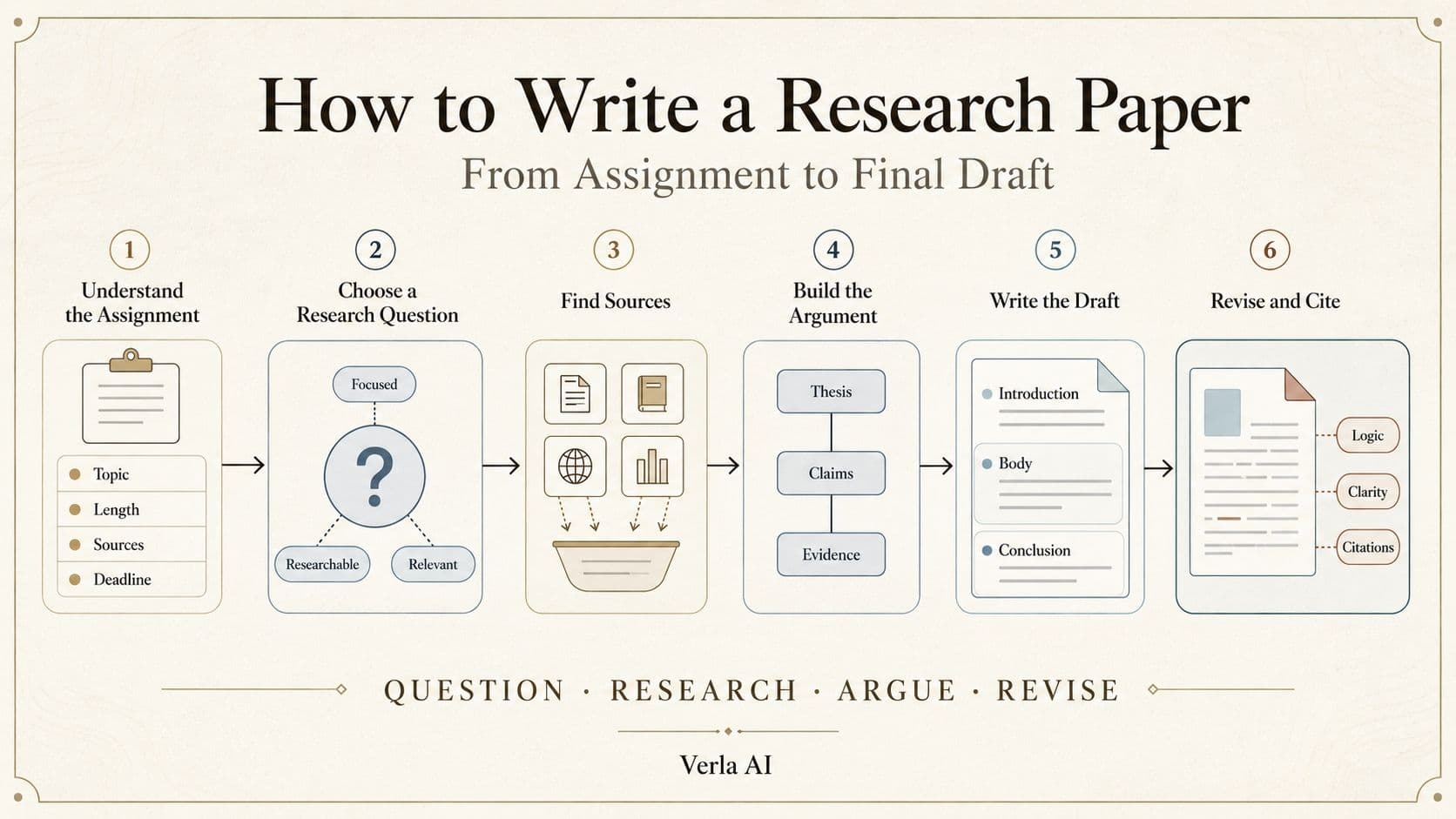
This guide follows that process from the first reading of the assignment to the final check before submission.
TL;DR: How to Write a Research Paper
Start by identifying exactly what the assignment requires and what kind of research paper you are writing. Narrow your topic into a question you can realistically answer, then conduct preliminary research to understand the conversation around it.
As you read more deeply, develop a working thesis and organize sources according to the claims they support, challenge, or complicate. Build your outline around those claims, draft the evidence-rich sections first, and write the introduction once you know what the paper has actually become.
Finally, revise from the assignment backward: check the argument and evidence before polishing grammar, citations, and formatting.
Before You Search, Find Out What You Are Being Asked to Write
Maya's assignment does not simply say “write about smartphones.” It asks her to analyze a contemporary issue, make an evidence-based argument, use at least eight peer-reviewed sources, and follow APA style.
Those details determine how she should work. “Analyze” means she cannot submit a descriptive overview of phone habits. “Evidence-based argument” means the paper needs a position supported by research. The source requirement tells her what kind of material counts, while the word limit determines how narrow her question must be.
Before opening another search tab, pull the following information out of your assignment:
The task words, such as analyze, evaluate, compare, explain, or report
The required number and type of sources
The expected length
The citation style
Any required sections
The grading criteria and submission deadline
You also need to identify what your instructor means by “research paper.” In many undergraduate courses, it means a source-based paper in which you build an argument from published evidence. Its structure may be as simple as an introduction, a thematically organized body, and a conclusion.
An empirical paper reports research you conducted yourself and may require Methods, Results, and Discussion sections. If your assignment centers on an experiment rather than an argument based mainly on published sources, first confirm whether your assignment calls for an experimental report or a broader research paper .
Maya is writing a source-based paper, so she does not need to invent a methodology or force her work into an IMRaD structure. Her job is to answer a focused question using credible published evidence.
Turn a Broad Topic Into a Question You Can Answer
“Smartphones and sleep” is a subject area, not yet a research question. It could include children, shift workers, university students, screen light, social media, notifications, sleep duration, insomnia, or dozens of other directions.
A 2,500-word paper cannot investigate all of them well.
Maya narrows the topic by choosing a population, behavior, context, and outcome:
Population: First-year university students
Behavior: Late-night smartphone use
Context: The period before sleep
Outcome: Sleep quality
This produces a workable question:
How does late-night smartphone use affect sleep quality among first-year university students?
The question is specific enough to guide a search but still open enough to investigate. It does not assume that smartphones necessarily cause poor sleep, and it leaves room for conflicting explanations.
Your first question does not need to be permanent. Preliminary research may reveal that one part is difficult to measure, already settled, or more complicated than expected. Kennesaw State University's Writing Center describes the research question as a starting point that can shift as the writer learns more about the subject. Narrowing is an iterative process , not a decision you make once and never revisit.
A useful test is to imagine answering the question in one sentence. If the only possible answer is “it depends,” the question may need clearer boundaries. If answering it would require a book, it is still too broad. If you already know the answer without examining evidence, it may not be a research question at all.
Research in Two Passes, Not One Endless Search
Maya's first search should not be an attempt to collect eight sources and finish researching. At this stage, she does not yet know which eight sources she needs.
The first pass is for orientation. She reads abstracts, review articles, and recent introductions to learn how researchers describe the issue. Several ideas recur: blue-light exposure, bedtime procrastination, emotionally engaging content, notification-related interruptions, and the limitations of self-reported screen time.
That vocabulary improves her next searches. Instead of repeatedly typing smartphones sleep students, she can search combinations such as:
(“bedtime smartphone use” OR “nighttime phone use”) AND (“sleep quality” OR “sleep duration”) AND (“university students” OR “college students”)
During this pass, Maya records useful keywords, frequently cited authors, competing explanations, and questions that remain unresolved. She is mapping the conversation rather than reading every paper from beginning to end.
The second pass is targeted. Now she looks for evidence that will help answer specific parts of her question. She needs sources that examine notification interruptions, sources that distinguish active phone use from total screen time, and perhaps a study that finds a weaker or more complicated relationship.
This is also the point to start a source log. For each paper, record:
Full citation
Research question
Population and method
Main finding
Limitation
Relevant page, table, or quotation
Possible role in your paper
Saving page numbers while you read is much easier than trying to recover them the night before submission. It also reduces the risk of attaching a citation to a claim the original source does not actually support.
Do not treat publication as automatic proof of quality. Consider whether the study's population resembles yours, whether its method can support its conclusion, and whether it reports an association or establishes causation. If a survey finds that students with more nighttime phone use also report poorer sleep, that does not by itself prove which behavior caused the other.
Give Every Source a Job
After two days, Maya has nine potentially useful papers. But collecting the required number does not mean she is ready to write.
The next question is:
What job will each source perform in the argument?
One paper may establish that sleep problems are common among first-year students. Another may support a relationship between bedtime phone use and delayed sleep. A third may explain a possible mechanism, such as psychological arousal. A longitudinal study may complicate the argument by suggesting that the relationship is smaller when researchers account for stress or existing sleep difficulties.
Maya begins arranging her sources by role:
Establish the problem: Why sleep quality matters for first-year students
Support the first claim: How phone use can delay bedtime
Explain a mechanism: Why notifications or engaging content may keep users alert
Complicate the argument: Why total screen time is an incomplete measure
Identify limitations: Reliance on self-reported behavior and cross-sectional studies
This is more useful than writing nine separate summaries. A paper becomes evidence only when you explain how its findings relate to a claim you are making. The Cornell Writing Workshop recommends organizing a paper around perspectives, points, or evidence that supports and complicates a claim. Each section can then synthesize the sources relevant to that part of the argument.
At this stage, Maya's original assumption begins to change. She no longer thinks that screen exposure alone explains the issue. Her working thesis becomes:
Late-night smartphone use is associated with poorer sleep among first-year university students, but notification-driven interruptions and psychologically engaging content may be more important than screen exposure alone.
This thesis is still provisional. If later evidence challenges it, she should revise the thesis rather than exclude the inconvenient evidence. A working thesis is supposed to evolve as the research becomes more precise.
This is also the first point where an AI tool can provide meaningful help. Maya does not need another blank text box that knows only her topic. She needs a workspace that can see the assignment, rubric, verified sources, and notes together.
With Verla's research paper generator , you can upload those materials and use them to organize possible claims, supporting evidence, contradictions, and gaps. The generated plan should remain a starting point: open the original sources and verify every interpretation, quotation, statistic, and citation before including it in your paper.
Build the Outline Around Claims, Then Draft From the Middle
A weak outline often mirrors the order in which sources were found:
Introduction
Smith study
Lee study
Patel study
Conclusion
That structure makes the sources—not the writer's argument—the center of the paper.
Maya instead builds her outline around the steps required to answer her question:
Introduction: Why late-night smartphone use and student sleep deserve attention
Section 1: Why total screen time alone cannot explain sleep quality
Section 2: How notification interruptions can delay or fragment sleep
Section 3: Why emotionally engaging content may prolong bedtime use
Section 4: What current research cannot yet establish
Conclusion: What the evidence suggests and why more precise measurement matters
Multiple sources can now appear in the same section because they address the same idea. One may support a relationship, another may disagree, and a third may explain why their findings differ.
Maya does not start by polishing the opening sentence of her Introduction. She begins with Section 2 because it has the clearest evidence. Once that section works, she moves to Sections 1 and 3.
Each paragraph makes a smaller move inside the argument. It introduces a claim, presents relevant evidence, explains what the evidence shows, and connects that interpretation back to the section's purpose. A paragraph should not end immediately after a quotation or statistic; the reader needs Maya's explanation of why that information matters.
For example:
Notification-related interruptions may affect sleep even when total screen time is relatively low. Studies that measure only the number of minutes spent on a device can miss brief but repeated checks triggered by alerts. This distinction matters because two students with the same total usage time may experience very different levels of disruption before sleep.
The paragraph does not merely report what a source said. It uses evidence to develop a point that moves the larger argument forward.
Drafting from the middle also makes the Introduction easier. Once Maya can see her actual argument, she knows what context the reader needs, what problem the paper will address, and what thesis accurately describes the paper she has written.
Write the Introduction and Conclusion After the Argument Is Visible
Maya's Introduction now has four jobs. It establishes the context, narrows to the problem, presents the research question, and states the paper's answer.
She does not need to begin with a dramatic quotation or a generic claim such as “Smartphones have changed the world.” A direct opening is often stronger:
Smartphones are a routine part of university life, including the period immediately before sleep. Although nighttime phone use is frequently associated with poorer sleep, total screen time may not capture the behaviors most likely to cause disruption.
From there, she introduces the problem with current measurements, identifies the focus on first-year university students, and states her working thesis.
The Conclusion performs a different task. It does not repeat the Introduction sentence by sentence or introduce one last source. It draws together what the evidence now allows Maya to say:
Current research suggests that the relationship between smartphones and sleep cannot be reduced to the number of minutes spent looking at a screen. The timing, purpose, and interruptive nature of phone use may be equally important.
She can then explain the implication: future studies and student wellbeing programs may need to distinguish passive screen exposure from notifications, compulsive checking, and emotionally engaging content.
A strong conclusion answers the research question at the level the evidence permits. It does not claim that Maya has “proved” smartphones cause poor sleep when most of her sources only report associations.
Revise Backward From the Rubric
Maya finishes a first draft with 2,700 words. Her first instinct is to correct commas and make individual sentences sound more academic. But polished sentences cannot rescue a paper that has missed the assignment.
She revises in the opposite direction:
Assignment → Thesis → Sections → Claims → Evidence → Paragraphs → Sentences → Formatting
First, she puts the rubric beside the draft. Has she analyzed the issue, or mostly described it? Has she used eight peer-reviewed sources? Does her conclusion answer the question she introduced?
Next, she writes the main point of every paragraph in the margin. This reverse outline reveals that two paragraphs repeat the same point about blue light, while an important claim about notification interruptions has only one weak source.
She then conducts an evidence check. Every statistic, specific finding, quotation, or borrowed idea needs an appropriate citation. More importantly, the cited source must support the exact statement being made. A citation at the end of a long paragraph does not automatically cover every sentence above it.
Only after repairing the argument does Maya work on transitions, clarity, grammar, references, headings, page numbers, and APA formatting. Purdue OWL distinguishes these large structural issues from lower-order sentence concerns and recommends prioritizing the paper's thesis, purpose, organization, and development during revision. The big-picture problems usually have the greatest effect on the paper .
Verla can support this stage by reading the draft alongside the original assignment and uploaded sources. It can help surface sections that drift away from the thesis, claims that may need stronger support, repeated ideas, and language that feels stiff or generic. You still make the academic judgment and verify the evidence, but you no longer have to review the paper without context.
A research paper becomes manageable when you stop treating it as one enormous writing task. First identify the question. Then determine what the evidence allows you to say. Give every source a job, build the paper around claims, and revise from the rubric before polishing individual sentences.
You probably do not need more open tabs. You need a way to turn the assignment, sources, and notes you already have into a paper that answers the question. Upload them to Verla and build your next step from the material in front of you.