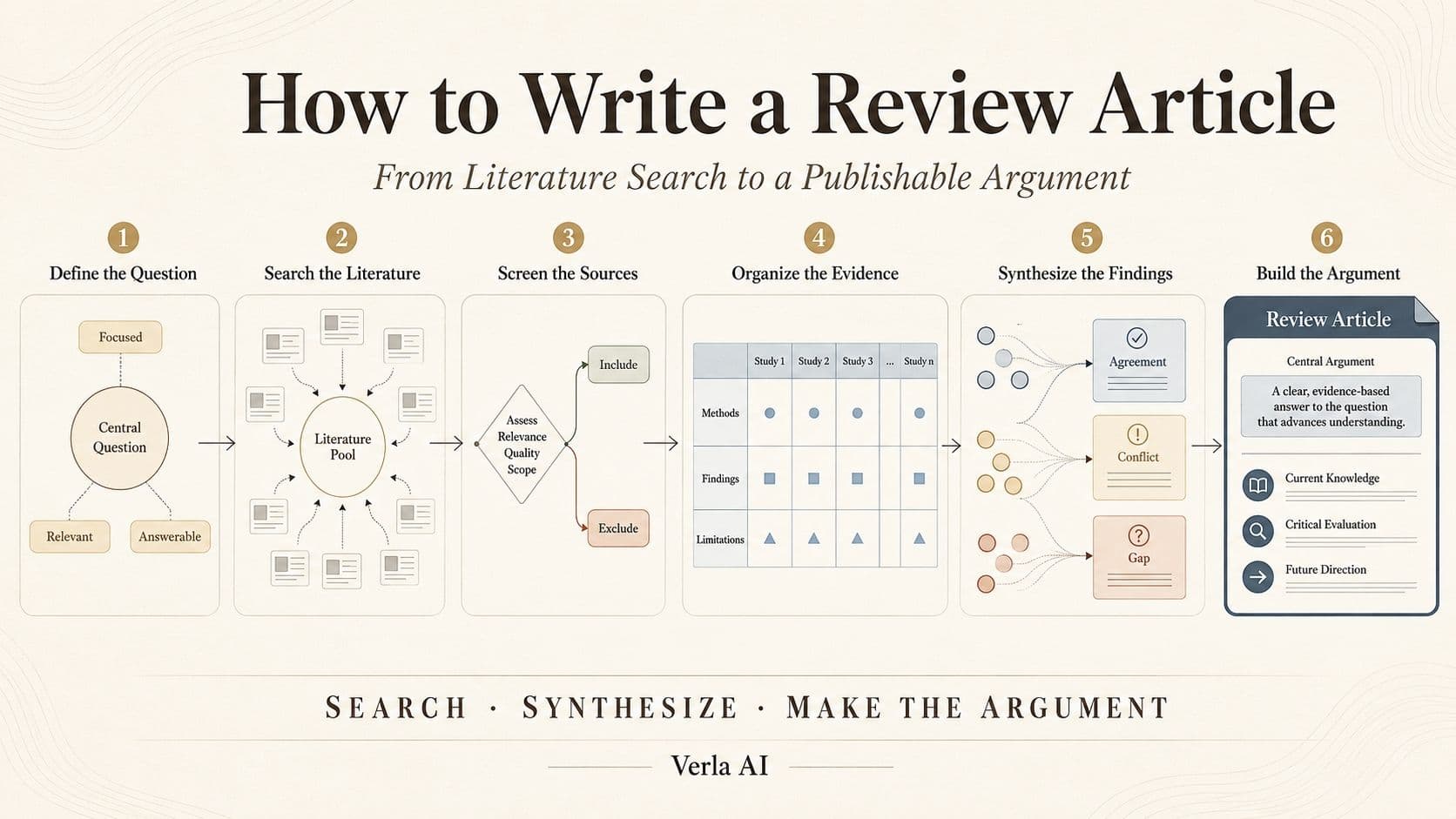
Learning how to write a review article often begins with a folder full of PDFs and a blank document. You may understand each paper individually, yet still have no idea what the article as a whole should say.
That uncertainty is normal. In a discussion on r/academia , a recent bachelor's graduate described writing a first review paper as so difficult that it felt almost impossible. The most useful replies did not offer a magic template. They suggested studying published reviews in the field, tracing ideas through earlier papers, keeping detailed notes, and watching how debates developed over time.
That is the real work of a review article. You are not simply collecting everything researchers have said. You are deciding what the literature adds up to—and giving readers a clearer way to understand where the field has been, where it stands, and where it should go next.
Key Takeaways
A publishable review article needs a clear intellectual contribution, not just a large reference list.
Choose a topic that is timely, sufficiently researched, and narrow enough to evaluate in depth.
Define your scope and search process before collecting more papers.
Organize sources around patterns, methods, disagreements, and unanswered questions.
Build the article around a central interpretation of the field, then use evidence to develop it.
AI can help compare sources and plan the article, but authors must verify every interpretation and citation.
What Makes a Review Article Worth Publishing?
A literature review may be a university assignment, a thesis chapter, or one section of a research paper. A review article is usually a standalone journal manuscript written for readers who want an authoritative assessment of a field.
That creates a higher standard. Editors are unlikely to publish an article simply because it summarizes many studies. Readers can already find those papers themselves. Your review needs to provide something they cannot get by reading one source at a time.
That contribution might be:
A new way of classifying existing approaches
An explanation for conflicting research results
A comparison of methods that have not previously been evaluated together
A model showing how several research variables interact
A research agenda identifying the most important next steps
The editors of Nature Reviews Bioengineering argue that a good review should be timely, objective, balanced, forward-looking, and engaging. It should help readers understand both the progress of a field and the opportunities that remain. Their standard is demanding but useful: even an experienced researcher should learn something from the finished article. Nature Reviews Bioengineering
Before opening another database, try completing this sentence:
This review is needed because existing research has not yet clearly explained, compared, or organized __________.
If you cannot complete it, you may have a topic but not yet have a reason for the article to exist.
Decide What Kind of Review Article You Are Writing
“Review article” does not describe one universal method. A narrative review interprets a field flexibly, while a systematic review follows a predefined and reproducible selection process. Scoping reviews map the extent of available evidence, and meta-analyses statistically combine sufficiently comparable results.
Before proceeding, identify which of the different types of review articles fits your question and target journal. This decision changes how you search, select, evaluate, and report sources.
It is also worth choosing a journal early. Some journals publish many reviews, some accept them only after a proposal, and others rarely accept unsolicited review manuscripts. Taylor & Francis recommends checking the journal's aims, scope, article types, and author instructions before writing.
Study two or three recent review articles from that journal. Look beyond the topic and notice how they work:
How narrow is the question?
Does the article describe its search method?
How are the main sections organized?
What kinds of figures and tables appear?
Does the conclusion summarize the field or propose specific next steps?
Published articles show you the journal's expectations more clearly than a generic template can.
Choose a Topic That Is Ready for Review
Imagine that Maya, a graduate student, wants to write about digital mental health interventions. After an afternoon of searching, she has papers about meditation apps, online counselling, wearable devices, cognitive behavioral therapy, depression, anxiety, employees, adolescents, and university students.
She has found a field, but she has not found a review article.
A useful topic needs three qualities. It should be timely enough to matter, developed enough to contain substantial evidence, and unsettled enough to benefit from a new interpretation.
The Nature editorial offers a practical benchmark: around 30 relevant primary research papers published within the past two or three years may indicate that a developing topic is ready for review. This is a rule of thumb, not a universal requirement. A mature humanities topic may depend on a longer historical period, while a new technical field may develop much faster.
Maya examines recent reviews and notices that mobile cognitive behavioral therapy apps are often discussed as effective or ineffective, but fewer reviews connect outcomes with user engagement and dropout. That relationship gives her a possible angle:
Why do mobile CBT interventions report promising short-term outcomes while struggling to maintain student engagement?
Now the topic contains tension. The article is no longer “everything about digital mental health.” It is an investigation of a specific problem in the literature.
Define a Scope You Can Defend
A scope is not just a way to make the workload smaller. It determines which conclusions your evidence can support.
Maya narrows her review to mobile CBT interventions for anxiety among university students, focusing on studies published since 2019. She may include randomized trials and longitudinal studies while excluding interventions that require regular face-to-face therapy.
Her scope now establishes:
Population: University students
Intervention: Mobile CBT-based interventions
Outcome: Anxiety and continued engagement
Evidence: Primary empirical studies
Period: 2019 onward
Not every review needs these exact boundaries. The point is to make the logic visible. A reader should understand why one study belongs in the article and another does not.
Scope may change as you learn more, but document those changes. Expanding the topic every time you discover an interesting paper produces a review that is broad, uneven, and difficult to finish.
Build a Search Strategy You Can Explain
Begin with a small set of core concepts and their common alternatives. For Maya's question, an initial search might be:
(“mobile CBT” OR “digital cognitive behavioral therapy”) AND (anxiety) AND (“university students” OR “college students”) AND (engagement OR adherence OR dropout)
Search more than one relevant database because their coverage differs. Depending on the field, this could include PubMed, PsycINFO, Scopus, Web of Science, ERIC, IEEE Xplore, JSTOR, or a university library catalogue.
Then move in both directions. Examine the reference lists of important papers to find earlier research, and use citation tracking to identify later studies that built on or challenged them. This reflects one of the more practical suggestions in the Reddit discussion: start with a strong recent paper and trace how its concepts developed through the research network.
Keep a search record containing the databases, keywords, filters, dates, and selection decisions. A narrative review may not require a full systematic-review protocol, but readers should still be able to understand where the evidence came from.
Do not assume that every search result is suitable. Check the journal, authors, study design, methods, and references. If you are uncertain about a source, use this guide to determine how to know if an article is scholarly or peer reviewed .
Turn a Folder of Sources into an Original Argument
Downloading papers creates a collection. It does not create a review.
The shift happens when you stop asking, “What did this paper say?” and begin asking, “What role does this paper play in the field?”
For each important source, record its research question, population, method, main result, limitation, and relationship to other studies. Maya's notes might gradually reveal a pattern like this:
This evidence map changes the article. Maya is no longer planning one paragraph per paper. She can organize the review around efficacy, engagement, measurement, and the relationship between them.
This is also the stage where Verla can provide the clearest practical value. If you already have journal requirements, a research question, and a curated collection of papers, Verla's review article generator can help compare source-based findings, surface recurring themes, and turn scattered notes into a clearer outline.
AI should work from materials you have selected, not invent the evidence base for you. Open the original papers to verify every quotation, statistic, interpretation, and citation before including it in the manuscript.
How to Write a Review Article Around a Clear Story
Once the evidence is organized, decide what you want readers to understand by the end.
Maya's review could make this central argument:
Mobile CBT apps may offer short-term support for student anxiety, but the literature often treats engagement as a simple usage metric rather than a changing part of the intervention itself. This limits comparisons across studies and may explain some conflicting conclusions about effectiveness.
That argument gives every section a job:
Explain why mobile CBT is increasingly used among university students.
Evaluate evidence for short-term and sustained outcomes.
Compare how studies define and measure engagement.
Examine why participants discontinue or continue using interventions.
Show how inconsistent engagement measures affect conclusions.
Propose a clearer framework for future trials.
The introduction should establish the problem, explain why the review is needed, define its scope, and preview its central angle. Keep it accessible enough for readers outside the narrow specialty.
The main discussion should move between evidence and interpretation. Avoid a sequence such as “Smith found this, Jones found that, and Patel found something else.” Instead, compare representative studies and explain why their results may differ.
A paragraph might begin like this:
Evidence for mobile CBT among university students appears promising but difficult to compare. While several studies associate continued app use with improved outcomes, “engagement” may refer to completed modules, login frequency, time spent, or self-reported participation. These measures capture different behaviors, making it difficult to determine whether inconsistent results reflect the interventions themselves or the way participation was measured.
Figures and tables should do analytical work. A useful figure might present your proposed conceptual model, while a table could compare populations, intervention designs, engagement measures, and outcomes. Avoid visuals that merely decorate information already stated in the text.
Finish with an outlook rather than a generic summary. Identify the questions that now matter, the methods needed to answer them, and the milestones that would move the field forward. Before submission, confirm the journal's formatting rules, refine the title and abstract, check citation balance, and ask a knowledgeable colleague to challenge your interpretation.
A review article becomes publishable when it stops looking like a catalogue of papers and starts offering a defensible view of the field. Begin with a question worth answering, give every source a role, and let the evidence lead you toward an interpretation readers could not reach from any single study.
Turn your source collection into a review plan. Bring your research question, journal guidelines, notes, and selected papers to Verla to organize the evidence and build a clearer path from reading to writing.