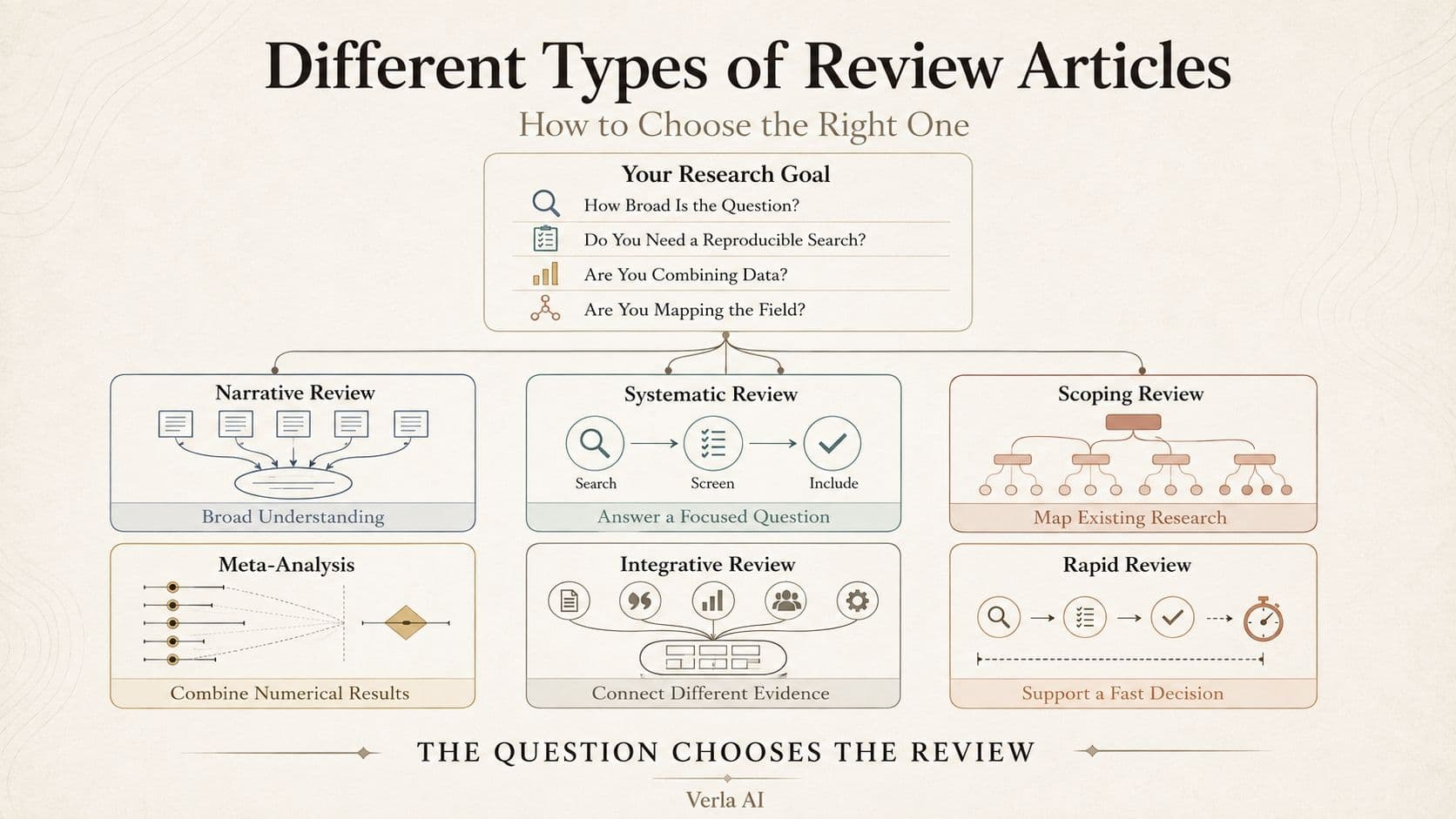
Maya wants to study digital mental health support for university students. Her supervisor recommends a systematic review. A librarian suggests a scoping review. Then Maya finds an integrative review covering almost the same topic.
All three sound reasonable, but each would produce a different piece of paper.
This confusion is common because “review article” is an umbrella term. Some labels describe the purpose of the review, others describe the evidence being analyzed or the method used to combine it.
A student in an r/AskAcademia discussion even wondered whether Google Scholar's “review articles” filter meant “peer-reviewed articles.” It does not: “review article” describes what an article does, while “peer reviewed” describes how it was evaluated.
The right choice, therefore, starts with your research question—not the name that sounds most academic.
TL;DR
Choose a narrative review to explain a field, a scoping review to map it, and a systematic review to answer a focused question. Use meta-analysis only when comparable numerical results can be combined. Qualitative and mixed-methods reviews explore experiences and context, while umbrella reviews synthesize existing reviews. Rapid and living reviews describe how quickly evidence is produced or updated.
Why Are Review Article Types So Confusing?
Different academic guides classify reviews in different ways.
The Stanford Lane Medical Library presents six common formats, including narrative, scoping, systematic, rapid, and umbrella reviews. The Duke Medical Center Library compares a much larger set according to how each one searches, appraises, synthesizes, and analyzes evidence.
A 2025 primer for early-career researchers uses another approach, grouping reviews into quantitative, qualitative, mixed-methods, mapping, and meta-evidence synthesis. It treats rapid and living reviews as ways of conducting a review rather than completely separate evidence types.
These classifications are not necessarily contradictory. They are answering different questions:
This is also why meta-analysis should not be treated as a direct alternative to every other review article. It is a statistical technique commonly used inside a systematic review.
The Main Types of Review Articles at a Glance
The same topic can support several review types. What changes is the question being asked.
The topic alone does not determine the format. “Digital mental health” is not yet a review question. Maya first needs to decide whether she wants to describe the field, measure an effect, understand an experience, or challenge an existing interpretation.
Narrative, Critical, and State-of-the-Art Reviews
These formats are most useful when the goal is to explain or reinterpret a field rather than answer one narrowly defined effectiveness question.
A narrative review organizes research into a coherent account of what is known. It may trace the development of an idea, introduce major theories, or compare competing perspectives. Its search process is usually more flexible than that of a systematic review, making it suitable for broad or methodologically diverse literature.
That flexibility also creates a risk of selective evidence. A strong narrative review should still explain its scope and how sources were selected.
A critical review goes further by challenging assumptions, evaluating weaknesses, and proposing a new interpretation or framework. Maya might question why studies define app engagement only through login frequency when trust, attention, and perceived relevance may also matter.
A state-of-the-art review focuses on the newest developments and research frontier. It is valuable in fast-moving fields but should define what counts as “current” rather than collecting recent papers without a clear argument.
Systematic Reviews and Meta-Analyses
A systematic review answers a focused question using explicit and reproducible methods. It normally requires a protocol, comprehensive search, predefined selection criteria, quality assessment, and structured synthesis.
Maya could ask:
Among university students with anxiety, do mobile CBT apps reduce symptoms compared with usual support?
That question creates clear boundaries around the population, intervention, comparison, and outcome.
Systematic reviews demand more than a Google Scholar search. In the Reddit discussion, an academic librarian emphasized that a proper systematic review usually involves a research team and a reproducible search strategy. Students should consider working with a librarian, especially when the project is intended for publication.
A meta-analysis may be added when several eligible studies report sufficiently comparable numerical outcomes. It pools their results to estimate an overall effect.
Not every systematic review can include one. If the studies examine different populations, interventions, or outcomes, combining their numbers may produce a misleading result. A systematic review without meta-analysis can instead use narrative synthesis.
Scoping Reviews and Evidence Maps
A scoping review asks what research exists rather than whether one intervention definitively works.
Maya might ask:
What types of digital mental health interventions have been studied among university students?
The review could organize studies by intervention, population, outcome, and research design. It might reveal that anxiety apps have been studied extensively while interventions addressing loneliness or international students remain underexplored.
Scoping reviews follow a transparent search and selection process, but they do not always formally assess study quality. Their purpose is to map a research landscape, clarify concepts, and identify gaps—not usually to make clinical or policy recommendations.
An evidence map serves a similar purpose but emphasizes visual presentation. It may show where evidence is abundant and where future primary studies or systematic reviews are needed.
The simplest distinction is:
Systematic review: What does the best available evidence conclude?
Scoping review: What evidence exists?
Evidence map: Where is that evidence concentrated or missing?
Qualitative and Mixed-Methods Reviews
Some questions cannot be answered with numerical outcomes alone.
A qualitative evidence synthesis combines findings from interviews, observations, and other qualitative studies. It is suitable for exploring experiences, perceptions, behavior, and context.
Instead of asking whether mental health apps reduce anxiety, Maya might ask:
Why do university students continue or stop using mental health apps?
The review could identify recurring themes such as privacy concerns, notification fatigue, stigma, personalization, or trust in automated advice.
A mixed-methods review integrates quantitative and qualitative findings. Maya could examine both whether the apps improve outcomes and why students engage with them. This creates a fuller explanation but also requires a clear method for connecting the two forms of evidence.
Umbrella, Integrative, Rapid, and Living Reviews
An umbrella review synthesizes existing systematic reviews and meta-analyses. It is useful when a field already contains several reviews on related questions. Its conclusions, however, are only as reliable as the reviews it includes.
An integrative review can combine quantitative studies, qualitative research, theoretical literature, and sometimes gray literature. This breadth is useful for understanding complex topics, but the author must explain how very different evidence is evaluated and connected.
A rapid review streamlines parts of a systematic process to meet an urgent deadline. It may restrict databases, dates, languages, or screening stages. Faster results come with a higher risk of missing evidence, so every shortcut should be reported.
A living review is repeatedly updated as new studies appear. It works best in fast-changing fields but requires continuing searches, screening, and analysis.
Rapid and living reviews are therefore better understood as modes. A systematic review can be rapid because it uses an accelerated process or living because it is continuously updated.
How to Choose the Right Review Article Type
Begin by completing one sentence:
I want this review to determine, map, explain, compare, or challenge __________.
The verb usually reveals the direction:
Explain a field → Narrative review
Challenge an interpretation → Critical review
Map available research → Scoping review
Answer a focused question → Systematic review
Combine comparable effects → Meta-analysis
Understand experiences → Qualitative synthesis
Connect outcomes with experiences → Mixed-methods review
Summarize existing reviews → Umbrella review
Next, check whether the available evidence supports your plan. A meta-analysis is impossible without comparable quantitative results, while an umbrella review makes little sense if only one relevant systematic review exists.
Finally, consider the conclusion you need, the time available, and the people involved. A formal systematic review may require multiple reviewers, specialist databases, protocol registration, and months of work. A method should fit the project you can complete properly.
Once you have selected the format, continue with this guide on how to write a review article .
If you are still deciding between two approaches, upload your requirements, tentative question, and representative sources to Verla's review article generator . Verla can help you compare possible questions, identify the evidence in your source set, and build a source-based plan.
It cannot certify that a search is exhaustive or replace guidance from a supervisor, librarian, or review methodologist. Every methodological decision and citation must still be verified.
The right review article is not the one with the most impressive name. It is the one whose method matches your question, evidence, resources, and intended conclusion.
Turn a broad topic into a workable review question. Bring your requirements, early ideas, and selected sources to Verla and build a clearer path from choosing the review type to organizing the evidence.