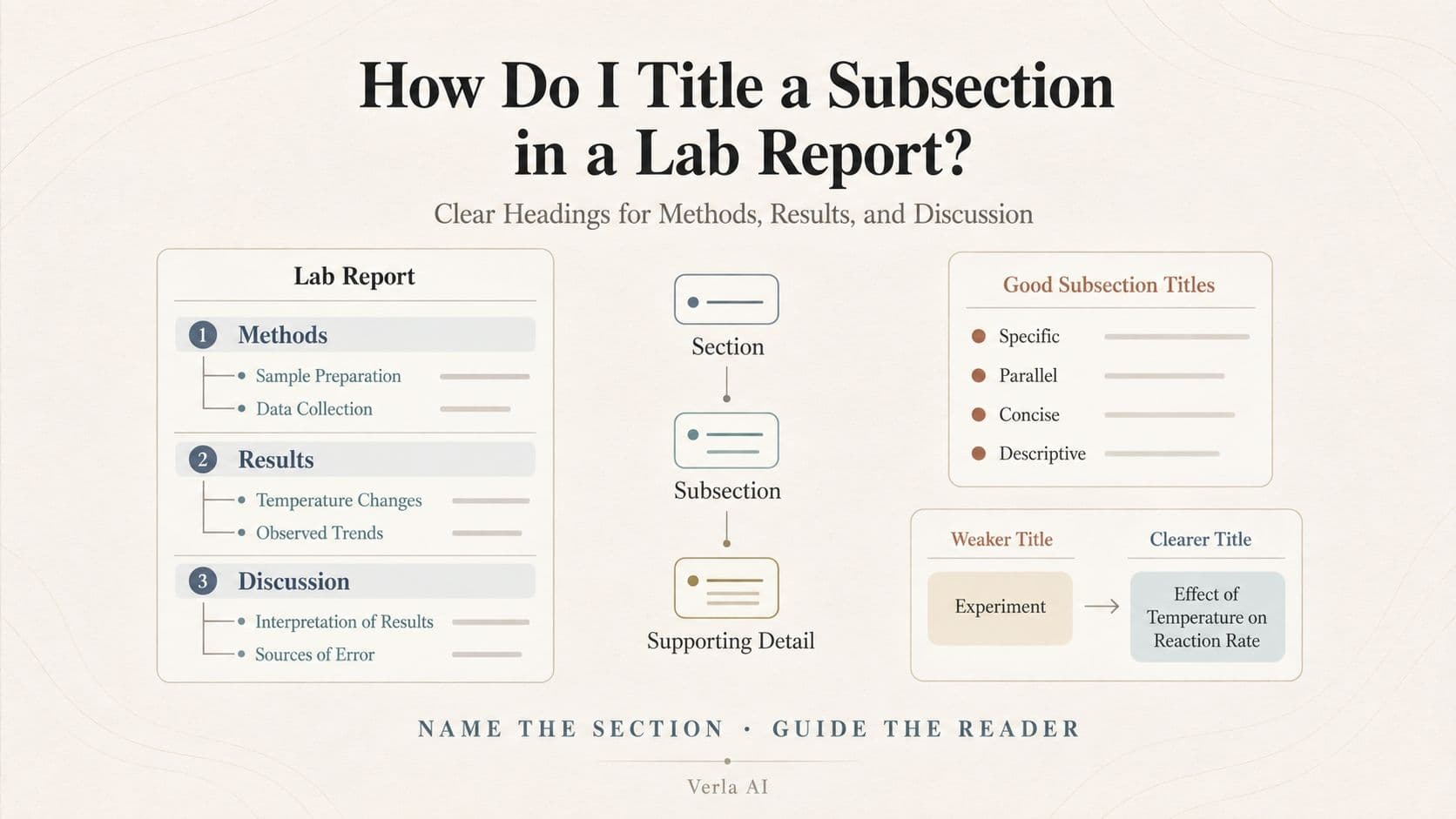
You have finished the experiment, organized the data, and started writing your Results section. Then a surprisingly small decision stops you: what should the subsection be called?
“Experiment 1” feels vague. “Temperature” feels unfinished. “The Effect of Temperature on Catalase Activity” sounds better—but should it describe the topic or reveal the result?
A useful subsection title does more than divide a page. It lets someone scanning your report understand what was tested, measured, or interpreted before reading the paragraphs underneath. The wording will change depending on whether the subsection belongs to Methods, Results, or Discussion, but the underlying rule remains simple: name the scientific content, not merely its position in the report.
TL;DR
Give a lab report subsection a short, descriptive title that tells the reader what specific procedure, variable, experiment, result, or interpretation appears below it.
For example, under Methods, you might use Temperature Treatment Conditions. Under Results, the related subsection could be Catalase Activity Across Temperature Conditions.
Follow your instructor's template or rubric first. If no format is specified, use a consistent heading hierarchy throughout the report. In an APA-style paper, a subsection beneath a Level 1 section heading will usually use a Level 2 heading: flush left, bold, and in title case.
First, Is It a Section or a Subsection?
Imagine a student named Maya writing about an experiment on how temperature and pH affect catalase activity. Her report already contains the familiar major sections:
Introduction
Methods
Results
Discussion
These are section headings. They tell readers what each part of the report does. A subsection divides one of those sections into smaller scientific topics:
Results
Catalase Activity Across Temperature Conditions
Catalase Activity Under Different pH Conditions
A helpful way to remember the distinction is:
Main headings tell readers what the section does. Subsection titles tell them what this particular part is about.
Not every science assignment follows the same structure. If the instructions ask you to make a claim and support it with evidence and reasoning, first confirm when your instructor expects CER instead of a full lab report . Similarly, the recommendations in this guide are intended for experimental reports; how the structure changes in a research paper is a separate question.
Your course requirements take priority over any general rule. The University of Minnesota's lab report guide notes that format and style can vary by discipline, course, and instructor. If your rubric provides required headings, preserve them even when another style guide presents a different arrangement.
Replace “Experiment 1” With a Title That Says Something
Maya initially divides her Results section like this:
Experiment 1
Experiment 2
Other Results
The labels show where one part ends and another begins, but they do not help the reader anticipate what is coming. Someone looking for the pH data would still need to read every paragraph.
She revises them to:
Catalase Activity Across Temperature Conditions
Catalase Activity Under Different pH Conditions
Variation Between Experimental Trials
Now the structure communicates information. A reader can immediately locate the temperature results, the pH results, or the discussion of variation.
This does not mean that “Experiment 1” is always unacceptable. If the lab manual itself divides the assignment into numbered experiments, retaining those numbers may help your instructor follow the report. Add a descriptive phrase instead of leaving the number alone:
Experiment 1: Effect of Temperature on Catalase Activity
A strong subsection title will usually name one or more of the following:
The procedure or technique used
The sample, treatment, or experimental condition
The variable or relationship being examined
The result or interpretation discussed below
Avoid placeholders such as Additional Results, More Information, or Part A unless those labels come directly from the assignment. They describe the document's arrangement rather than its scientific content.
MIT's journal article guidelines make a similar recommendation for Methods sections: instead of relying on generic labels such as “Apparatus” and “Method,” writers should choose subheadings that reflect the particular technical or intellectual approach used in the study. The subsection should be specific to the experiment , not reusable in almost any report.
The Same Experiment May Need Different Titles in Each Section
Maya's temperature experiment appears in Methods, Results, and Discussion. It would be easy to use Effect of Temperature three times, but each section is doing different work.
In Methods, the title should help readers find how the conditions were created:
Temperature Treatment Conditions
In Results, it should identify the measurement or comparison being reported:
Catalase Activity Across Temperature Conditions
In Discussion, it can introduce the finding that needs to be interpreted:
Interpreting the Decline in Activity at Higher Temperatures
The titles are related, so the reader can follow the experiment through the report. They are not identical, because they reflect the purpose of each section.
Methods subsection titles commonly name a process, sample, instrument, or analytical procedure. Examples include Sample Preparation, Spectrophotometric Measurement, Temperature Treatments, and Statistical Analysis.
Results titles usually identify the variable, comparison, or major group of findings. Effect of Light Intensity on Oxygen Production is more useful than Graph 1, while Comparison of Treated and Control Samples tells readers what relationship the data will show.
Discussion titles can focus on the scientific question raised by the results: Possible Enzyme Denaturation at High Temperatures, Why the Control Group Produced an Unexpected Response, or Sources of Variation Between Trials. Keep the language appropriately cautious. If the experiment does not establish a cause, do not turn a possible explanation into a definite claim in the heading.
The Methods and Results subsections should generally follow a compatible order so readers can connect what was done with what was found. However, the titles do not have to match word for word. The MIT Communication Lab explains that one Results subsection may depend on several Methods subsections, while a single method may produce several groups of results.
How Should a Lab Report Subsection Be Formatted?
There is no universal format that overrides your assignment. Check the instructions in this order:
The template supplied by your instructor
The assignment rubric
The required academic or journal style
A consistent default format if no guidance is provided
If your report uses APA 7, its heading levels communicate hierarchy. Level 1 headings are centered, bold, and in title case. Level 2 headings are flush left, bold, and in title case. Level 3 headings are flush left, bold italic, and in title case. The text begins as a new paragraph after each of these headings. The Monmouth University APA 7 heading guide provides examples of all five levels.
In a straightforward APA-style report, the hierarchy might appear like this:
Results
Catalase Activity Across Temperature Conditions
Paragraph begins here.
Do not choose a different style for every subsection. If one first-level subsection is bold and left-aligned, the other subsections at the same level should look the same.
Numbering is usually unnecessary in a short undergraduate lab report unless the template requires it. A longer engineering or technical report may use headings such as 2.1 Sample Preparation and 2.2 Measurement Procedure. If you number headings, apply the system consistently rather than switching between numbered and unnumbered titles. North Dakota State University's heading guidelines emphasize consistency across headings at the same level.
When You Do Not Need a Subsection
Maya considers adding Equipment Calibration under Methods. The heading would contain only two sentences explaining that the spectrophotometer was calibrated before measurements began.
In this case, a separate subsection may make the report feel more fragmented rather than more organized. She can include those sentences in Spectrophotometric Measurement instead.
Subsections are most useful when they separate distinct experiments, procedures, variables, groups of findings, or areas of interpretation. They are less useful when they interrupt a short section or leave a heading stranded above a few lines of text.
Before adding one, ask:
Would a reader want to locate this material independently?
Does it form a meaningful unit within the parent section?
Is there enough content to justify visually separating it?
If the answer is no, a clear transition sentence may work better than another heading.
The opposite problem also occurs. A Results section that moves from temperature data to pH data and then to error analysis without any signposts forces readers to discover the structure for themselves. Subsections should appear where the scientific focus changes—not at a predetermined number of paragraphs.
Choose the Title From What the Subsection Actually Does
If you cannot name a subsection, the problem may not be the title. The paragraphs underneath it may contain several unrelated ideas.
Read the subsection and complete this sentence:
This part of the report explains, measures, compares, or interprets ______.
Your answer is usually close to the title.
If the paragraphs explain how three temperature conditions were created, Temperature Treatment Conditions works. If they compare reaction rates across those conditions, use Catalase Activity Across Temperature Conditions. If they explain why activity fell at 60°C, Interpreting Reduced Activity at 60°C is more accurate.
This is also where Verla becomes useful. A generic heading generator only sees a sentence or keyword. Verla can work from the actual assignment instructions, rubric, observations, data, and draft. Its Lab Report Generator can help organize those materials into the required hierarchy and suggest titles that correspond to what each subsection really contains.
If you have not yet built the main sections of your report, start with How to Write a Lab Report before deciding where subsections belong. Always compare the resulting structure with the original rubric and keep any headings your instructor explicitly requires.
A good subsection title should make the page easier to understand before the reader reaches the first sentence. Name the method, variable, comparison, or interpretation clearly, format headings at the same level consistently, and let the actual content—not a generic template—determine where each subsection begins.
Still staring at “Experiment 1” and wondering what to call it? Upload your lab instructions, rubric, data, and current draft to Verla to turn the material you already have into a clearer report structure.