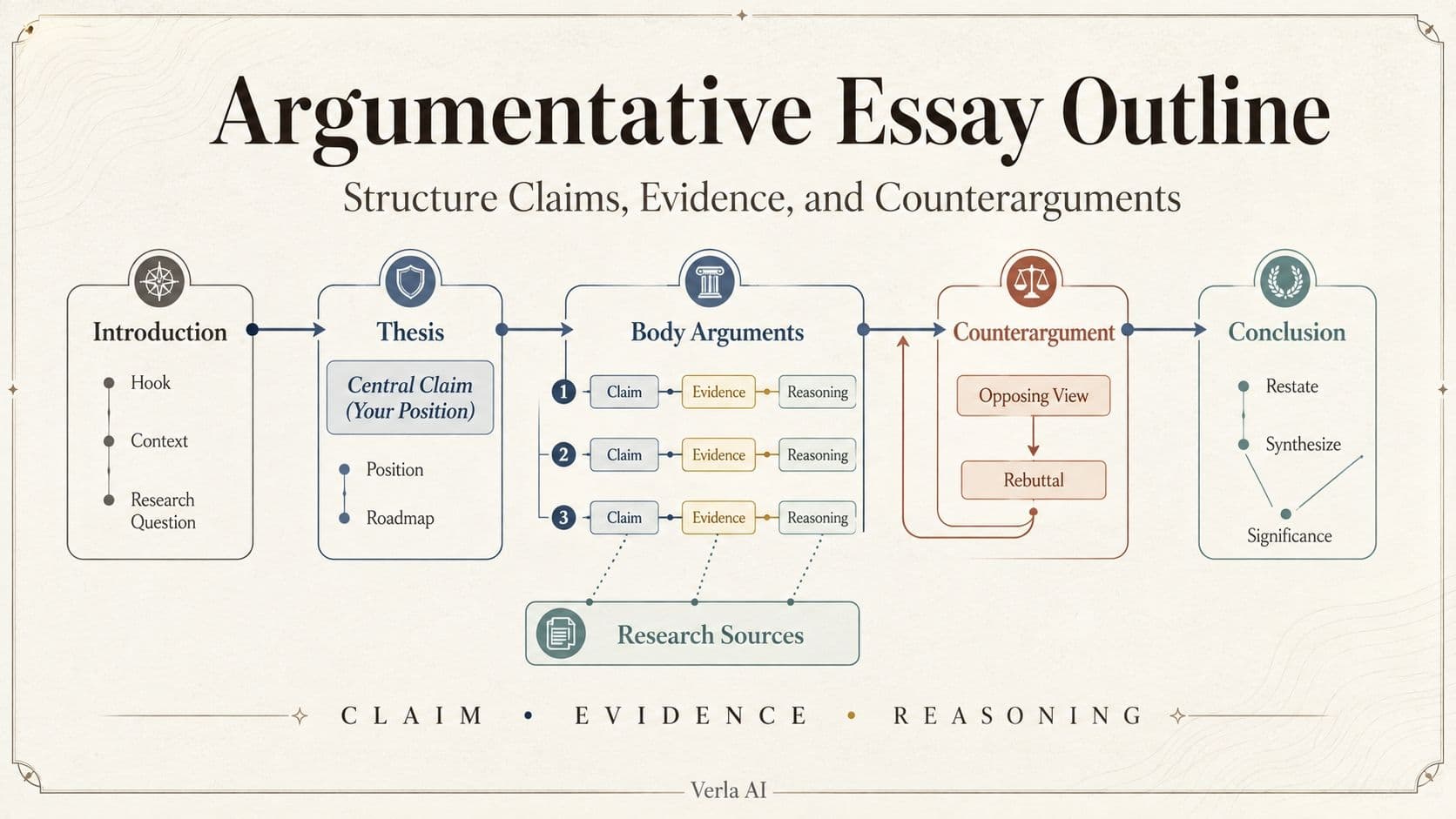
Jordan's argumentative essay outline looked complete. There was an introduction, three body sections, and a conclusion. Five academic sources for the research paper were waiting in a separate document. Technically, everything had a place.
The problem was that none of those places had a purpose.
“Body Section 1: Attendance” did not say what the section needed to establish. “Body Section 2: Student freedom” did not explain how the idea supported the thesis. The sources would probably be added later, wherever a paragraph looked short.
A useful argumentative essay outline is not a table of contents written early. In a research paper, it is a test of the argument's logic: what position you are defending, what each section must contribute, which evidence supports each claim, and where the reasoning is still weak.
Once those decisions are visible, drafting becomes less about filling pages and more about following a plan.
TL;DR: What Goes in an Argumentative Essay Outline?
An argumentative essay outline should show the route from the research question to the position the paper ultimately defends. It normally includes a working thesis, the claims needed to support it, planned evidence, reasoning, a serious counterargument, and the larger implication of the conclusion.
The outline does not need to look polished. It can contain sentence fragments, source names, questions, and notes such as “need evidence here.” Its job is to reveal missing logic before you build paragraphs around it.
The exact structure depends on the assignment. An argumentative research paper is usually organized around claims and counterarguments, while an empirical paper may follow Introduction, Methods, Results, and Discussion. If you need help with the full process rather than the outline alone, see How to Write a Research Paper .
Read the Research Paper Assignment Before You Outline
Jordan's prompt says:
Write a 1,500-word argumentative research paper evaluating whether universities should require attendance in large lecture courses. Use at least five academic sources, consider competing perspectives, and recommend a policy.
Jordan's first impulse is to plan an introduction and search for a hook about students skipping class. But the prompt contains more important instructions. The paper must evaluate a policy, use academic evidence, consider more than one perspective, and finish with a recommendation.
An outline that forgets the competing perspective could still look tidy while failing the assignment.
Before creating headings, mark the task verbs: evaluate, compare, analyze, explain, or recommend. Then identify the boundaries—the population, setting, period, source requirements, and word count. These details determine what the paper must make room for.
Also confirm which kind of paper you have been assigned. A research paper develops an answer through sources, analysis, or original research. A lab report records and interprets an experiment through sections such as Methods and Results. Reviewing how a lab report differs from a research paper can prevent you from forcing the wrong structure onto the task.
Only after the assignment is clear should you decide what comes first, second, and third.
Write a Working Thesis Before Naming the Sections
An outline needs a destination. Without one, the body becomes a collection of related facts.
Jordan's first answer is:
Universities should not require attendance because students are adults.
This takes a position but does not give the argument much room to think. Being an adult does not settle whether a university may set course requirements. The statement also ignores evidence that attendance can support participation or help instructors identify struggling students.
After reviewing the early research, Jordan writes a more useful working thesis:
Universities should replace blanket attendance requirements in large lectures with course-specific participation policies because physical presence is an imperfect measure of learning, uniform rules affect students unequally, and instructors can assess engagement more directly.
The thesis now identifies the proposed policy and the three ideas the paper must investigate. A thoughtful reader could still disagree, which matters: Purdue OWL notes that an argumentative thesis must be debatable .
“Working” is important. Research may reveal that the claim needs to be narrower or that practical courses require an exception. Change the thesis when the evidence changes. An outline is a model of your current thinking, not a contract.
Give Every Section a Job
Jordan's original body looks like this:
Section 1: Attendance
Section 2: Student freedom
Section 3: Online learning
These are topics, not analytical tasks. They do not tell Jordan what to do with the material.
A stronger version assigns each section a job:
Section 1 establishes why physical attendance is an imperfect measure of engagement.
Section 2 demonstrates how blanket requirements affect groups of students differently.
Section 3 evaluates alternatives that measure participation more directly.
Now Jordan can search and draft with a purpose. Instead of asking, “What can I say about attendance?” the question becomes, “What evidence would show whether attendance is a reliable measure of learning?”
An argumentative essay does not always need three equal body sections. One section might define a disputed concept; another might compare studies; a third might examine limitations or an alternative explanation. The Harvard College Writing Center recommends breaking a thesis into the points needed to support it effectively.
Use a simple removal test. If a section disappears and the thesis remains equally convincing, that section may be repeating another point or providing interesting background the paper does not need.
Match Evidence to Claims—and Explain the Connection
A source list is not yet an evidence plan. The outline should record what each source contributes and why it belongs in a particular section.
Jordan plans one section like this:
Claim: Blanket attendance requirements affect students unequally.
Evidence: Research on working students, commuters, students with disabilities, and caregivers; relevant university attendance policies.
Reasoning: The same penalty is not necessarily the same burden. A policy based on physical presence may measure schedule flexibility and health as much as engagement.
Limit: Some absences reduce learning, particularly in discussion-based or practical courses.
Link to thesis: This supports course-specific policies rather than removing all participation requirements.
The reasoning line does the most important work. Evidence does not interpret itself. The UNC Writing Center emphasizes that the strength of an argument depends on how evidence is used . A study showing that working students miss more classes would not automatically prove that an attendance policy is unfair. Jordan must explain the connection and consider other interpretations.
Planning this connection prevents the argumentative research paper from becoming a stack of quotations. It also exposes gaps. Three sources cannot rescue a section with no clear claim; a strong claim with no credible support shows Jordan exactly what to research next.
When the prompt, rubric, notes, and PDFs are scattered across different files, a research paper generator can help group evidence under possible claims and identify unsupported sections. Use the resulting plan as something to inspect and revise. Never include a quotation, statistic, or citation without checking it against the original source.
Plan for Counterarguments and Alternative Explanations
Jordan initially writes:
Some people support mandatory attendance because skipping class is bad.
That is easy to dismiss because it is not the strongest opposing view. A serious counterargument is that attendance may improve performance, build routine, and help instructors identify disengagement early.
Harvard's Writing Center describes a counterargument as a reasonable challenge to the thesis or its supporting claims. Addressing it is not a formality. It tests whether the conclusion remains persuasive after a fair comparison.
Jordan can concede that attendance matters in seminars, laboratories, clinical training, and courses built around collaboration. The response is not “attendance never matters.” It is that this evidence supports targeted requirements rather than one rule for every large lecture.
In an argumentative essay outline, the challenge may appear as a counterargument, conflicting study, methodological limitation, or evidence that does not fit the preferred interpretation. Place it beside the claim it affects rather than automatically saving it for the final body paragraph.
A Complete Argumentative Essay Outline for a Research Paper
Here is Jordan's revised sentence outline. It is detailed enough to guide the draft without pretending the paragraphs have already been written.
I. Introduction: Define the Policy Problem
Establish the tension: attendance may support learning, but physical presence is not identical to engagement.
Limit the paper to large lecture courses rather than laboratories, seminars, or clinical instruction.
Working thesis: Universities should replace blanket attendance requirements in large lectures with course-specific participation policies because physical presence is an imperfect measure of learning, uniform rules affect students unequally, and instructors can assess engagement more directly.
II. Attendance Is an Imperfect Measure of Learning
Job: Separate visible presence from meaningful engagement.
Evidence: Research examining attendance and academic performance; course policies that grade attendance.
Analysis: An association between attendance and performance does not prove that recording presence is the best assessment method. Motivation, prior achievement, and course design may influence both.
Transition: If attendance is indirect, the paper must examine whom the policy measures most harshly.
III. Uniform Rules Create Unequal Consequences
Job: Show why the same rule can create different burdens.
Evidence: Studies of working and commuting students; accessibility guidance; institutional absence policies.
Analysis: A blanket rule may reward schedule flexibility as much as learning.
Boundary: The claim concerns policy design, not whether every absence is unavoidable.
IV. Course-Specific Participation Offers an Alternative
Job: Propose a workable replacement rather than merely criticizing attendance rules.
Evidence: Research on active learning and examples such as low-stakes quizzes, discussions, problem-solving activities, and brief reflections.
Analysis: These methods connect assessment to a learning activity more directly than a seat check, although the best option depends on course design.
Recommendation: Let instructors justify participation requirements at course level and provide accessible alternatives when appropriate.
V. Counterargument and Response
Counterargument: Regular attendance can improve performance, establish routine, and reveal disengagement.
Concession: These benefits matter most where students must participate in the learning activity.
Response: They justify targeted requirements, not a universal mandate for every lecture.
VI. Conclusion: Explain What the Evidence Changes
Restate the position in light of the analysis rather than repeating the thesis word for word.
Emphasize the implication: universities should assess meaningful participation instead of relying on the easiest behavior to count.
End with the course-specific policy recommendation.
Before drafting, Jordan reads the outline like a skeptical reader. Does every promise in the thesis have a section? Does each section contain evidence and analysis? Does the proposed alternative answer the strongest objection?
One gap remains: the outline needs credible evidence that alternative participation methods can work in large lectures. Finding that gap now is much cheaper than discovering it after writing 800 words. Jordan also checks the order: the paper questions the measure, explains its consequences, and then offers a replacement. Each section arrives when the reader needs it.
An argumentative essay outline will not make difficult decisions disappear. It puts them where you can see them. Bring your research paper prompt, rubric, notes, and sources into Verla, then build a plan that shows what each section must establish—and where the argument still needs work.