Question
Angela and Carlos are asked to determine the relationship between the normal force on a box of mass and the incline angle while the box rests on the incline.
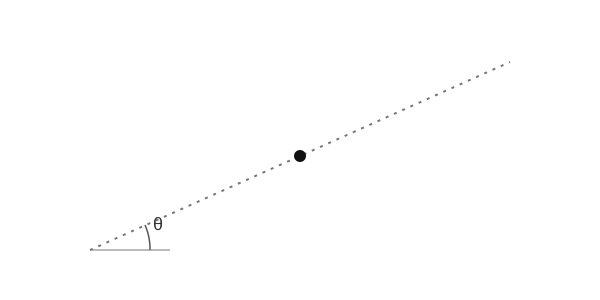
A. Draw a free-body diagram at the dot. Label the forces, not their components; each force needs a distinct outward arrow whose length reflects its magnitude.
B. Begin with and derive in terms of , and constants, explaining each step.
| Normal force (N) | Incline angle (degrees) |
|---|---|
| 97 | 10 |
| 95 | 15 |
| 85 | 30 |
| 80 | 35 |
| 75 | 40 |
| 63 | 50 |
| 49 | 60 |
C. From the equation in B, what should be plotted to make a linearized graph? D. What does that graph's slope mean physically?
This question has been answered.
Explore the full answer and supporting references to better understand this question.
$19.99/month
- Everything in Study Pass
- Assignments with writing output
- AI detection and humanizer
- Basic quotas across every tool
$0.99/month
- Entire question library
- Knowledge guides and sources
- Detailed answers and explanations
- No AI tools or quotas
Evidence boundary
The workbook gives no numerical mass or angle for Part A, so the force-arrow lengths can show only the relative magnitudes , , and ; the illustration uses one example angle. The seven force readings are experimental observations, not exact points on an error-free theoretical line. A numerical fitted slope depends on the fitting convention, although its physical meaning remains .