A literature review organizes research around ideas. It compares findings, examines differences in the evidence, and develops conclusions across multiple sources.
The example focuses on research into sleep and academic performance among university students. A section-by-section analysis follows, along with a comparison of weaker and more effective paragraphs. It also includes language that can be adapted to other research topics.
Key Takeaways
A literature review introduction defines the topic, scope, and focus.
Each body paragraph should connect several sources around one idea.
Effective synthesis explains where studies agree, reach different conclusions, or rely on different methods.
The conclusion states what the research collectively suggests and identifies remaining uncertainty.
Examples are useful for studying structure and technique. Their wording should not be copied into another assignment.
Literature Review Example at a Glance
This sample uses a thematic structure to examine the question:
How are sleep duration and sleep quality related to academic performance among university students?
Full Literature Review Example
Sleep and academic performance among university students
University students commonly experience insufficient or inconsistent sleep, which may affect processes such as learning, memory, and concentration. Research has examined whether academic outcomes are associated with sleep duration and quality, as well as sleep-related disorders. This review considers evidence from objective tracking and self-reported measures to assess which aspects of sleep are most closely related to academic performance.
Studies using wearable devices point to the importance of regular sleep patterns. Creswell et al. (2023) tracked first-year students across five studies at three universities and found that longer average nightly sleep early in the semester predicted a higher end-of-term grade point average. Okano et al. (2019) likewise associated better sleep quality, longer duration, and greater consistency with stronger academic performance among college students. Sleep on the night immediately before an examination was not related to test results. The findings indicate that established sleep habits have a closer relationship with performance than sleeping longer just before an assessment.
Studies with larger samples report a broadly similar relationship, although they rely more heavily on self-reported sleep. Gaultney (2010) found that students at risk for sleep disorders were overrepresented among those in academic jeopardy. Lemma et al. (2014) also associated better sleep quality with stronger academic performance among Ethiopian university students. These results extend across different student populations, but variations in location, academic systems, and measurement methods make direct comparison difficult.
The evidence remains associational and does not establish a simple causal relationship. Academic stress may reduce sleep while also affecting grades. Students with more consistent routines may manage both sleep and coursework more effectively. Methodological differences create another limitation. Objective tracking provides more precise data but has often involved smaller samples, while larger studies frequently depend on participants reporting their own sleep accurately. Research that combines objective measurement with experimental interventions would help determine whether improving sleep directly improves academic outcomes.
Across these studies, longer, better-quality, and more consistent sleep is generally associated with stronger academic performance. Regular sleep patterns appear more relevant than sleep on a single night. Study design and the influence of stress, workload, and daily routines nevertheless show that sleep is one of several connected factors affecting student achievement.
References
Creswell, J. D., et al. (2023). Nightly sleep duration predicts grade point average in the first year of college . Proceedings of the National Academy of Sciences, 120(8), e2209123120.
Gaultney, J. F. (2010). The prevalence of sleep disorders in college students: Impact on academic performance . Journal of American College Health, 59(2), 91–97.
Lemma, S., Berhane, Y., Worku, A., Gelaye, B., & Williams, M. A. (2014). Good quality sleep is associated with better academic performance among university students in Ethiopia . Sleep and Breathing, 18(2), 257–263.
Okano, K., Kaczmarzyk, J. R., Dave, N., Gabrieli, J. D. E., & Grossman, J. C. (2019). Sleep quality, duration, and consistency are associated with better academic performance in college students . npj Science of Learning, 4, 16.
How the Example Is Structured
The introduction establishes the broader issue, specifies which aspects of sleep the review will examine, and limits the scope to university students and academic performance. Individual studies appear only after that framework is clear.
The first body paragraph brings together two studies based on objective sleep measurements and draws a conclusion from their findings. The second considers evidence from broader student populations, with attention to differences in context and measurement. The third assesses the limits of the evidence, particularly the distinction between association and causation.
The conclusion answers the research question by stating what literature collectively suggests. It adds no new studies and does not repeat the preceding discussion point by point.
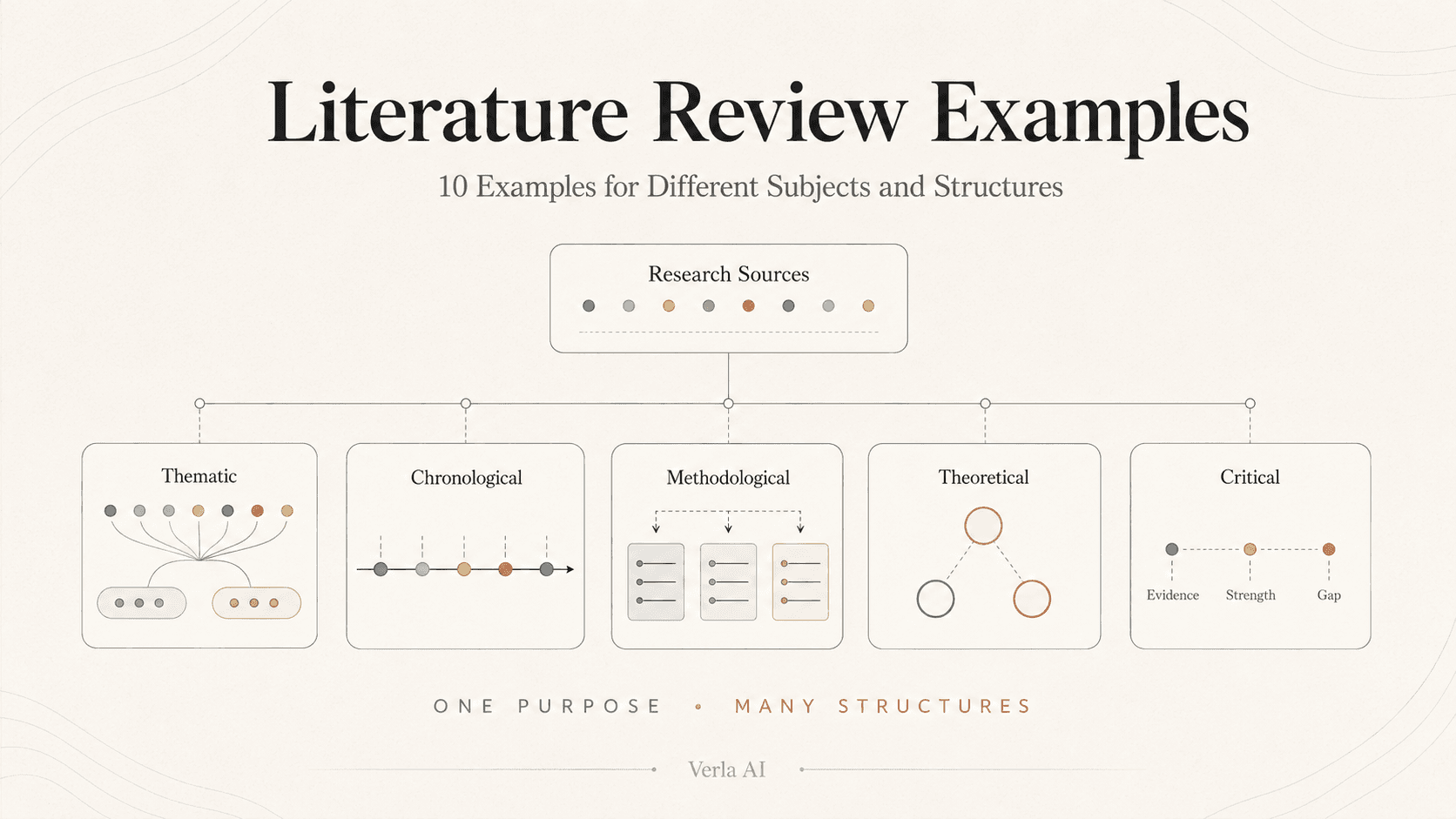
Other collections of sources may require a different structure. Literature reviews can be organized thematically, chronologically, methodologically, or theoretically. Our guide to what a literature review is provides a fuller explanation of these approaches.
Weak and Effective Literature Review Paragraphs
A weak paragraph often reports findings without establishing a relationship among them:
Creswell et al. (2023) found that longer sleep predicted a higher GPA. Okano et al. (2019) found that sleep quality, duration, and consistency were associated with better grades. Gaultney (2010) studied sleep disorders and academic performance.
All three statements are relevant, but their combined significance remains unexplained.
An effective paragraph makes the relationship explicit:
Existing research consistently associates healthier sleep patterns with stronger academic outcomes, although studies define and measure sleep differently. Objective tracking studies emphasize duration and consistency, while broader survey research suggests that sleep quality and the risk of sleep disorders may also be important. Together, these findings indicate that academic performance is related to several dimensions of sleep rather than total sleep time alone.
The revised paragraph begins with a conclusion drawn from several studies. It then groups evidence by measurement approach, accounts for a methodological difference, and ends with an interpretation of the combined findings.
When notes remain organized as separate source summaries, Verla's Literature Review Generator can help locate recurring findings, disagreements, and possible themes in the provided materials. Verify every suggested claim and citation against the original research.
Useful Phrases for Synthesizing Sources
Use transitions to make relationships between studies visible.
Transitions should express a real relationship. Adding "however" does not create synthesis unless the following evidence genuinely contrasts with the previous point.
How to Use a Literature Review Example
Focus first on what each paragraph accomplishes. The wording matters less than the underlying structure. When reviewing an example, ask:
What claim does the topic sentence establish?
Which sources support that claim?
Do the studies agree, conflict, or examine different parts of the question?
Where does the paragraph shift from reporting evidence to interpreting it?
Does the writer identify a limitation or gap in the research?
These questions provide a framework for organizing your own material. The final structure should reflect the requirements of the assignment and discipline, as well as the evidence available for your research question.
Keep the distinction between a literature review and a source-by-source annotated bibliography in mind. If the assignment format remains unclear, consult our comparison of an annotated bibliography and a literature review .
A literature review example is most useful when it reveals how the writing is organized. Study the progression from the paragraph's main claim through its evidence to its interpretation, then apply that approach to your own sources.