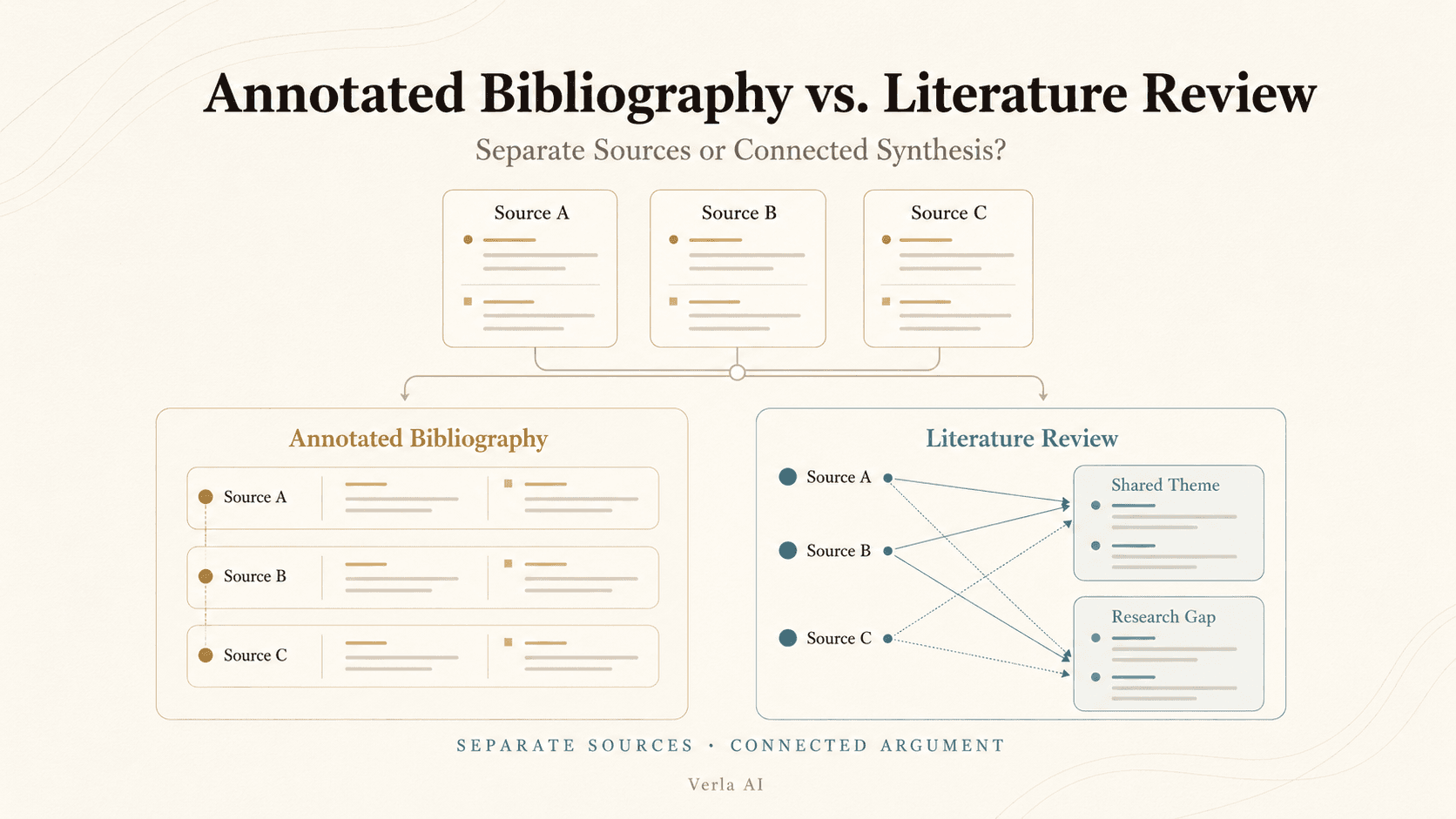
An annotated bibliography discusses each source separately. A literature review examines several sources together to determine what the research collectively shows. Both involve finding, summarizing, and evaluating academic material, but they present that work in different ways.
The same journal articles, books, and reports may appear in either assignment. What changes is the purpose of the analysis. In an annotated bibliography, each source receives its own summary and evaluation. In a literature review, sources are placed in relation to one another so that shared themes, disagreements, and gaps become clear.
This guide explains the distinction by showing how the same three sources would be handled in each format.
Key Takeaways
An annotated bibliography presents each citation with a summary and evaluation of that source.
A literature review combines evidence from multiple sources into a connected discussion.
Annotated bibliographies are usually arranged by source. Literature reviews are structured around themes, methods, debates, or developments.
Both require credible evidence, accurate citations, and critical evaluation.
Requirements differ by subject and instructor. Follow the instructions for your assignment.
Annotated Bibliography vs. Literature Review: Quick Comparison
An annotated bibliography treats each source as a separate unit. A literature review organizes multiple sources around the relationships among their findings.
The UNT Dallas Learning Commons compares the assignments through their definitions, purposes, structures, and writing processes. Of these differences, source organization is usually the easiest to recognize on the page.
What Is an Annotated Bibliography?
An annotated bibliography is an organized list of sources, with each citation followed by a short paragraph called an annotation.
A typical entry contains:
A complete citation in the required style
A summary of the source's main argument or findings
An assessment of its credibility, methods, or limitations
An explanation of its relevance to the research topic
Annotations are often about 150 words, but their length and content vary by assignment. Some instructors require only a summary. Others also ask for evaluation and personal reflection.
Writers often prepare annotated bibliographies early in the research process. Recording the contribution of each source makes it easier to review the available material before developing a broader argument. According to the ATLAS.ti guide, this process may also reveal themes, trends, and gaps in the research.
Entries are generally arranged alphabetically by the first author's surname. An instructor may require a chronological or thematic structure instead, so the assignment instructions should determine the final arrangement.
What Is a Literature Review?
A literature review examines research on a focused topic or question as a connected body of evidence. It summarizes relevant studies, compares their findings, assesses the available evidence, and explains what remains uncertain.
Most literature reviews have three parts:
An introduction defining the topic and scope
A body structured around themes, methods, theories, or developments
A conclusion describing the overall state of the research
Sources do not usually receive separate sections. A study may appear in more than one paragraph if it contributes to different themes. Several studies may also be cited in the same sentence when they support or challenge the same point.
The aim is to give readers a clear account of the research as a whole. Our guide to what a literature review is provides a fuller explanation of synthesis and structure.
The Main Difference: Individual Sources or Synthesis
Both assignments involve summary and evaluation, but they apply those tasks differently.
An annotated bibliography considers each source separately:
What does this source say, and how useful or reliable is it?
A literature review considers the relationship among sources:
What do these sources show when they are examined together?
The University of North Alabama comparison guide describes this as a move from separate entries to sources integrated throughout paragraphs.
This integration requires synthesis. Instead of discussing Source A, Source B, and Source C one after another, the writer groups evidence according to agreement, disagreement, methodology, or another meaningful relationship.
Example: Turning Three Annotations into a Literature Review Paragraph
Consider this research question:
How does nighttime smartphone use affect sleep among university students?
Assume that the review draws on three studies.
Annotated bibliography approach
Study A
A survey of university students found that frequent nighttime smartphone use was associated with shorter sleep. Its observational design could not establish whether phone use caused the difference.
Study B
An experiment asked participants to avoid smartphones before bed. Participants reported better sleep, but the sample was small and the study lasted only two weeks.
Study C
This study found no clear relationship between total smartphone use and sleep after accounting for stress and work schedules. Unlike the other studies, it measured overall daily use rather than use immediately before bedtime.
Each annotation records one study's finding and limitation. The studies remain separate, even when they address the same research question.
Literature review approach
A literature review connects the evidence:
The relationship between smartphone use and student sleep may depend more on timing and context than on total screen time. A survey associated frequent nighttime use with shorter sleep, and a small experiment found that participants who avoided smartphones before bed reported better sleep. By contrast, a third study found no relationship after accounting for stress and work schedules. The studies measured smartphone use differently. The first two focused on behavior around bedtime, while the third measured total daily use. Future research should distinguish between general smartphone use and use immediately before sleep.
The paragraph compares the findings and explains how differences in method may account for the disagreement. Its conclusion comes from examining the studies together rather than summarizing each one in isolation.
When existing notes do not make these connections clear, Verla's Literature Review Generator can help group sources by recurring themes or disagreements and suggest ways to structure the evidence. Verify each interpretation and citation against the original source.
When Should You Use Each Format?
The assignment prompt will usually specify whether you need an annotated bibliography or a literature review. Particular instructions can help identify the expected format:
Use an annotated bibliography when the purpose is to document your research process or evaluate sources individually. A literature review is appropriate when the assignment asks you to explain the current state of knowledge or establish a research context for a paper, thesis, or dissertation.
When the prompt is ambiguous, Verla Assignment can help identify the required deliverable, structure, and grading criteria from the prompt and rubric. Requirements that differ from standard practice should still be confirmed with the instructor.
When a literature review paragraph still resembles a list of summaries, Verla's AI Refiner can help revise the transitions, flow, and academic tone. Check every quotation, finding, and citation before submission.
An annotated bibliography records the contribution of each source. A literature review explains what the evidence shows when the sources are examined together. That distinction should determine the structure of the assignment.