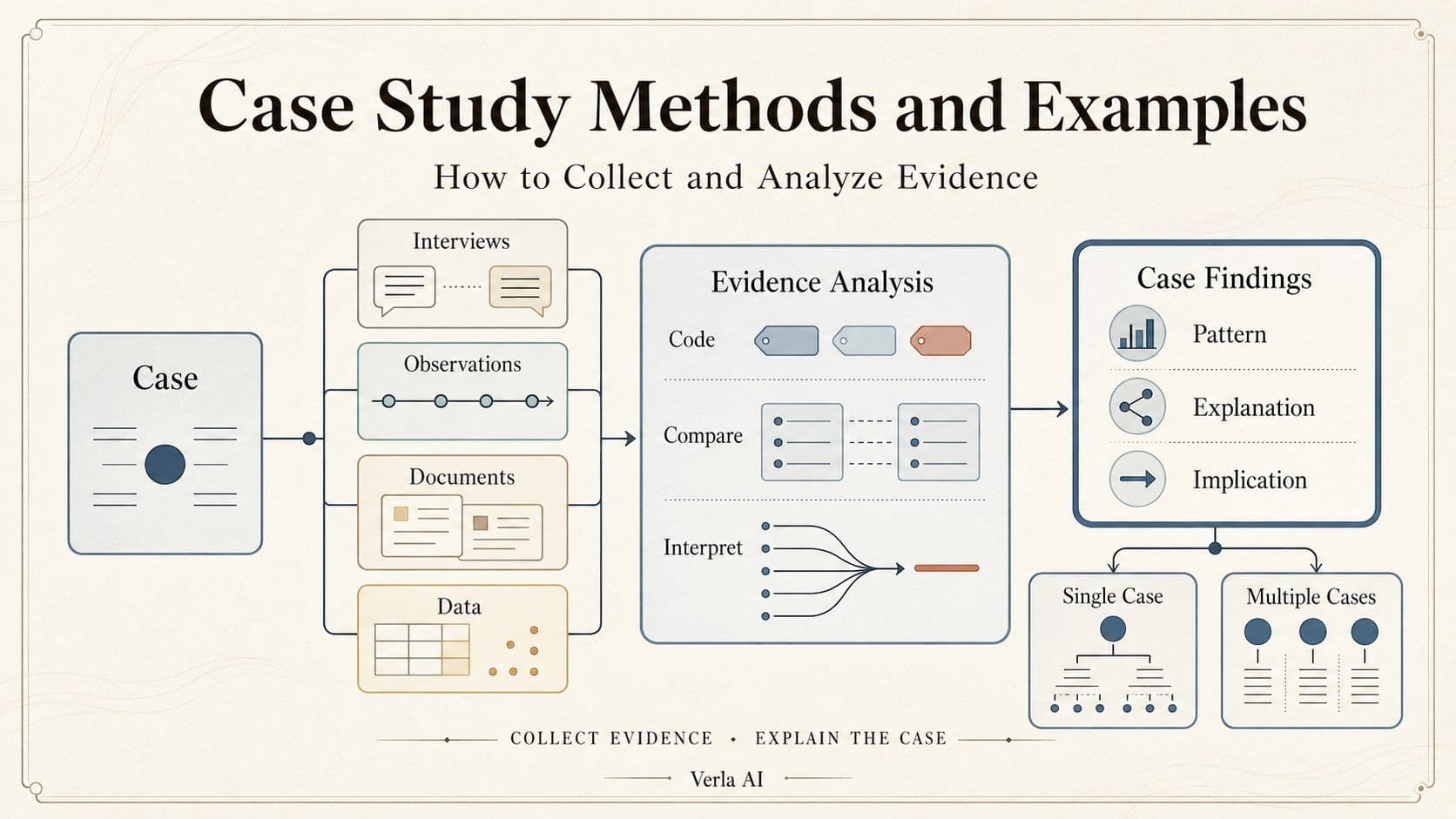
Leah had eight interview transcripts, an attendance spreadsheet, three program documents, and pages of observation notes. Her case study looked well researched.
Then her supervisor asked: “What does each source allow you to conclude?”
The spreadsheet showed when participation dropped, but not why. Students could explain why they stopped attending, but memory might shape their answers. Program documents described how the mentoring scheme was supposed to work, not necessarily what happened in the room.
That is the real challenge of case study research. Interviews, observations, documents, records, and surveys are not interchangeable ways to collect “more data.” Each reveals one part of the case and leaves another hidden. A strong design chooses them deliberately, then compares what they show, what they miss, and where they disagree.
This guide follows one fictional university project from a broad question to a usable evidence plan.
TL;DR: Choose Methods Based on What You Need to Know
There is no universal case study method. Interviews reveal how people interpret an experience. Observations show behavior in context. Documents preserve policies and decisions, while records and surveys show timing, frequency, and distribution.
Case study research commonly draws on more than one source . Before collecting data, define the case and its boundaries. Then write down what each method should contribute and what it cannot establish alone. This turns a pile of material into a defensible design.
If you are still deciding what a case study is and when it is useful , start there. This guide begins with the next decision: you have chosen a case study and now need an evidence plan.
Bound the Case Before Choosing Your Methods
Leah begins with a question that sounds promising:
Why do first-year students disengage from university support programs?
It is too broad. “First-year students” could mean thousands of people, while “support programs” might include tutoring, counseling, mentoring, or financial aid. Leah cannot decide whom to interview or which records to request because the case has no clear boundary.
She narrows it:
Why did participation in PeerStart, a first-year peer-mentoring program at the fictional Northbridge University, decline during Fall 2025?
The case is now one program at one university during one semester. It includes registered students, peer mentors, the coordinator, scheduled sessions, communications, and participation records. It excludes other support programs, later cohorts, and the larger question of whether mentoring improves university retention.
Research on defining and bounding cases treats this as a central design decision because the boundary determines what counts as evidence. A university-wide retention database may provide context, but it cannot directly explain what happened inside PeerStart. A 2026 policy revision falls outside the study period.
Leah writes four boundaries at the top of her plan: case, location, participants, and time period. She also records what is excluded, preventing the project from expanding whenever she finds something interesting.
If your assignment gives you a company, patient, or business scenario and asks for a solution, you may not be conducting original research. Check whether the assignment requires research or analysis of a provided case before designing interviews.
Interviews and Focus Groups: Understanding Experience
Leah first plans to interview students who stopped attending. They can explain how they experienced PeerStart, but interviewing only that group would build the study around one perspective. A stronger sample includes continuing participants, students who left, peer mentors, and the coordinator.
Semi-structured interviews let Leah ask everyone about scheduling, session content, communication, and expectations while following up on unexpected answers. If a student says the program began to feel like another lecture, Leah can ask what changed and when. That detail may guide an observation or document search.
Focus groups produce different evidence. Participants can react to one another and remember shared events, but the group setting may discourage discussion of sensitive experiences. Individual interviews are usually safer when questions involve health, finances, conflict, or academic difficulty.
Interview accounts also require interpretation. Participants may forget dates or explain past decisions through what they now believe. Questions can shape answers too. “How did the schedule affect attendance?” assumes the schedule mattered. “Walk me through how you decided whether to attend each week” leaves room for other explanations.
Leah therefore treats interviews as evidence of participants' meanings, expectations, and remembered decisions—not objective proof that events occurred exactly as described. She must also obtain appropriate consent, protect identifying details, and follow any institutional ethics requirements.
Observations: Seeing What Participants May Not Mention
Several interviewees say PeerStart sessions felt “too formal.” An observation can show what that means in practice.
Leah records who speaks, how seats are arranged, how long the mentor presents, whether students ask questions, and when people arrive or leave. She avoids writing only that a session was “engaging” or “awkward.” Those are conclusions; field notes should preserve the actions and context behind them.
Observation can reveal a gap between design and delivery. A mentor guide might promise small-group discussion while the session consists mostly of slides. Students may say they attend for social connection but leave before informal discussion begins. These differences do not prove anyone is dishonest. Participants may interpret the activity differently, or Leah may have observed an unusual week.
She therefore uses an observation guide connected to the research question and keeps reflective notes about her own role. Did participants behave differently because she was present? Was she more likely to notice disengagement after hearing about it in interviews?
Observation shows behavior more clearly than motivation. A student leaving early might be bored, unwell, or late for work. Leah needs another source before assigning a reason.
Documents and Records: Reconstructing Context and Decisions
PeerStart has an original proposal, mentor handbook, session calendar, promotional emails, slides, and meeting notes. These documents help Leah reconstruct what students were promised, what mentors were instructed to deliver, and how the program changed.
Because many documents were created before the research began, they are not distorted by later memory. They are still not neutral. A promotional page shows the version of PeerStart the university wanted students to see. Meeting minutes reflect what someone chose to record. A handbook may describe a procedure that was rarely followed.
Leah therefore asks who created each document, when, for whom, and for what purpose. She also compares its account with interviews and observations.
Administrative records such as registrations, weekly attendance, cancellations, and withdrawal dates help establish sequence. Attendance might decline gradually, or remain stable until the session time changes. Those patterns lead to different follow-up questions.
Records can be incomplete. A sign-in sheet does not show whether students stayed, and a missing entry may reflect poor record-keeping rather than a missed session. The aim is not to collect every file, but to select materials that answer the research question and document how each source was produced.
Surveys and Quantitative Data: Adding Pattern and Scale
Case studies are often associated with qualitative research, but a bounded case can include quantitative evidence when the numbers illuminate that case.
Weekly attendance can show the timing and size of PeerStart's decline. A short survey can estimate how often participants report schedule conflicts, unclear expectations, or dissatisfaction with content. Leah might compare commuters, campus residents, continuing participants, and students who left.
This adds something interviews cannot. If three interviewees mention transport problems, Leah knows the issue exists but not how widely it was experienced. A survey can show whether it appears across the respondent group. Conversely, if 40 percent select “schedule conflict,” the number does not explain which conflicts mattered or how students made decisions. Interviews provide that depth.
Numbers from one case should not become population-level claims. PeerStart may be well documented without representing every university program. Nonresponse also matters: students who disengaged completely may be least likely to answer the survey.
Using several sources is not automatically mixed methods. Mixed methods deliberately integrates qualitative and quantitative approaches . Attaching an attendance chart to an interview study without examining how they relate is addition, not integration.
Combining Methods: A Complete Case Study Example
Leah's design now includes several methods, but their number is not what makes it strong. Each must contribute to the same research question.
Leah first builds a timeline from attendance records, calendars, emails, and meeting notes. She then organizes interview and observation material around recurring ideas such as scheduling, expectations, session format, mentor contact, and belonging. Finally, she compares those themes with the timeline and survey patterns, including evidence that does not fit the leading explanation.
Suppose attendance falls sharply after sessions move from late afternoon to early evening. The change is announced only two days in advance, and several commuting students describe conflicts with transport and work. Mentors, however, believe students left because the sessions became more demanding.
Leah should not choose the most convenient story. She checks whether the decline was larger among commuters, whether continuing students also disliked the content, and whether observations show a format change. Scheduling might be the main barrier for one group while content mattered for another.
This comparison is often called triangulation. It does not mean forcing every source to agree. Methodological work on triangulation in case studies shows how different methods can deepen interpretation. Agreement can increase confidence; disagreement can reveal subgroup experiences, timing differences, or faulty assumptions.
The conclusion must remain proportional to the evidence. Leah may explain why participation changed in PeerStart during Fall 2025. She cannot conclude that evening mentoring programs cause disengagement everywhere.
Organization becomes difficult once the prompt, rubric, transcripts, program files, and research papers live in separate places. Upload them to Verla's Case Study Generator to group evidence around the research question, compare what each source contributes, and identify claims that still rely on one source. Verla can help build the evidence map, but it should not invent participants, findings, quotations, or citations.
Once the evidence is settled, the task changes from conducting the study to reporting it. This guide on turning your research into a well-structured case study covers that next stage.
A convincing case study is not the one with the most data. It is the one where readers can see why each source was chosen, how the sources relate, and where the evidence stops. Bring your prompt, notes, and sources into Verla and turn them into an evidence plan you can explain and defend.