The case is 18 pages long. It includes a timeline, interview excerpts, performance data, and several decisions that seem important. Your assignment asks for “critical analysis,” but your notes are crowded with facts and you still do not know what the paper should argue.
This is where many case studies go wrong. Students begin by writing the background because it feels easy. By the time they identify the real problem, most of the word count is gone.
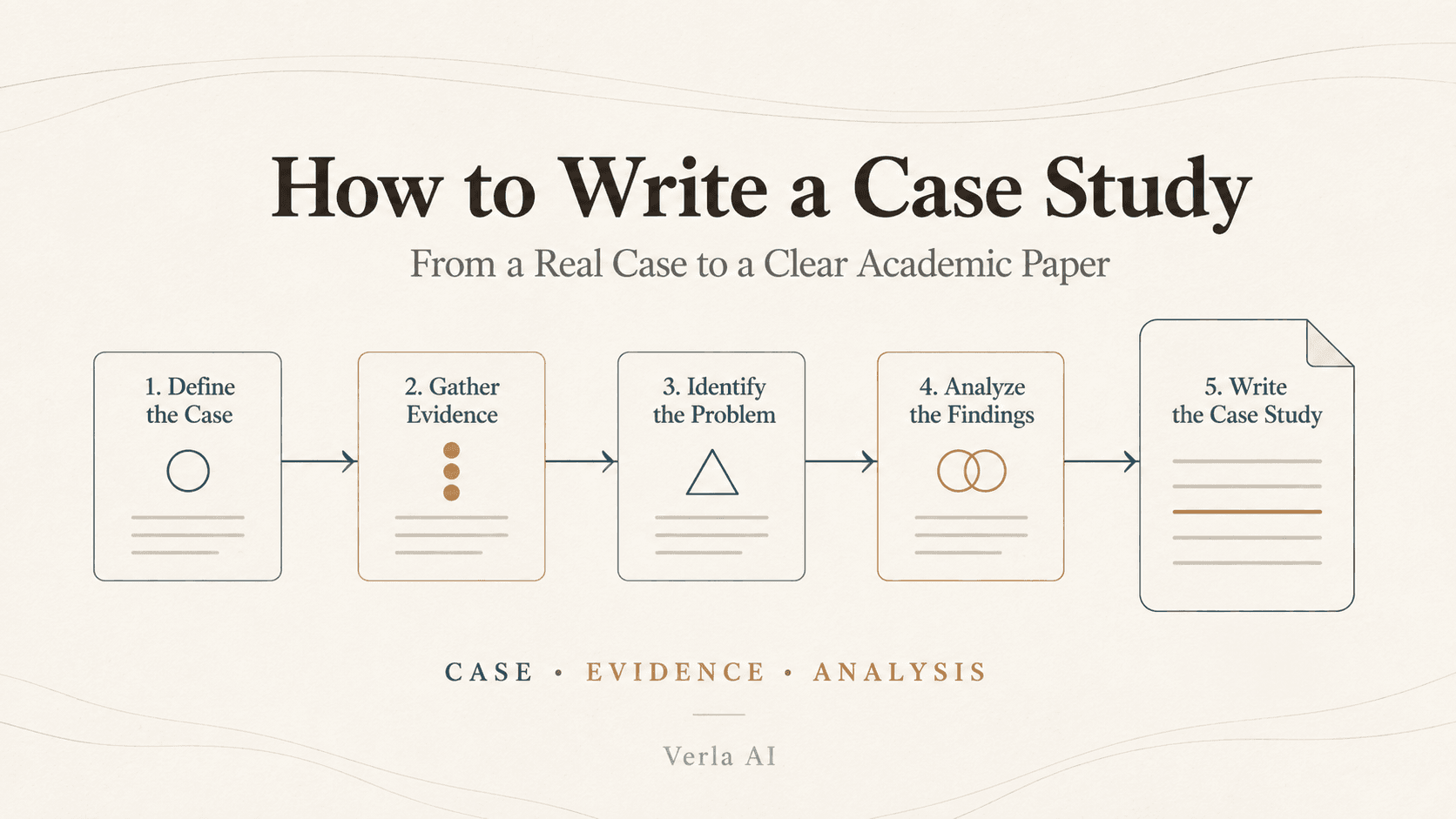
A stronger case study begins before the first paragraph: decide what task you have, find the issue connecting the evidence, and work out what that evidence allows you to conclude.
TL;DR
First determine whether you are analyzing a supplied case or researching an original one. For a typical university assignment, identify the central problem, separate relevant evidence from background detail, connect it to an appropriate theory, and build the paper around a supported interpretation. Recommendations should address the cause you identified—not merely its most visible symptom.
First, Find Out Which Case Study You Are Writing
“Write a case study” can describe two different tasks.
Your instructor may give you a company, patient, legal dispute, classroom, or project to examine. In that situation, the case already exists. Your job is to understand the material, answer the assigned question, apply course concepts, and reach a supported conclusion.
Alternatively, original case study research requires you to define a question, select a bounded case, gather evidence, explain the method, and discuss what the findings can and cannot show.
A student analyzing a supplied business case does not need to arrange interviews. A researcher developing an original case cannot rely only on an assignment packet.
Look at the verbs in the brief. “Analyze,” “evaluate,” “apply,” and “recommend” usually signal an analytical response to supplied material. “Investigate,” “collect,” “observe,” and “examine” may indicate original research. If the terminology is still unclear, the distinction is explained in more detail in Case Study vs. Case Analysis .
You can also upload the brief, rubric, and case materials to Verla’s case study generator to identify the required questions, permitted sources, expected format, and parts of the case that need attention before drafting.
Read the Case for a Different Reason Each Time
The first reading is for orientation. Who is involved? What changed? Which decision created tension? Do not stop every few lines to invent a solution; first understand the world of the case.
On the second reading, mark conflicting explanations, unusual results, missing information, and moments when someone could have acted differently. Declining sales, for example, may be an outcome; pricing, distribution, or a poorly timed decision may be the cause.
The third reading is selective. Which facts support your emerging explanation? Which complicate it? What course concept explains the relationship? A useful note records not only what happened but why it may matter.
Imagine Lakeside University extended its tutoring center’s hours. Attendance increased by 40%, but pass rates did not improve. Most new visitors attended only once, usually during the week before an exam.
The first reading reveals the story. Later readings reveal the problem: access improved, but the way students used the service did not.
Build an Evidence Path Before You Build an Outline
An empty outline invites empty headings—Introduction, Background, Analysis, Recommendation—without telling you what the paper will say.
Start by connecting case facts to interpretations and implications:
“May suggest” matters because a case study should not claim more than its evidence supports. The table creates a path from observation to conclusion.
Now try to express that path in one sentence:
Lakeside’s extended hours increased access but did not improve pass rates because students used tutoring too late and too infrequently; the university should therefore shift from passive availability to earlier, course-linked participation.
This sentence identifies the result, explains the likely cause, and previews a response without pretending that one case proves a universal rule.
Turn the Evidence into a Case Study
The introduction should establish the case, central issue, and purpose without retelling the timeline. For Lakeside, readers need to know what changed, what outcome was expected, and what problem the case raises—not the tutoring center’s full history.
Background should be equally selective. Include the operating change, attendance increase, unchanged pass rates, and pattern of one-time visits. Everything else can remain in your notes.
Analysis is where facts begin to mean something. A weak paragraph might say:
Lakeside increased the tutoring center’s opening hours. Attendance increased, but pass rates stayed the same. Most students only visited once.
The reader still has to perform the analysis. A stronger version makes the relationship explicit:
Lakeside treated limited opening hours as the main barrier to academic support, yet the results suggest that availability was not the decisive problem. Although attendance rose after the schedule changed, most new visitors used the service only once and shortly before an exam. This pattern is inconsistent with distributed practice, which depends on learning being reinforced over time. The intervention expanded access without creating sustained participation.
The theory has a job: it explains why the usage pattern matters. Naming a framework would not produce the same reasoning.
If alternatives are required, compare responses to the diagnosed cause. Lakeside could extend hours again, introduce an early-semester session in selected courses, or integrate tutors into high-risk classes. The strongest option is the one best supported by evidence and feasible within the case.
A recommendation should explain what should happen, why it follows from the analysis, and how success will be assessed. Lakeside might pilot course-linked tutoring in two high-risk modules and compare repeat attendance and pass rates with the previous semester. That is more useful than “promote tutoring more effectively.”
Monash University notes that case study sections vary with discipline-specific requirements and assessment criteria. Your rubric remains more important than any online template.
If You Are Researching the Case Yourself
An original case study begins earlier. Define its boundaries: one organization during a particular change, one community responding to a policy, or one patient with an unusual presentation. Otherwise, an “in-depth” study can become an unmanageable topic.
Review related research so the case connects to an existing question rather than becoming an isolated story. Paperpal’s guide to writing a case study in research places the literature review before data collection because theory helps determine what evidence will matter.
Evidence may come from interviews, observations, documents, records, or quantitative data. Explain how it was collected, obtain appropriate consent, protect confidential details, and acknowledge limitations. A single case can offer a valuable explanation without proving cause and effect.
Different descriptive, exploratory, explanatory, single-case, and multiple-case designs are covered in Case Study Methods and Examples . If you only need a foundational definition, see What Is a Case Study? .
Revise the Reasoning, Not Just the Sentences
Grammar is rarely the biggest weakness. Before polishing sentences, trace the reasoning through the paper.
Can the central problem be stated in one sentence? Does the evidence point to that problem, or have you selected only convenient facts? Does the theory explain the evidence, or is it merely mentioned? Does the recommendation address the identified cause? Could a reader distinguish facts from your interpretations and proposed actions?
These questions expose problems a spell-checker cannot. If a paragraph could disappear without changing the reader’s understanding of the problem, it may not belong.
Verla can review a draft alongside the brief, rubric, and case files to show whether required questions have been answered and planned sections match the assignment. Check AI-generated interpretations, quotations, figures, and citations against the original materials.
A good case study does not include every fact you found. It selects the evidence needed to explain one bounded situation clearly and honestly. Once you can show how the facts lead to an interpretation—and how that interpretation leads to a conclusion—the writing becomes much easier.