Question
Activity context
Use a periodic table. The preceding worksheet page shows these H and He examples:
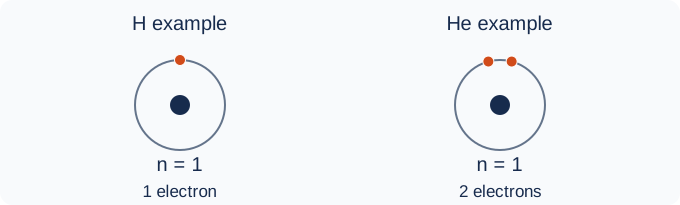
Period-two atoms have two occupied shells, n = 1 and n = 2.
Question 2
Complete the three supplied Bohr diagrams by adding electrons for lithium (Li), nitrogen (N), and neon (Ne). Each diagram has a nucleus and two shells marked n = 1 and n = 2.
First find each neutral atom’s total electron count; fill the inner shell before the outer shell. Consult the periodic table to decide when the second shell starts filling. The required result is the electron count on each shell; angular placement around a shell is arbitrary. Pairing electron dots, as in the helium illustration, follows the worksheet convention.
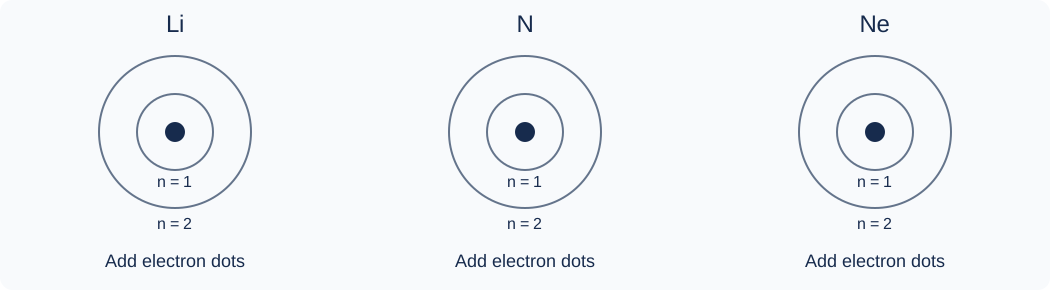
Complete all three diagrams
The neutral atoms have 3, 7, and 10 electrons respectively. Put two electrons in the first shell, then place the remaining electrons in the second shell.
| Atom | Atomic number / total electrons | n = 1 shell | n = 2 shell | Valence electrons |
|---|---|---|---|---|
| Lithium, Li | 3 | 2 | 1 | 1 |
| Nitrogen, N | 7 | 2 | 5 | 5 |
| Neon, Ne | 10 | 2 | 8 | 8 |
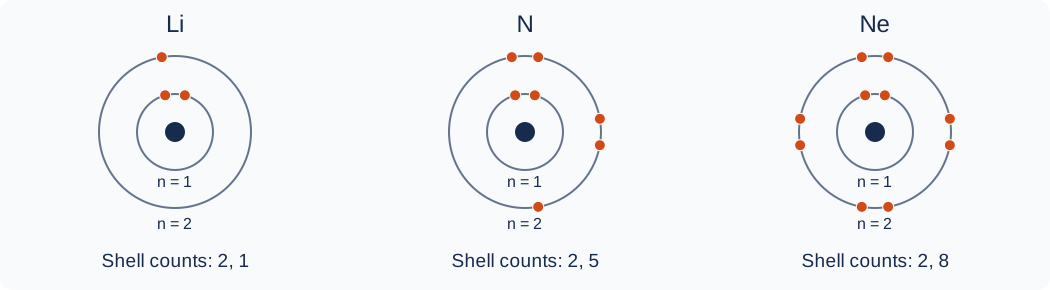
Lithium
Draw two dots on the inner ring and one on the outer ring: 2 + 1 = 3 electrons.
Nitrogen
Draw two dots on the inner ring and five on the outer ring: 2 + 5 = 7 electrons. The five outer dots represent nitrogen’s five valence electrons.
Neon
Draw two dots on the inner ring and eight on the outer ring: 2 + 8 = 10 electrons. Both occupied shells are full in this introductory shell diagram.
Keep the nucleus and the n = 1 / n = 2 labels. The supplied diagrams show one correct arrangement. Other angular arrangements with the same shell counts are equally valid; pairing the dots follows the worksheet’s drawing convention.
Check the counts against the ground-state electron configurations: Li is 1s²2s¹, N is 1s²2s²2p³, and Ne is 1s²2s²2p⁶. Paired dots on a shell are not an orbital-spin diagram: nitrogen’s three 2p electrons occupy separate p orbitals before pairing.
Evidence boundary
This page covers only Question 2 of Bellevue College’s CHEM&121 Workbook Key F2019, printed page 68 (PDF page 76), including the H/He context from printed page 67. The prompt is restated and the diagrams are redrawn; teacher answers are removed from the prompt. Questions 1, 3, and 4 are separate exercises. Shell drawings are counting models, not electron trajectories or spin-orbital diagrams; no isotope or neutron count is assumed.
Sources
These references support the concepts and methods used in the explanation above.