Question
After a mishap, a 76.0-kg circus performer clings to a trapeze, which is being pulled to the side by another circus artist, as shown here. Calculate the tension in the two ropes if the person is momentarily motionless. Include a free-body diagram in your solution.
Figure geometry: T₁ points upward and left, 15° from the vertical. T₂ points upward and right, 10° above the horizontal. Weight w points vertically downward.
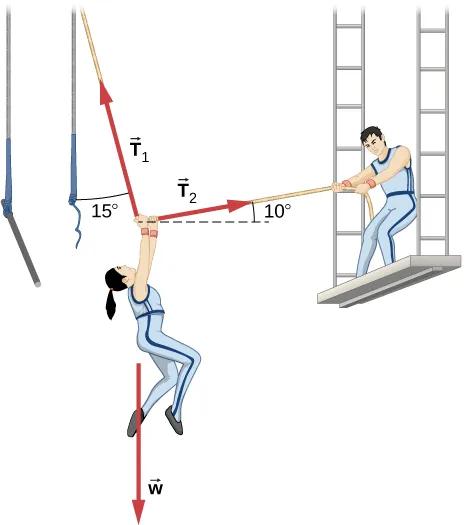
Original figure: OpenStax / Rice University, University Physics Volume 1, Chapter 6 Problem 30, CC BY 4.0. Source.
This question has been answered.
Explore the full answer and supporting references to better understand this question.
$19.99/month
- Everything in Study Pass
- Assignments with writing output
- AI detection and humanizer
- Basic quotas across every tool
$0.99/month
- Entire question library
- Knowledge guides and sources
- Detailed answers and explanations
- No AI tools or quotas
Evidence boundary
This solution follows OpenStax University Physics Volume 1, Chapter 6, Problem 30 and its official figure: T₁ is 15° from vertical and T₂ is 10° above horizontal. It uses the intended static-equilibrium idealization, g = 9.80 m/s², and negligible trapeze and rope masses. “Momentarily motionless” only states zero instantaneous velocity; if acceleration is nonzero, the supplied information would not uniquely determine the tensions. The calculated values are conditional on equilibrium.