Question
The figure represents a generic amino acid, with R denoting a variable carbon-based side chain. Explain how this structure permits amino acids to join into long peptide chains that form proteins.
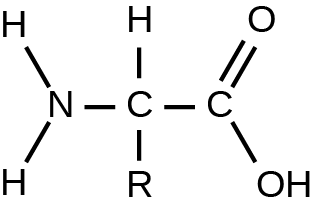
Structural notation: . Figure source: OpenStax Biology 2e, Chapter 3, Question 23.
This question has been answered.
Explore the full answer and supporting references to better understand this question.
$19.99/month
- Everything in Study Pass
- Assignments with writing output
- AI detection and humanizer
- Basic quotas across every tool
$0.99/month
- Entire question library
- Knowledge guides and sources
- Detailed answers and explanations
- No AI tools or quotas
Evidence boundary
The single question and generic structure are from Biology 2e, Chapter 3, Critical Thinking Question 23. The neutral drawing is a structural convention; free amino acids commonly have ionized amino and carboxyl groups near physiological pH. The equation is a net condensation representation, not a complete cellular translation mechanism. No particular R group or protein sequence is specified.