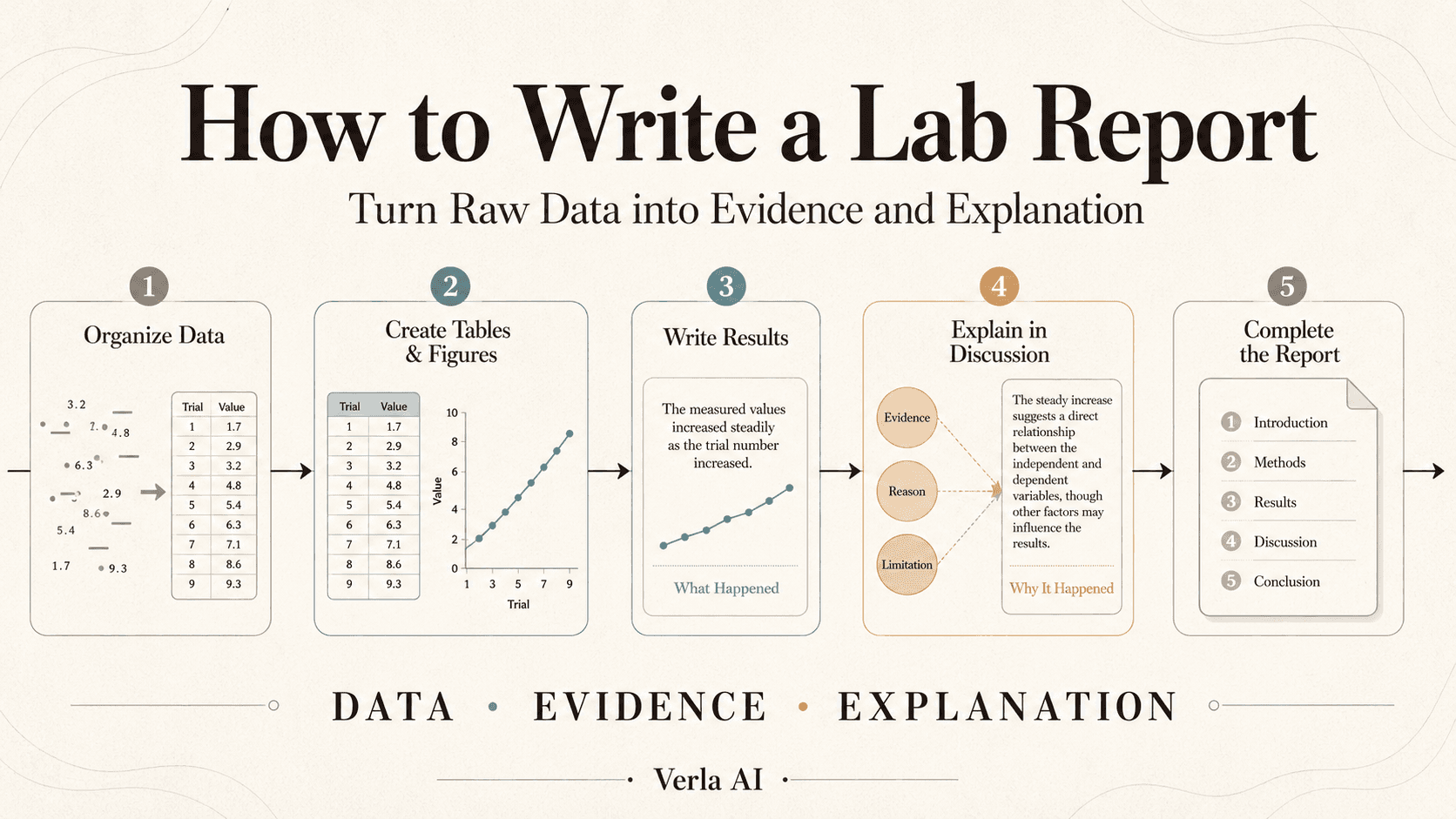
Master the Art of Lab Report Writing — From data analysis to polished PDF, learn the exact structure that gets top grades.
What is a Lab Report?
The purpose? To demonstrate that you can:
Apply the scientific method
Collect and analyze data systematically
Draw evidence-based conclusions
Lab reports train you for real-world scientific communication. The same format is used in peer-reviewed journals like Nature and Science. Learn more at Purdue OWL
The 7 Essential Sections of a Lab Report
Every lab report follows this universal structure — memorize it, and you'll never struggle with formatting again.
Title Page — Identify experiment, authors, date (1 page)
Abstract — Summarize entire report (100-200 words)
Introduction — Background, hypothesis, objectives (1-2 paragraphs)
Materials & Methods — Equipment, procedure, materials (1-2 pages)
Results — Data, tables, figures (1-3 pages)
Discussion — Interpretation, error analysis (2-3 paragraphs)
Conclusion & References — Summary, citations (0.5-1 page)
According to Columbia Physics Department guidelines, most undergraduate lab reports should be 2-6 typed pages including figures.
Common Mistakes Students Make
After reviewing feedback from University of Toronto Writing Advice and McGill Library Lab Report Guides, here are the top mistakes that cost students points:
How to Write Each Section (With Examples)
Title Page
Keep it simple and informative: experiment title, authors, course name, professor, and date.
Abstract
Write this last. Include purpose (1 sentence), methods (1-2 sentences), key results (1-2 sentences), and conclusion (1 sentence).
Introduction
Follow the funnel structure:
Broad context → "Enzymes are biological catalysts..."
Specific background → "Catalase breaks down hydrogen peroxide..."
Research gap/question → "However, temperature effects on catalase kinetics remain unclear..."
Hypothesis → "We hypothesize that enzyme activity will peak at 37°C..."
Methods
Write in past tense, passive voice, with enough detail for replication.
Results
Do: Present data in tables and graphs, use figure captions, report statistical values.
Don't: Interpret data (save for Discussion), include raw data sheets (put in Appendix).
Discussion
Use this framework:
Summarize key findings: "Maximum enzyme activity occurred at 37°C"
Compare to hypothesis: "This supports our initial hypothesis"
Explain results: "The decline above 45°C indicates thermal denaturation"
Address limitations: "Temperature fluctuations may have introduced error"
Connect to literature: "These findings align with Michaelis-Menten kinetics..."
Suggest improvements: "Future studies could use more precise temperature control"
Lab Report vs. Research Paper
Purpose: Lab Report = Document a specific experiment; Research Paper = Advance scientific knowledge
Length: Lab Report = 2-6 pages; Research Paper = 10-30+ pages
Literature Review: Lab Report = Brief; Research Paper = Comprehensive
Original Contribution: Lab Report = Replicate known experiments; Research Paper = Novel findings required
The S.C.I.E.N.C.E. Framework for Lab Reports
Use this checklist before submitting:
Component | Checkpoint Question |
|---|---|
Structure | All 7 sections present? |
Clarity | Can a peer replicate your experiment? |
Interpretation | Did you analyze (not just present) data? |
Evidence | Are all claims supported by data? |
Numbers | Are units, significant figures correct? |
Citations | Did you cite all external sources? |
Edit | Did you proofread for grammar and spelling? |
FAQs
How long should a lab report be?
Most undergraduate reports are 2-6 pages including figures.
Can I use first person ("I") in a lab report?
Generally, no. Use passive voice unless your instructor specifies otherwise.
What tense should I use?
Introduction: Present tense (for established facts)
Methods & Results: Past tense
Discussion: Mix (past for your findings, present for general principles)