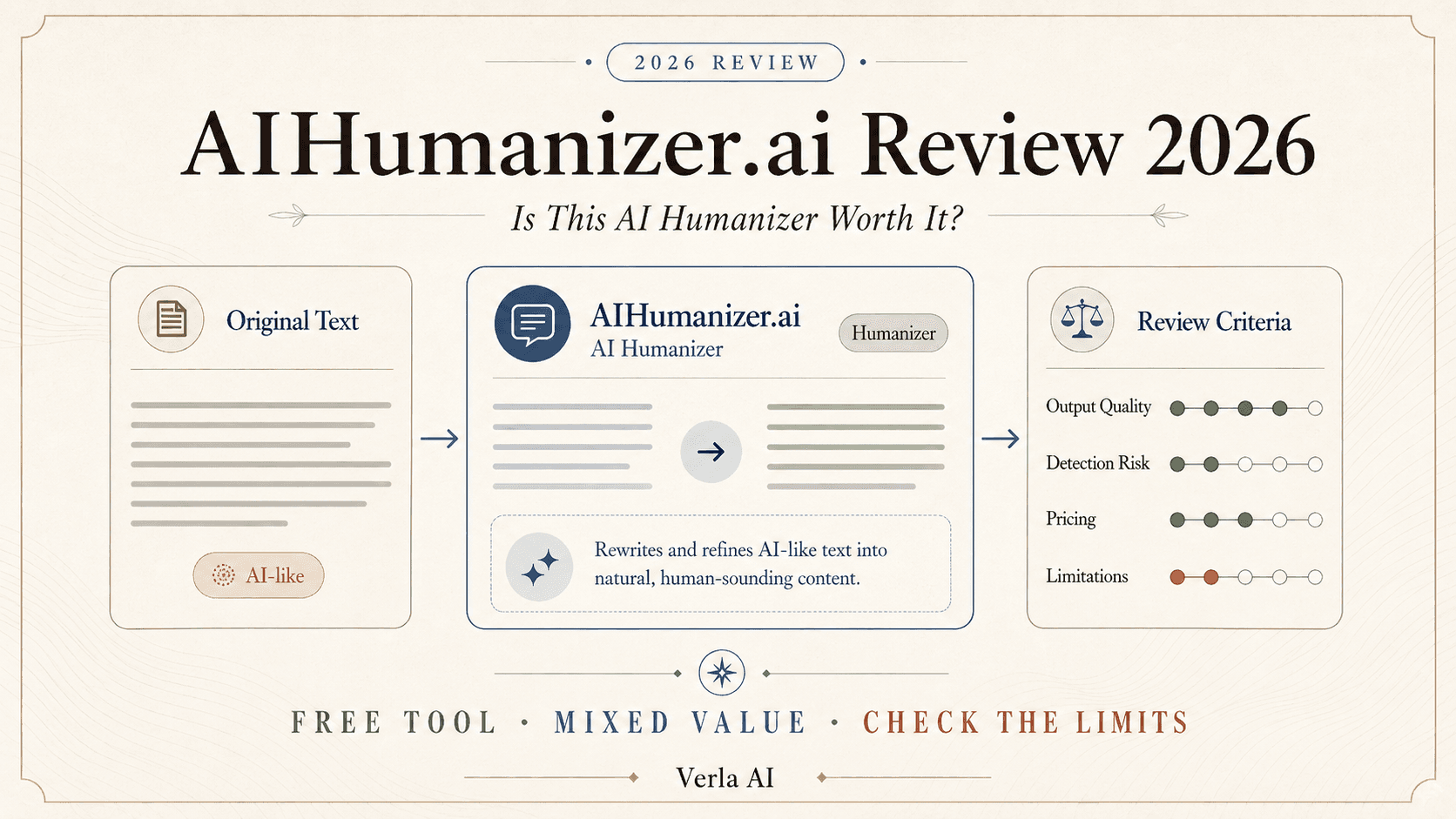
AI Humanizer tools tend to make the same promise: paste in AI-written text, click once, and get a natural version that no detector can recognize. The promise is simple. The buying decision is not.
AIHumanizer.ai goes further than most. Its website advertises a “100% human” result, plagiarism-free output, and the ability to bypass detectors ranging from GPTZero to Turnitin and Originality.ai. Those are exactly the claims that should make a buyer slow down and look at what the product actually provides.
Our conclusion is straightforward. AIHumanizer.ai is a convenient standalone rewriter for short passages and users who mainly want humanization volume. It is harder to recommend as the only tool a student uses before submitting a complete assignment. Tight per-input limits on its lower plans, a short refund window, and the need to review every rewrite reduce the value of its headline detector claims.
This review covers the price, free limits, practical restrictions, and who should consider paying.
What Is AIHumanizer.ai, and What Do You Actually Get?
AIHumanizer.ai is a browser-based rewriting tool. You paste AI-generated text, select a mode, and ask the platform to produce a version designed to sound more human. A built-in AI detector lets you check the rewritten result without immediately moving to another website.
The interface offers Basic, Standard, and Advanced modes and supports more than 30 languages. The site does not provide enough public technical detail to compare the modes precisely, but the intended progression is clear: Basic makes lighter changes, while the higher modes attempt a deeper rewrite.
That focus works well when the task is small—a mechanical paragraph, an overly formal email, or a repetitive section. Paste it in, choose a mode, and compare the output.
The limitations appear when the job becomes a complete essay. AIHumanizer.ai only sees the text inside its input box. It does not know the assignment question, grading rubric, lecture materials, required sources, or citation rules. Its detector may give the rewritten version a score, but that score cannot tell you whether the argument is accurate or the assignment has actually been answered.
A built-in AI detector is convenient, but it does not independently verify the company’s humanization claims: both the rewrite and the result come from the same product environment. Treat the score as a review signal, not a submission certificate.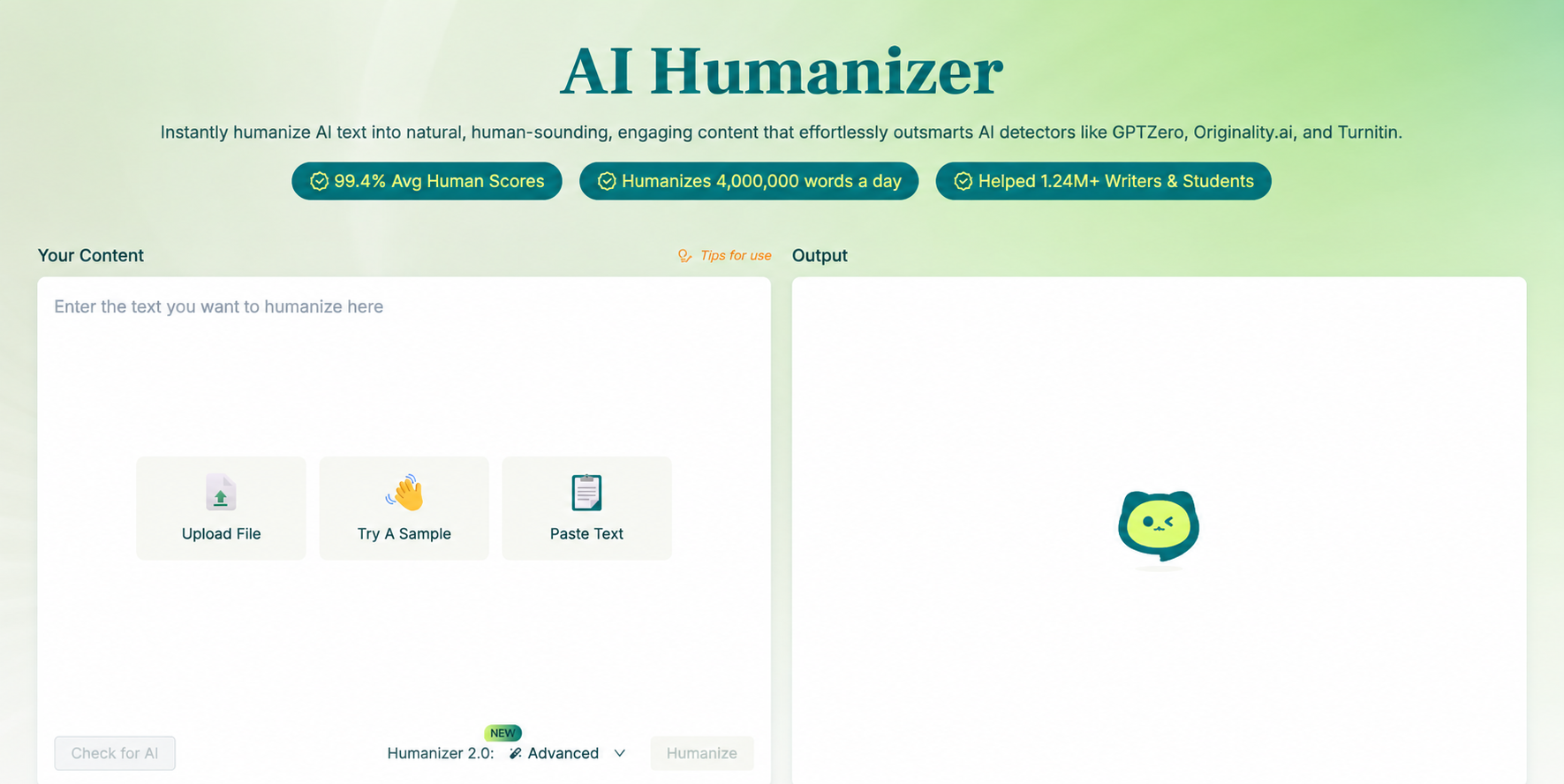
AIHumanizer.ai Pricing: Discounted Annual Plans, but Tight Input and Refund Limits
AIHumanizer.ai looks inexpensive when the yearly tab is selected. The monthly prices tell a different story, and the word allowance is only half of the limit users need to examine.
Prices below were checked in August 2026. Subscription details can change, so confirm the final charge and renewal period at checkout.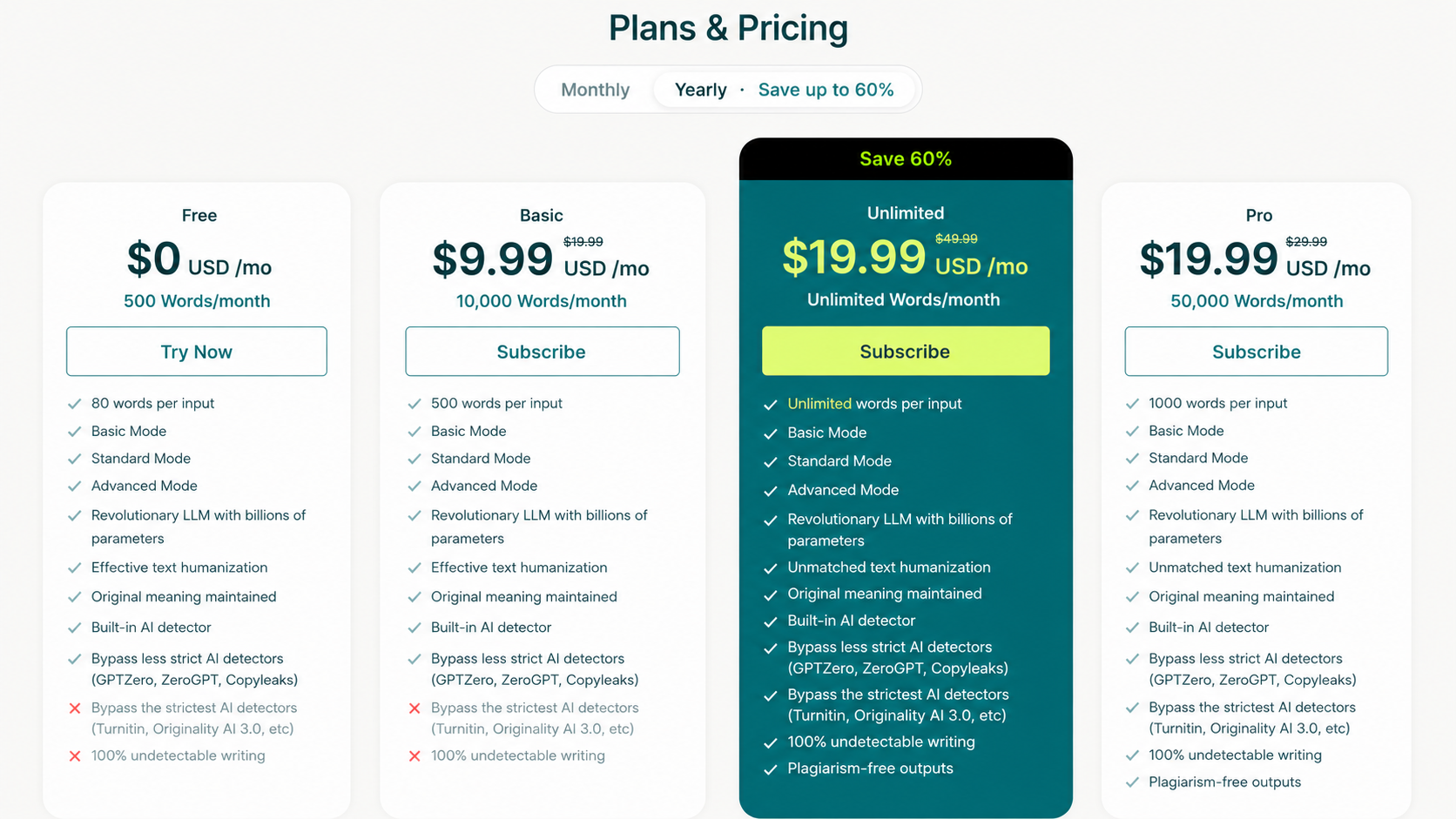
The first number most buyers notice is 10,000 words on Basic. It sounds sufficient for several essays. Yet the 500-word input ceiling changes the experience. A 1,500-word paper must be divided into at least three pieces. A longer report may require five or six separate rewrites.
Each section is processed without seeing the whole paper. Terms can shift and the tone at the beginning may no longer match the conclusion. The monthly allowance tells you how much text you can process; the per-input allowance tells you how much context the tool can see.
Pro raises that ceiling to 1,000 words. That is more comfortable for articles and essay sections, but many university papers still will not fit in a single run. Unlimited is the only plan that removes both restrictions.
The current annual pricing deserves a second look as well. The official page displays Pro and Unlimited at the same $19.99 monthly equivalent when billed yearly, even though their monthly prices and limits differ. If that offer is still visible when you subscribe, check the total annual payment and selected plan before confirming the purchase.
The free experience is also less clear than it should be. The pricing page shows 500 words per month with an 80-word input limit. The homepage FAQ says an unregistered user can humanize up to 300 words and receive another 500 credits after registering. Because these two descriptions do not align perfectly, the allowance shown inside your account is the one that ultimately matters.
In either case, the free tier is a product sample. Eighty words can test one paragraph, not consistency across an essay. Before paying, try formal analysis, technical language, and a passage containing citations.
Then there is the refund policy. AIHumanizer.ai accepts refund requests within three calendar days of the initial purchase, provided usage has not exceeded 1,000 words. Once either limit is crossed, a refund is no longer available under the published policy.
That is a narrow window: a Basic subscriber can lose refund eligibility after using only 10% of the monthly allowance. Check the output immediately and stay below 1,000 words while deciding.
Pricing verdict: Basic offers a reasonable amount of pure rewriting volume on annual billing, but its 500-word input limit makes it a paragraph tool rather than a full-essay workspace. Unlimited is the cleaner long-form option, although it requires a much larger commitment if purchased month to month.
The Real Trade-Off: A Fast Rewrite Still Needs a Full Review
“Does it work?” is too vague to guide a purchase. AIHumanizer.ai generates a different version; the more useful question is what remains for the user afterward.
First, the meaning has to be checked. A sentence can sound smoother while becoming less precise. In academic writing, a small substitution may change the strength of a claim, turn a correlation into causation, or replace a technical term with a word that sounds similar but means something else.
Citations need separate attention. Direct quotations should not be rewritten. Paraphrases still need to represent the source accurately and carry the appropriate citation. No “plagiarism-free” label removes the writer’s responsibility to check the original source.
Processing an essay in 500-word blocks also limits context. Terminology, formality, or argumentative direction may shift, so the complete document still needs a beginning-to-end read.
Finally, an AI detector score cannot evaluate academic quality. It does not know whether the thesis answers the prompt, whether the evidence supports the conclusion, or whether the references are real. A lower score may reduce one anxiety while leaving the larger assignment untouched.
This is why “100% undetectable” should not be treated as a purchase guarantee. External detectors use different models and update over time. Results can change with text length, subject, language, editing history, and the detector used.
The practical result is more balanced than either “it works” or “it does not.” AIHumanizer.ai can save time when you already know which passage needs rewriting and are prepared to review the output. It saves less time when you expect the first rewritten version to become a finished paper automatically.
Is AIHumanizer.ai Worth It?
AIHumanizer.ai is worth considering if humanization is the only job you need done.
A blogger rewriting short sections, a marketer adjusting web copy, or someone who already has separate detection and proofreading tools may appreciate its focused workflow. Basic provides 10,000 words each month on annual billing, with little setup beyond paste, select, rewrite, and inspect.
Students face a different calculation. The Basic plan cannot see more than 500 words at once. Pro still tops out at 1,000 words. Neither plan reads the prompt or checks whether the rewritten material fits the rest of the assignment. The user must reconnect every section, protect citations, and verify the final argument manually.
AIHumanizer.ai is therefore easier to recommend as a focused utility than as a complete student subscription. Choose it for standalone rewriting volume and short passages. Consider an alternative if you want to upload requirements and sources, identify only the paragraphs that need attention, and complete the final review in one workflow.
The safest buying sequence is free first, monthly second, annual last. If the free input limit prevents a meaningful evaluation, buy one month and test immediately within the refund conditions.
The Best AIHumanizer.ai Alternative for Students
AIHumanizer.ai and Verla solve overlapping problems, but they are not selling the same workflow.
AIHumanizer.ai starts after the user has already decided what to rewrite. It provides more pure humanization volume on its Basic annual plan: 10,000 words per month, compared with 5,000 Humanizer words on Verla Basic.
Verla is built around what happens before and after the rewrite.
With Verla AI Detection, a student can scan the draft paragraph by paragraph and locate the sections that deserve closer attention. This reduces the temptation to rewrite an entire paper just because one overall score looks uncomfortable.
Those sections can then be reviewed in Verla AI Humanizer. The original and revised versions remain available for comparison, making it easier to preserve a technical term, reject an unnecessary change, or keep a sentence that was already clear.
The larger difference appears in Verla Assignment. Students can work with the assignment prompt, source materials, files, and broader academic requirements rather than sending isolated pieces of text through a rewriting box. Humanization becomes one stage of the work—not the definition of a finished assignment.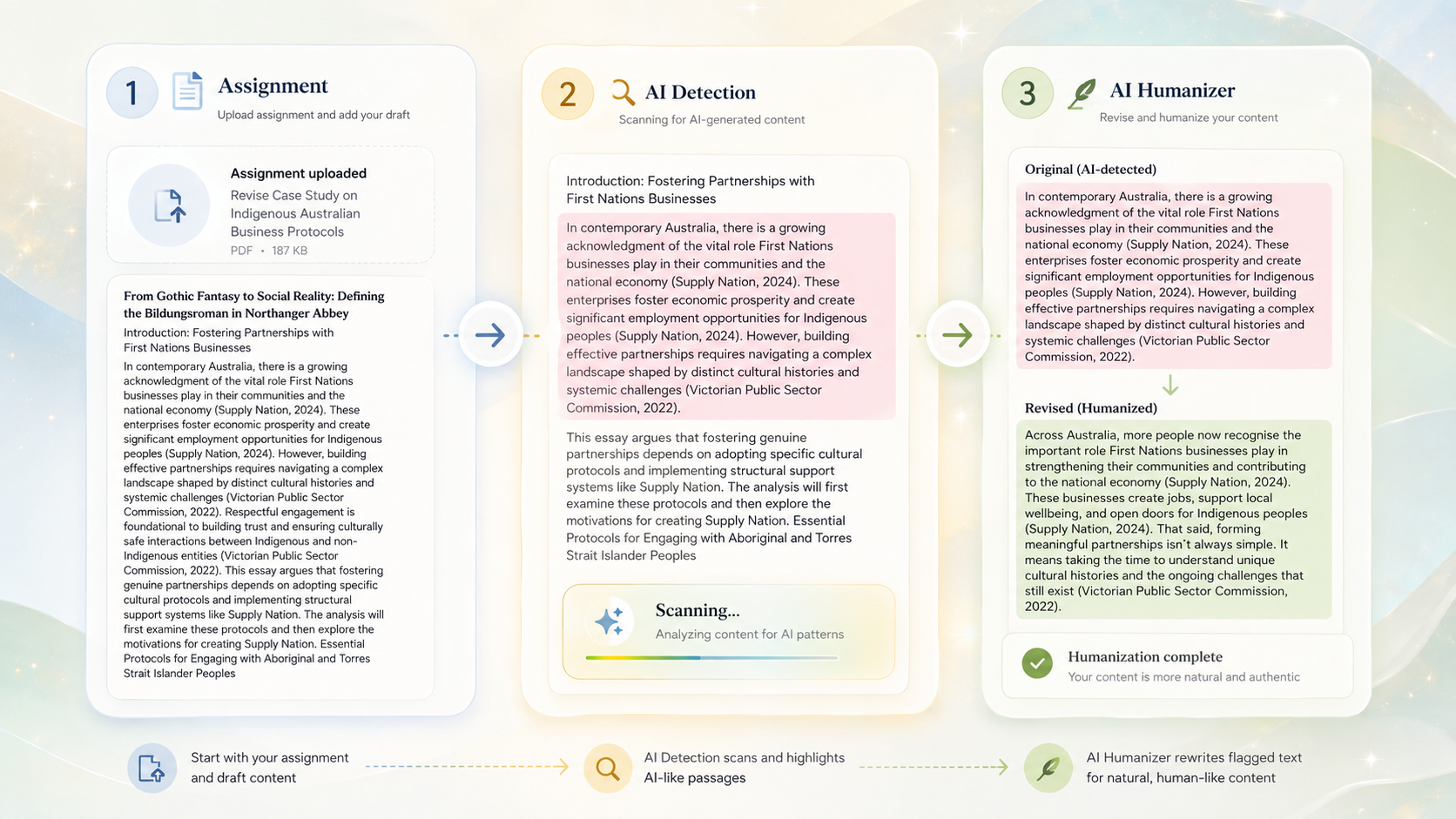
Verla Basic currently costs $7.99 per month when billed annually. It includes 5,000 Humanizer words, 10,000 AI Detection words, three Assignment uses, and up to five uploaded files per assignment. AIHumanizer.ai Basic costs $9.99 per month on annual billing and offers twice the Humanizer volume, but not the same assignment-aware workflow.
That creates a clear choice.
If you want the largest amount of focused rewriting on an entry plan, AIHumanizer.ai has the stronger quota. If you are a student trying to move from requirements and sources to a reviewed final draft, Verla offers more of the workflow at a lower annual entry price.
The point is not to run every sentence through more tools. It is to rewrite selectively, confirm the meaning, and review the document against the task it was supposed to complete.