Question
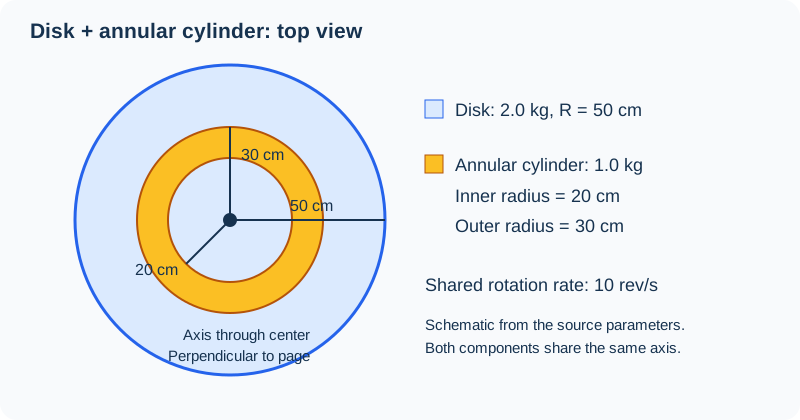
A circular disk has mass 2.0 kg and radius 50 cm. An annular cylinder of mass 1.0 kg, inner radius 20 cm and outer radius 30 cm is mounted concentrically on it. Both rotate at 10 rev/s about their common central axis perpendicular to the disk. (a) Find the total moment of inertia. (b) Find the rotational kinetic energy.
Answers
(a) The total moment of inertia is before rounding, or about to two significant figures.
(b) The rotational kinetic energy is before rounding, or about to two significant figures.
(a) Add the two inertias about the shared axis
Convert all radii to metres: , and . The rotation axis passes through the common center and is perpendicular to the disk. No parallel-axis shift is required.
For the uniform disk,
For the uniform annular cylinder,
The annular cylinder has appreciable radial thickness. Using the thin-hoop formula with one selected radius would lose information about its mass distribution.
Both components rotate about the same axis, so
(b) Calculate the rotational kinetic energy
The specified frequency is , not . Convert it before using the energy formula:
Then
Keep while calculating energy; rounding it to first introduces avoidable intermediate-rounding error.
Check the annular contribution
Every mass element in the annulus lies between and from the axis, so its inertia must lie between and . The calculated satisfies that bound.
Evidence boundary
The calculation uses the textbook idealization of uniform components about the axis shown. No off-center axis, extra shaft mass, density measurement or nonuniform mass distribution is supplied. The diagram is a schematic reconstructed from the verified source geometry, not a new measurement. Guard digits are retained to make both calculations reproducible; final results are also given to two significant figures.
Sources
Các nguồn này hỗ trợ những khái niệm và phương pháp được giải thích ở trên.