Question
After a mishap, a 76.0-kg circus performer clings to a trapeze, which is being pulled to the side by another circus artist, as shown here. Calculate the tension in the two ropes if the person is momentarily motionless. Include a free-body diagram in your solution.
Figure geometry: T₁ points upward and left, 15° from the vertical. T₂ points upward and right, 10° above the horizontal. Weight w points vertically downward.
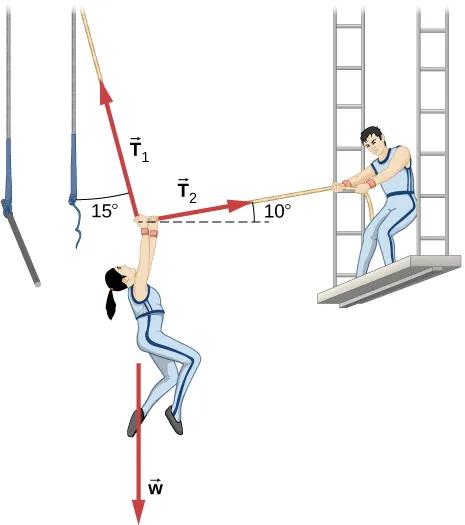
Original figure: OpenStax / Rice University, University Physics Volume 1, Chapter 6 Problem 30, CC BY 4.0. Source.
Free-body diagram
Use the performer and negligibly light trapeze as the supported body. The external forces are upward-left along the trapeze rope, upward-right along the pulling rope, and weight downward. The figure’s angles are measured from different axes: from vertical for , and above horizontal for .
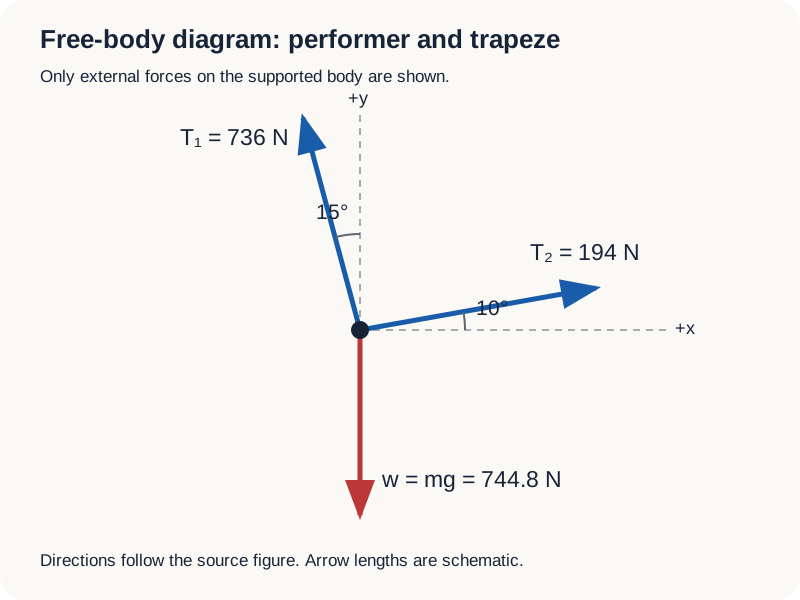
The diagram shows only external forces, not extra forces for the components. Arrow lengths are schematic. Positive is right and positive is up.
Set up the equations
For the textbook’s intended equilibrium model, . The components are
| Force | component | component |
|---|---|---|
| Weight |
Newton’s second law gives
Solve for both rope tensions
From the horizontal equation,
Substitute into the vertical equation:
Therefore
is the mostly vertical trapeze-rope tension; is the mostly horizontal pulling-rope tension. Different directions mean different magnitudes, even though their horizontal components balance.
Check and interpretation
Using unrounded tensions, and . Both net-force components are zero.
This equilibrium assumption is essential. A body can have zero velocity at a turning point while accelerating. If “momentarily motionless” were meant only in that kinematic sense, the right-hand sides would be and , and additional acceleration information would be required.
Evidence boundary
This solution follows OpenStax University Physics Volume 1, Chapter 6, Problem 30 and its official figure: T₁ is 15° from vertical and T₂ is 10° above horizontal. It uses the intended static-equilibrium idealization, g = 9.80 m/s², and negligible trapeze and rope masses. “Momentarily motionless” only states zero instantaneous velocity; if acceleration is nonzero, the supplied information would not uniquely determine the tensions. The calculated values are conditional on equilibrium.
Sources
Эти источники подтверждают изложенные выше концепции и методы.