Question
Report: Structure of Molecules Using Molecular Models — HF (hydrofluoric acid).
For the HF entry, use the molecular-model procedure to construct and report on a model. Draw its Lewis structure with every bonding and nonbonding electron pair. Name the molecular shape. Decide whether the molecule is polar and explain why. Determine whether it has any likely isomers or resonance forms; draw them if they exist.
1. Model and complete Lewis structure
HF has valence electrons. One shared pair forms a single H–F bond; the remaining six electrons form three lone pairs on F. Hydrogen has its two-electron shell and fluorine has an octet.
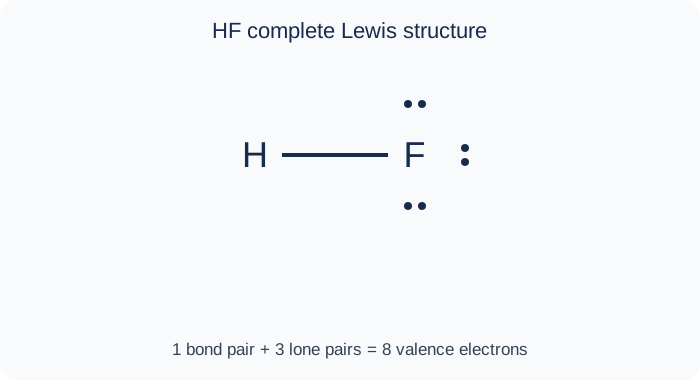
The formal charges are on H and on F. To complete the practical modeling task, connect the kit's hydrogen and fluorine pieces with one connector, following the source procedure and your kit's actual color convention. The drawing supplies the theoretical electron-pair structure; build and report the physical model yourself. A connector represents a bond, not a measured bond length.
2. Molecular geometry
HF is linear because it has only two nuclei. There is no three-atom bond angle to measure. Counting the one bond domain and three lone-pair domains around F is useful electron-pair bookkeeping, but it does not make this diatomic molecule tetrahedral in molecular shape.
3. Polarity and explanation
HF is polar. F attracts the shared electrons more strongly than H, so H has partial positive character and F has partial negative character. The bond dipole points toward F. There is only one bond, so there is no second bond dipole to cancel it. Zero formal charges do not mean zero bond polarity.
4. Isomers or resonance forms
No ordinary structural or stereoisomers, and no additional usual Lewis resonance forms, are needed for neutral HF. With only one H and one F, reversing the drawing to F–H rotates the same molecule; it creates no different connectivity or spatial isomer.
In this introductory Lewis exercise, the H–F single-bond structure with three lone pairs on F is the appropriate complete structure. A second bond would put more than two electrons around H. Separate and ions describe ionization, not an alternate molecule or a standard bonded Lewis resonance form for this report row. More advanced bond theories may discuss ionic contributions to a polar bond; that does not require drawing an extra resonance form here.
Completed report row
| Lewis structure | Molecular geometry | Polar? Explain | Isomers or resonance structures? |
|---|---|---|---|
| One H–F single bond; three lone pairs on F | Linear; no three-atom bond angle | Yes: unequal electron sharing gives a dipole toward F | No in the usual neutral-HF Lewis model; no extra structures to draw |
Evidence boundary
The task is the standalone HF row on page 10 of David A. Katz's 2009 molecular-model worksheet, with the page 8 instructions applied to that row. The answer supplies theoretical structure, shape, polarity, and isomer/resonance conclusions. It does not claim the student's physical model was constructed or report invented measurements. The row labels HF as hydrofluoric acid, but its molecular-geometry task concerns neutral HF; aqueous ionization is a separate process.
Sources
Эти источники подтверждают изложенные выше концепции и методы.