Question
A compound has an approximate molar mass of 70 g/mol. Its composition by mass is 19.7% nitrogen and 80.3% fluorine. Determine its chemical formula, draw a complete Lewis structure, and assign a formal charge to every atom.
Chemical formula
Use a 100 g basis: 19.7 g N and 80.3 g F. Convert mass to moles using 14.01 g/mol for N and 19.00 g/mol for F.
| Element | Mass on the 100 g basis | Amount | Ratio divided by the smaller amount |
|---|---|---|---|
| N | 19.7 g | 1.406 mol | 1.000 |
| F | 80.3 g | 4.226 mol | 3.006 ≈ 3 |
The empirical formula is . Its formula mass is , consistent with the stated approximate value of 70 g/mol. The molecular multiplier is approximately one, so the molecular formula is NF₃. The percentages are rounded data; do not demand an exact 70.00 g/mol match.
Complete Lewis form
The electron budget is valence electrons. Put N at the center with three N–F single bonds. Those bonds use six electrons. Each F receives three lone pairs, using 18 more electrons. Put the remaining two electrons in one lone pair on N.
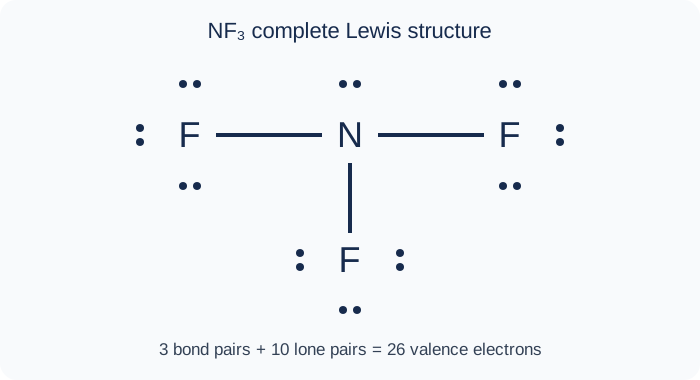
The diagram shows every pair: three bond pairs, three lone pairs on each F, and one lone pair on N. That is 13 pairs, or 26 electrons. Each atom has an octet. This is a Lewis electron-pair drawing, not a scale drawing of three-dimensional bond angles.
Formal charge on every atom
Use , where the last two counts refer to electrons.
| Atom | Valence electrons | Nonbonding electrons | Bonding electrons | Formal charge |
|---|---|---|---|---|
| Central N | 5 | 2 | 6 | |
| F at the left | 7 | 6 | 2 | |
| F at the right | 7 | 6 | 2 | |
| F below N | 7 | 6 | 2 |
Final result: NF₃; N forms three single bonds and has one lone pair; every F has three lone pairs; all four formal charges are zero.
Evidence boundary
This answer addresses Chemistry 2e Chapter 7 exercise 61, including its mass composition, approximate molar mass, chemical formula, complete Lewis drawing, and all formal charges. The 100 g basis is a calculation convenience, not an experimental sample. The diagram represents electron pairs and connectivity, not measured bond angles or partial atomic charges.
Sources
Эти источники подтверждают изложенные выше концепции и методы.