Question
A particle’s acceleration is . At , its position and velocity are zero.
(a) What are the particle’s position and velocity as functions of time?
(b) Find the equation of the path of the particle. Draw the - and -axes and sketch the trajectory of the particle.
(a) Position and velocity as functions of time
The acceleration components are constant:
Integrate once and use :
Integrate again and use :
Thus and . If is entered in seconds, the position components are in meters and velocity components are in meters per second.
(b) Path equation and trajectory sketch
Eliminate using :
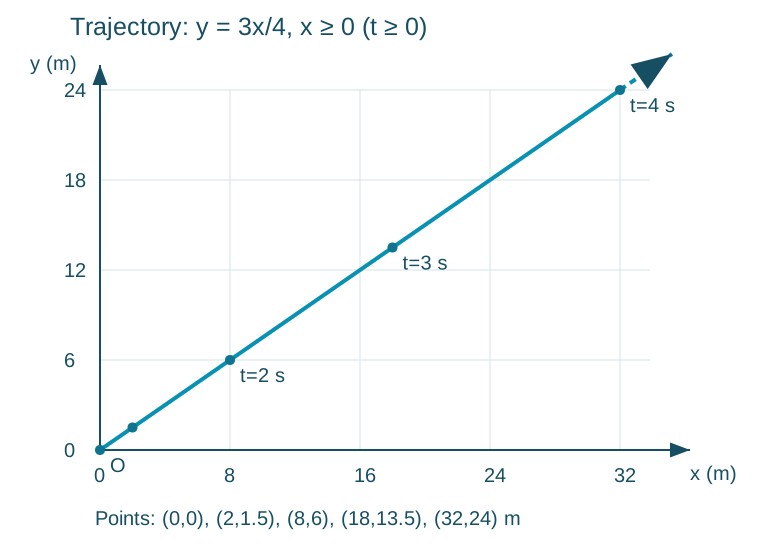
For the motion beginning at and followed forward in time, , so and . The trajectory is the first-quadrant ray from the origin, at above . It is straight even though both position components are quadratic in time: both grow in the same fixed ratio.
| Time (s) | x (m) | y (m) |
|---|---|---|
| 0 | 0 | 0 |
| 1 | 2.0 | 1.5 |
| 2 | 8.0 | 6.0 |
| 3 | 18.0 | 13.5 |
| 4 | 32.0 | 24.0 |
Draw perpendicular axes labeled (m) and (m), plot these points, and connect them along . Mark the direction away from the origin; the dashed continuation in the sketch indicates that the ray continues beyond the displayed range.
Check the result
Differentiating gives the stated ; differentiating gives . Both initial vectors vanish at , and every plotted point satisfies .
Evidence boundary
This page uses the 4.0 i + 3.0 j m/s² acceleration and zero position/velocity initial conditions in OpenStax University Physics Volume 1, Chapter 4, Problem 27. The curve is calculated, not measured. The sketch shows the t ≥ 0 motion, with a finite viewing window and a continuing ray.
Sources
Các nguồn này hỗ trợ những khái niệm và phương pháp được giải thích ở trên.