Question
Sketch the boundary surface of a dₓ²₋ᵧ² and a pᵧ orbital. Be sure to show and label the axes.
Sketch both requested orbitals
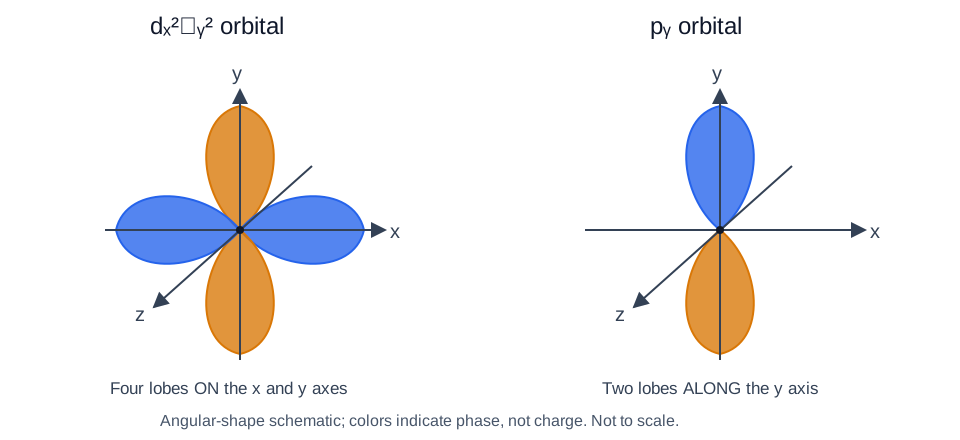
dₓ²₋ᵧ²
Draw four lobes in the xy plane, pointing along , , , and , with the nucleus at the origin. The lobes lie on the axes, not between them. Its angular factor is proportional to ; opposite lobes on x share one phase, and the y lobes have the other phase. The angular nodal planes are and , both extending along z.
pᵧ
Draw two lobes along and , meeting at the nucleus. The xz plane () is its angular nodal plane. The two colors indicate opposite wavefunction phases, not opposite charges or different electrons.
The drawing labels x, y, and z for each orbital. Lobes show an idealized boundary of the probability distribution; they are not an electron's trajectory. The exercise specifies orbital orientation but no principal quantum number, so the schematic does not assign a size or a number of radial nodes.
Evidence boundary
The task is OpenStax Chemistry 2e Exercise 39 and includes both orbitals. The diagram is an original qualitative angular-shape schematic, not a measured surface or a scale drawing. No principal quantum number, radial-node pattern, or orbital occupation is specified.
Sources
Các nguồn này hỗ trợ những khái niệm và phương pháp được giải thích ở trên.