Question
Racemic -4-methylcyclohexene reacts with . Draw the major organic product structure(s), show a complete stepwise mechanism for one pathway, and state how many distinct stereoisomeric products are formed.
Answer — structures. The alkene becomes 1,2-dibromo-4-methylcyclohexane. Bromine atoms are added to opposite faces of C1 and C2; no double bond remains. On the same numbered ring skeleton, the four distinct wedge/dash structures are:
| Structure | Br on C1 | Br on C2 | CH₃ on C4 |
|---|---|---|---|
| A | solid wedge | hashed wedge | solid wedge |
| B | hashed wedge | solid wedge | hashed wedge |
| C | solid wedge | hashed wedge | hashed wedge |
| D | hashed wedge | solid wedge | solid wedge |
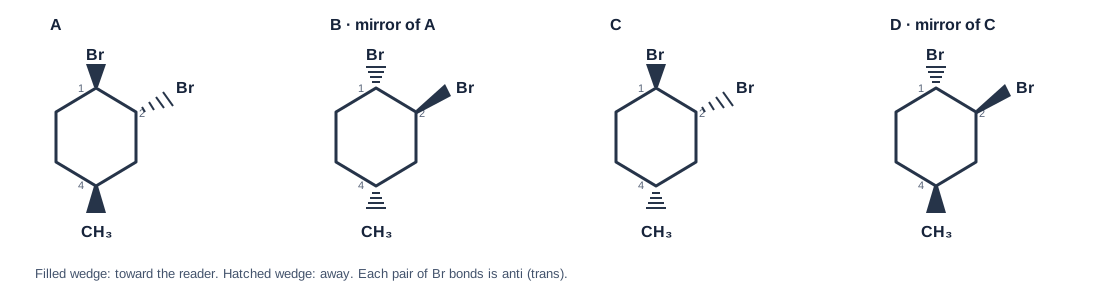
A/B and C/D are mirror-image pairs. The pairs are diastereomeric with respect to each other. The number of distinct stereoisomeric products is four. Every drawing has trans Br substituents; drawing cis Br at C1 and C2 would contradict the anti-addition pathway.
Answer — one complete stepwise mechanism. (1) The alkene bond attacks one atom of as the bond breaks to . The electrophilic bromine bridges C1 and C2 in a three-membered bromonium ion. (2) attacks one bridged carbon from the face opposite the bridge and opens a C–Br bridge bond, giving the anti vicinal dibromide. Attack at the opposite alkene face supplies the corresponding stereochemical alternative; the racemic C4 starting configurations complete the four-structure set. No free carbocation rearrangement is required in this mechanism.
Evidence boundary
The source specifies a racemate and but no reaction conditions or product ratio. The structure count follows stereochemical enumeration and anti addition; it does not assert four equal yields or a measured major/minor ratio. The diagram specifies connectivity and relative face orientation, not a preferred chair conformer.
Sources
Các nguồn này hỗ trợ những khái niệm và phương pháp được giải thích ở trên.