Question
For each molecular formula below, calculate its degree of unsaturation and draw as many compatible structures as you can:
(a)
(b)
(c)
Calculate the degree of unsaturation
For a neutral, connected, closed-shell hydrocarbon with ordinary carbon valence:
| Part | Formula | Calculation | Degree of unsaturation |
|---|---|---|---|
| (a) | C₄H₈ | (2 × 4 + 2 − 8) / 2 | 1 |
| (b) | C₄H₆ | (2 × 4 + 2 − 6) / 2 | 2 |
| (c) | C₃H₄ | (2 × 3 + 2 − 4) / 2 | 2 |
(a) Structures for C₄H₈
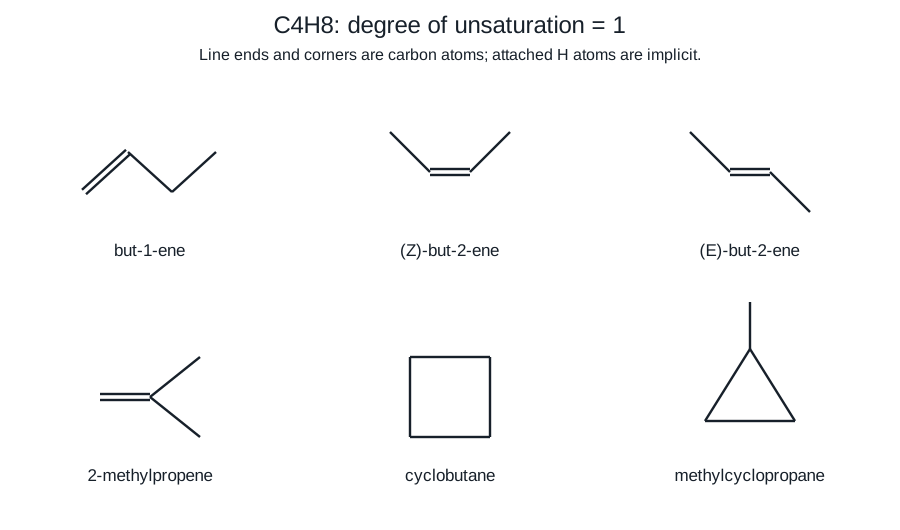
One degree can be one C=C bond or one ring. The five constitutional possibilities shown are but-1-ene, but-2-ene, 2-methylpropene, cyclobutane, and methylcyclopropane. But-2-ene additionally has distinct E and Z forms, both drawn below; that gives six structures when those stereoisomers are counted separately.
(b) Structures for C₄H₆
Two degrees can be a triple bond, two double bonds, a ring plus a double bond, or two independent rings. The drawings give nine different connectivities:
- One triple bond: but-1-yne and but-2-yne.
- Two double bonds: buta-1,3-diene and buta-1,2-diene.
- One ring plus one double bond: cyclobutene, 1-methylcyclopropene, 3-methylcyclopropene, and methylenecyclopropane.
- Two rings: bicyclo[1.1.0]butane.
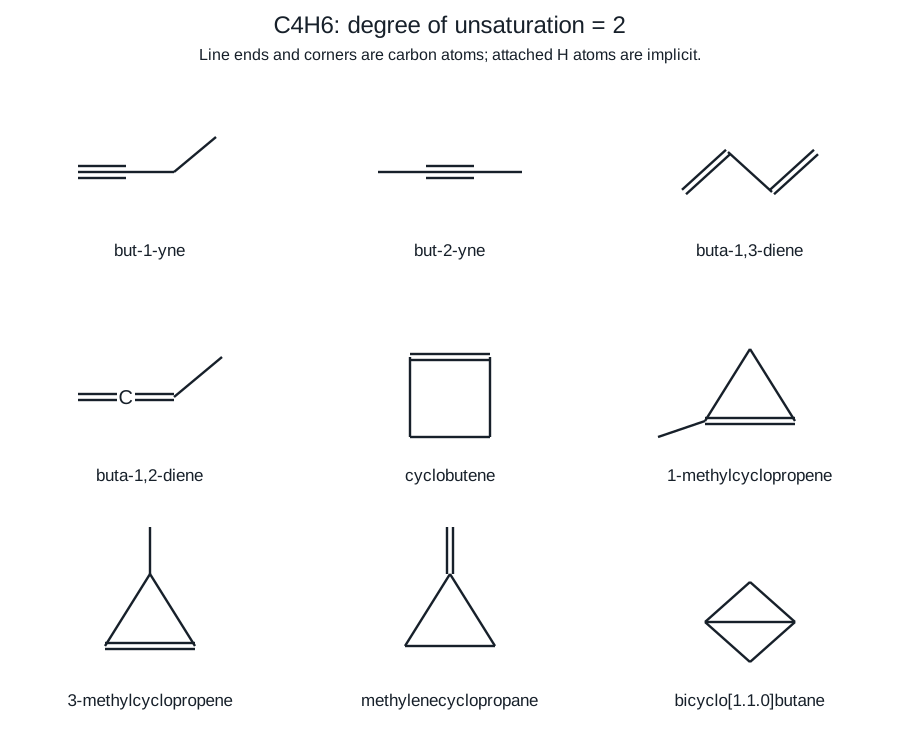
The two triangles in bicyclo[1.1.0]butane share a bond; they represent two independent rings. Ring strain does not make its carbon and hydrogen counts invalid. These structures are compatible structural proposals, not a claim that they have equal stability or occur in one sample.
(c) Structures for C₃H₄
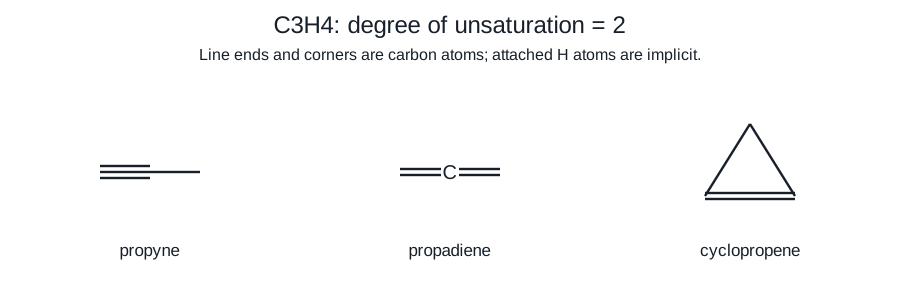
The three conventional connectivities shown are propyne (one triple bond), propadiene or allene (two double bonds), and cyclopropene (one ring and one double bond).
Verify every drawing
Unlabeled line ends and corners represent carbons, with enough implicit H atoms to give each carbon valence four. The central carbon of each allene is labeled explicitly so that two consecutive double bonds cannot be mistaken for a single long double bond.
For each drawing, count the carbon atoms, complete their hydrogens, and count rings plus π bonds. The sets above reproduce C₄H₈, C₄H₆, and C₃H₄ and their respective DoU values of 1, 2, and 2. Molecular formulas alone do not choose one unique structure.
Evidence boundary
This preserves all three formula calculations and the structure-drawing requirement of OpenStax Organic Chemistry Problem 7-1. The diagrams and enumeration are independently constructed and checked by carbon valence, implicit hydrogen counts, and graph cycles. They use conventional connected, neutral, closed-shell hydrocarbons; radicals, ions, disconnected fragments, and exotic bonding are outside this introductory scope. No spectra are supplied, so the structures are candidates rather than a uniquely identified compound.
Sources
Các nguồn này hỗ trợ những khái niệm và phương pháp được giải thích ở trên.