Question
Rhetorical analysis assignment — OpenStax Writing Guide, section 9.5Write a rhetorical analysis of persuasive writing, such as an editorial, review, essay, chapter, or letter to an editor. Analyze the situation and persuasive strategies; support each claim with textual evidence. You may analyze the accompanying letter by Octavio D. Peterson or choose another text, including a speech suggested by your instructor. The worked response here chooses Peterson’s letter.Address these six guiding requirements:1. Identify the subject.2. Identify the writer, what is known about them, and their position or agenda.3. Identify the intended readers and what is known about that audience.4. Explain the writer’s purpose and desired outcome.5. Explain relevant time, place, circumstances, and cultural context, using only what the text establishes.6. Identify the specific rhetorical strategies and assess their effectiveness or limitations.Read Peterson’s complete letter below. Reflect on its effect on you, focusing on how the language persuades rather than whether you agree with the policy. This is an open writing task with more than one defensible analysis.
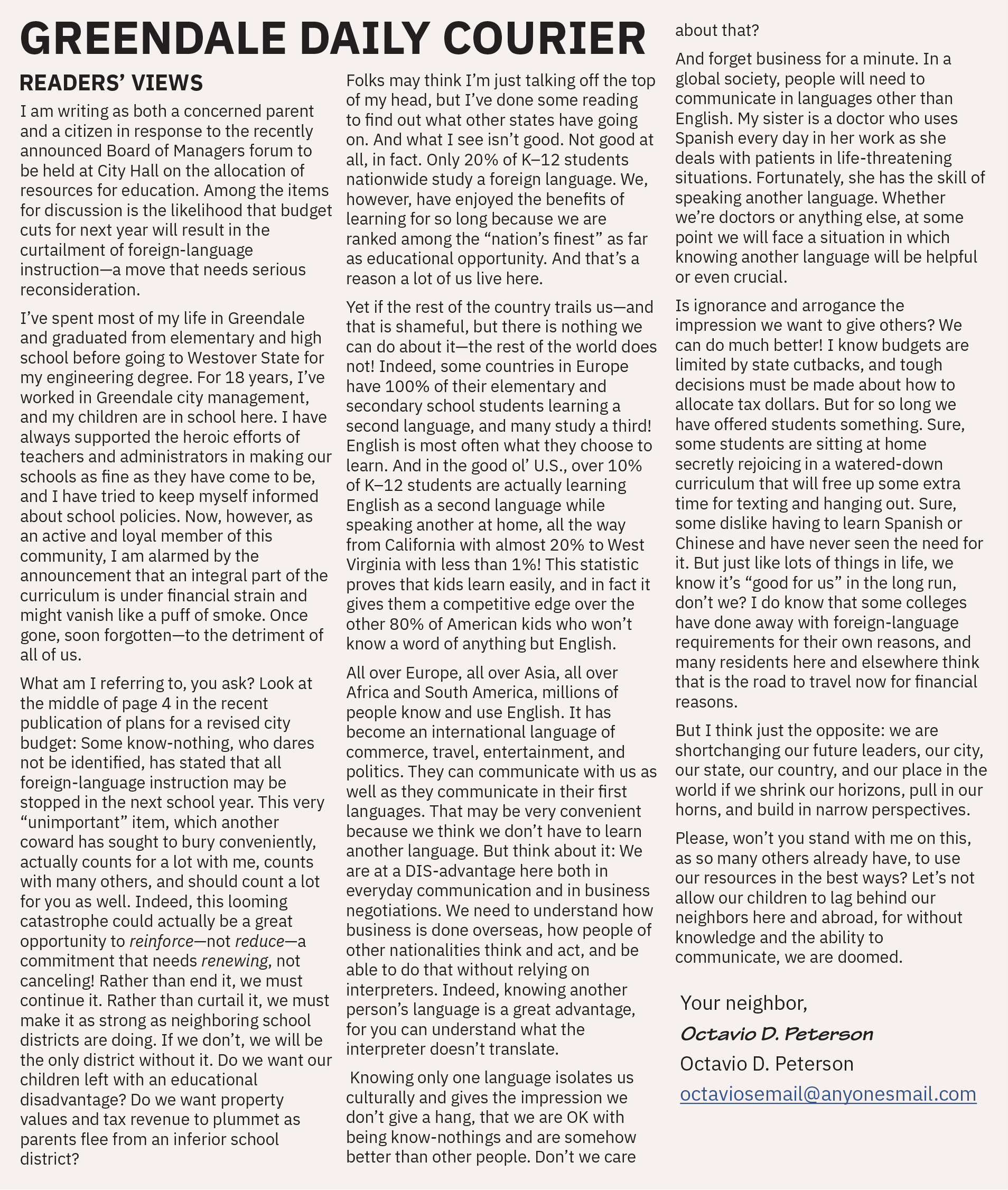
Original reading: Octavio D. Peterson’s letter accompanying OpenStax Writing Guide, section 9.5. Read down each column from left to right. Open the full-resolution letter.
Responses to the six guiding requirements
| Requirement | Analysis grounded in the selected letter |
|---|---|
| 1. Subject | Possible reductions or elimination of foreign-language instruction in Greendale schools during an education-budget allocation debate. |
| 2. Writer | Octavio D. Peterson presents himself as a local parent, longtime resident, engineering graduate, and city-management employee. He advocates continued language instruction; his personal involvement establishes a position, rather than neutrality. |
| 3. Readers | The letter addresses readers of the Greendale Daily Courier, especially residents and parents concerned about schools and public spending. His direct appeals also seek community support that could influence the Board of Managers. The text gives no reader survey or evidence of actual audience reactions. |
| 4. Purpose | Persuade the community to reconsider proposed cuts and continue or strengthen foreign-language teaching. His closing request asks readers to join him in directing educational resources toward that goal. |
| 5. Context | A recently announced City Hall forum on allocating education resources and possible cuts for the next school year provides the immediate occasion. Peterson acknowledges state cutbacks and limited budgets. The letter supplies no exact date, detailed budget, or independently established financial crisis. Cultural concerns include English’s international use, communication across languages, and the community’s educational identity. |
| 6. Strategies and evaluation | Local credentials build ethos; statistics and practical language-use scenarios attempt logos; fears for children and community standing appeal to pathos. Repetition, parallel phrasing, rhetorical questions, conversational address, and the timely forum invite action. Uncited figures, personal insults, and predictions about property values weaken evidential force. Their persuasive effects are reasoned interpretations, not measured outcomes. |
Sample rhetorical-analysis essay
Community credibility and the limits of alarm
In his letter to the Greendale Daily Courier, Octavio D. Peterson urges residents to resist cuts to foreign-language instruction. The announced City Hall education forum gives his argument an immediate audience and an opportunity for action. Peterson’s combination of local credibility, practical examples, and concern for children can make his appeal compelling to readers who value the town’s schools. However, his insulting treatment of opponents and his insufficiently supported predictions may make budget-conscious readers less receptive. His rhetoric is strongest when it connects language learning with identifiable community interests, and weakest when alarm replaces a demonstrated argument.
Peterson first establishes ethos by presenting himself as someone invested in Greendale. In the second body paragraph, he connects his local schooling, engineering education, city-management work, and children’s enrollment to his concern for school policy. His reference to “18 years” in city management gives his account a concrete professional dimension. These details encourage residents to hear him as an informed neighbor with a stake in the decision. They do not, by themselves, establish expertise in language pedagogy or prove that every proposed cut would be harmful. That distinction lets an analysis recognize credibility without treating credentials as sufficient evidence for the policy conclusion.
His appeals to logos draw on both numbers and practical scenarios. In the fourth and fifth paragraphs, Peterson contrasts reported language-study rates in the United States and abroad. The statistics lend an appearance of research and invite readers to consider whether Greendale should preserve an educational advantage. Yet the letter supplies no citations, definitions, dates, or comparable sampling details for those figures. The analysis can identify their rhetorical role without endorsing their accuracy. In the sixth and seventh paragraphs, he turns to communication in business and his sister’s use of Spanish with patients. These examples make language learning’s usefulness concrete, but the personal medical example cannot establish the size of a community-wide benefit on its own.
Peterson’s pathos places children’s prospects and community pride at the center of the dispute. In the third paragraph, questions about children’s disadvantage and property values turn a budget item into a threat to shared interests. The second paragraph’s image of a curriculum disappearing and the final paragraph’s invitation to stand together similarly make the issue feel consequential. Parallel phrasing in the third paragraph contrasts ending instruction with continuing it and reducing commitment with reinforcing it. This repeated contrast presents preservation as active responsibility. The approach may mobilize readers already sympathetic to language education, although its effect on any actual reader remains unmeasured.
The same intensity creates weaknesses. Calling an unnamed opponent a “know-nothing” and another a “coward” attacks people rather than demonstrating why their budget reasoning fails. The predicted fall in property values and flight of parents is asserted without evidence of the causal steps. The eighth paragraph acknowledges limited budgets, state cutbacks, and reasons some people support ending requirements, so it would be inaccurate to claim the letter ignores counterarguments entirely. Nevertheless, it does not compare costs, propose a funded alternative, or answer the strongest possible resource-allocation objection. Its conversational address can create solidarity, while the disparagement risks alienating residents who share concern for schools but disagree about spending.
Peterson therefore offers a forceful community appeal whose effectiveness is mixed. The timing of the forum, his local identity, and the practical value he assigns to multilingual communication support a coherent case for reconsideration. His unsupported forecasts and personal attacks reduce the argument’s ability to persuade readers who demand evidence and a workable budget. This evaluation concerns how his language advances his purpose, rather than whether a reader should adopt his educational policy. A stronger version of the appeal would preserve its concrete examples while documenting its statistics and addressing the financial tradeoff directly.
Scope and use of this sample
This essay is one defensible response to the open assignment, not a unique answer key. All paragraph numbers refer to the nine body paragraphs in the accompanying original letter, read down the left column, then the center, then the right. The sixth paragraph continues across the center-to-right column break. The thesis evaluates persuasion, every body paragraph connects evidence to audience effect, and the conclusion returns to that evaluation. If you choose a different text, construct a new analysis from its own evidence.
Evidence boundary
The response uses the Summary of Assignment and six guiding requirements in section 9.5 together with the exact accompanying Peterson letter. The letter is a textbook reading; its statistics, budget predictions, and claimed credentials are treated as statements in the text, not independently verified real-world facts. No exact publication date, actual budget, peer feedback, or audience reaction is invented. Later thesis-choice, drafting-table, and peer-review activities are separate from this selected assignment. The essay is an illustrative original analysis rather than an official solution.
Sources
Эти источники подтверждают изложенные выше концепции и методы.