Question
The optical activity of a fat depends on its structure. Draw two fat structures that each yield stearic acid (2 molar equivalents) and oleic acid (1 molar equivalent) on hydrolysis:(a) an optically active fat;(b) an optically inactive fat.
Building blocks and notation
Fats are triacylglycerols: glycerol esterified with three fatty acids. They are not ordinary repeating-unit polymers, so “lipid monomer” is better understood here as a search for their building blocks. Glycerol and fatty acids are the components relevant to this problem; other lipid classes can have different structures.
Define the two hydrocarbon tails:
A stearoyl group is ; an oleoyl group is . The carbonyl carbon is additional to the carbon atoms in the tail, so both acids have 18 carbon atoms.
(a) An optically active fat
Put stearoyl groups on glycerol positions 1 and 2, and an oleoyl group on position 3. Its connectivity is:
The central carbon has four different substituents: H, an O-stearoyl group, a CH₂-O-stearoyl arm, and a CH₂-O-oleoyl arm. It is a stereogenic center. The left Fischer projection below specifies one enantiomer, rather than an unspecified or racemic structure. Its mirror image is also an acceptable optically active molecular choice when present as a single enantiomer.
(b) An optically inactive fat
Put stearoyl groups at both terminal positions, 1 and 3, and put oleoyl at position 2:
The central carbon now has two identical CH₂-O-stearoyl arms. It is not a stereogenic center. This regioisomer is achiral and is an optically inactive structural answer.
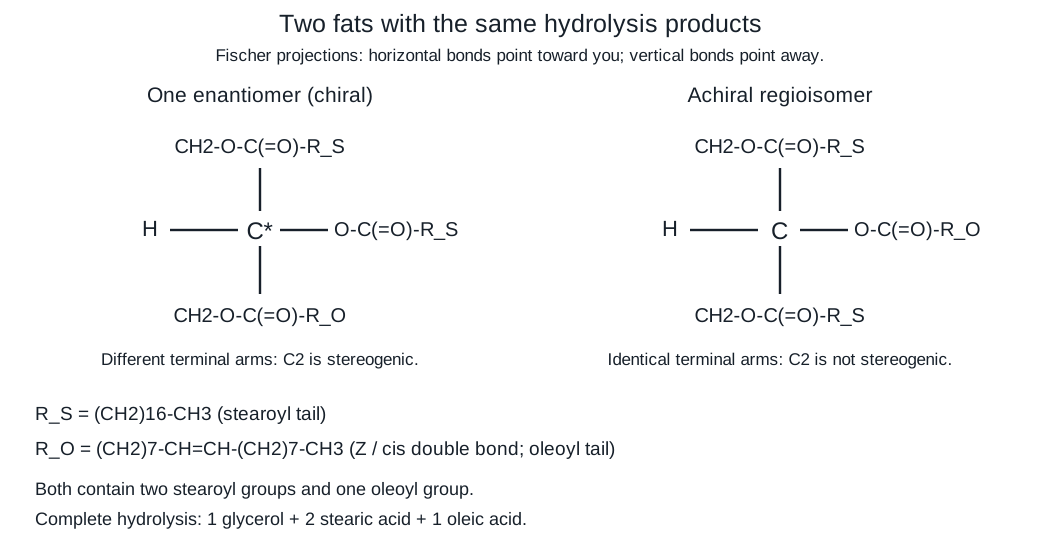
In these Fischer projections, horizontal bonds point toward the viewer and vertical bonds point away. The tail definitions are part of the structures; the oleoyl double bond remains cis in both drawings.
Check the required hydrolysis products
Each structure has two stearoyl esters and one oleoyl ester. Complete hydrolysis followed by an acidic workup therefore gives one glycerol, two stearic acids, and one oleic acid per molecule. Under basic saponification conditions, the immediate products are the corresponding carboxylate salts; acidification gives the free acids specified by the question.
A 1:1 mixture of the two enantiomers from part (a) would also be optically inactive as a sample. That is different from the achiral molecular structure supplied in part (b).
Evidence boundary
This addresses both drawing tasks in OpenStax Organic Chemistry Problem 27-18. The drawings are original representations with fully defined tails, not a copied answer key. “Optically active” assumes an enantiomerically enriched sample of the chiral structure; the problem supplies no experimental rotation, so neither its sign nor magnitude is assigned. Hydrolysis proportions alone do not establish acyl positions or enantiomeric composition.
Sources
Эти источники подтверждают изложенные выше концепции и методы.