Question
Determine all three branch currents in the circuit below, using the indicated reference directions.
The upper branch follows a → b → c → d → e: R₂ = 2.5 Ω, an 18 V source with its negative terminal at b and positive terminal at c, and internal resistance r₁ = 0.5 Ω. I₂ is referenced from a to e along this branch.
The middle branch joins e to a through R₁ = 6.0 Ω. I₁ is referenced from e to a.
The lower branch follows a → h → g → f → e: a 45 V source with its negative terminal at h and positive terminal at g, internal resistance r₂ = 0.5 Ω, and R₃ = 1.5 Ω. I₃ is referenced from a to e along this branch.
Both a and e are junctions shared by the three branches.
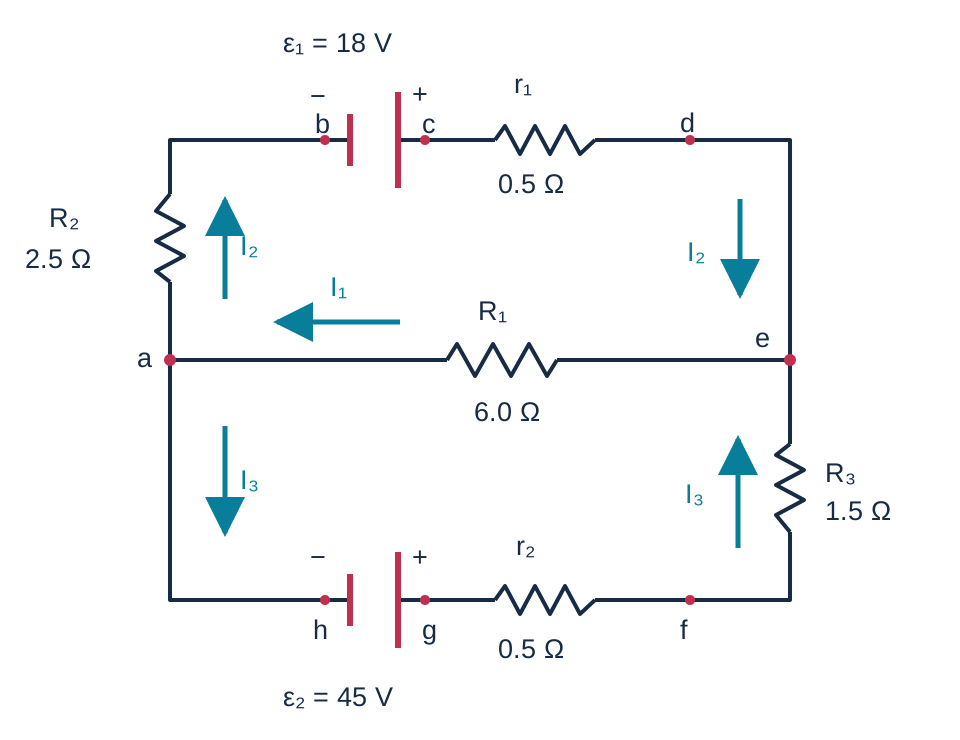
Circuit redrawn from OpenStax College Physics (BCcampus 2016), Section 21.3 Figure 5. The source polarities, values and reference directions are unchanged.
Keep the reference arrows
Use I₁ from e to a through the middle 6.0 Ω resistor, I₂ from a to e through the upper branch, and I₃ from a to e through the lower branch. A negative result will reverse an assumed direction.
Write three independent equations
At junction a, the signed currents satisfy:
Follow the upper branch from a to e, then return through the middle resistor from e to a. The source is crossed from negative to positive. The two upper resistances add to 3.0 Ω:
Follow the lower branch from a to e, then return through the middle resistor. The 45 V source supplies a rise and the two lower resistances total 2.0 Ω:
In these numerical equations resistances are in ohms, voltages in volts and currents in amperes. The middle resistor carries I₁ in both loops; the branch currents must not be treated as one series current.
Solve the system
The loop equations give:
Insert these into the junction equation:
Therefore:
| Branch | Signed result | Actual conventional-current direction |
|---|---|---|
| Middle | I₁ = 4.75 A | e → a |
| Upper | I₂ = −3.50 A | e → d → c → b → a |
| Lower | I₃ = 8.25 A | a → h → g → f → e |
The upper branch actually carries 3.50 A toward a. Its negative sign records that reversal, not a negative current magnitude.
Verify all three equations
Junction: 4.75 − (−3.50) − 8.25 = 0 A.
Upper loop: 18 − 3(−3.50) − 6(4.75) = 18 + 10.5 − 28.5 = 0 V.
Lower loop: 45 − 2(8.25) − 6(4.75) = 45 − 16.5 − 28.5 = 0 V.
These values satisfy every independent equation and agree with the source example.
Evidence boundary
This restates OpenStax College Physics, BCcampus 2016 edition, Section 21.3 Example 1 and Figure 5. The drawing and text preserve its source polarities, all resistances, node labels and current-reference arrows. Results use the ideal steady DC model with the specified internal resistances. The signed solutions are theoretical values under that model, not measurements or a claim of precision beyond the textbook data.
Sources
Эти источники подтверждают изложенные выше концепции и методы.