Question
Referring to Figure 14.20, prove that the buoyant force on the cylinder is equal to the weight of the fluid displaced (Archimedes’ principle). You may assume that the buoyant force is and that the ends of the cylinder have equal areas . Note that the volume of the cylinder (and that of the fluid it displaces) equals .
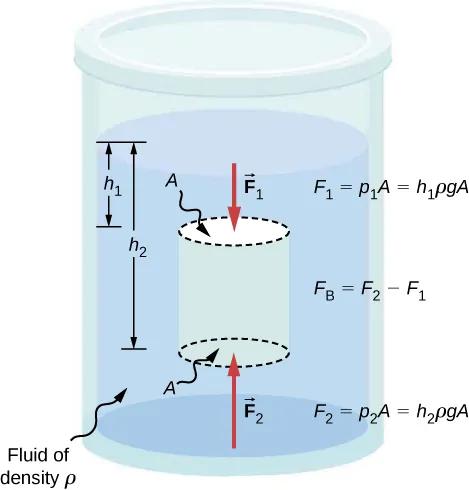
Figure 14.20. Source: OpenStax, University Physics Volume 1, Section 14.4. Depths are measured downward from the same fluid surface.
1. Read the forces and depths in Figure 14.20
The cylinder’s top and bottom are at depths and below the same fluid surface, with . Both horizontal faces have area . Pressure pushes downward on the top with force magnitude and upward on the bottom with magnitude . Horizontal side forces cancel by symmetry.
2. Calculate the two pressure forces
For a stationary fluid of constant density in a uniform gravitational field, pressure at depth is
where is the pressure at the surface. Therefore,
These are force magnitudes; upward is the positive direction for the net vertical force.
3. Subtract and use the displaced volume
Using the assumption in the problem,
The common surface-pressure terms cancel because the two end areas are equal. Since the displaced fluid has mass , its weight is . Hence,
and the net pressure force is upward. This proves Archimedes’ principle for the submerged cylinder shown. The cylinder’s own weight is a separate force and need not equal unless it is in vertical equilibrium without other vertical forces.
Evidence boundary
This proof uses OpenStax University Physics Volume 1, Chapter 14, Problem 73 and its Figure 14.20: equal cylinder end areas, depths h1 and h2, and buoyancy F2 − F1. It assumes a static constant-density fluid and uniform gravity. It proves the pressure force, without inventing measurements or assuming the cylinder is floating in equilibrium.
Sources
Эти источники подтверждают изложенные выше концепции и методы.