Question
Angela and Carlos are asked to determine the relationship between the normal force on a box of mass and the incline angle while the box rests on the incline.
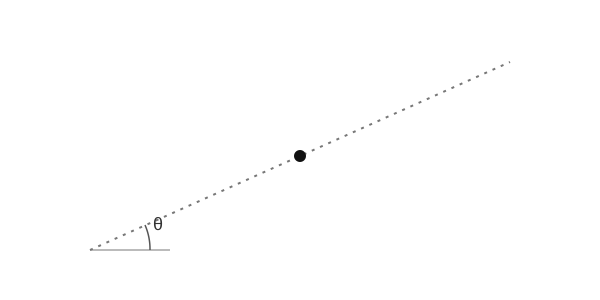
A. Draw a free-body diagram at the dot. Label the forces, not their components; each force needs a distinct outward arrow whose length reflects its magnitude.
B. Begin with and derive in terms of , and constants, explaining each step.
| Normal force (N) | Incline angle (degrees) |
|---|---|
| 97 | 10 |
| 95 | 15 |
| 85 | 30 |
| 80 | 35 |
| 75 | 40 |
| 63 | 50 |
| 49 | 60 |
C. From the equation in B, what should be plotted to make a linearized graph? D. What does that graph's slope mean physically?
A. At the dot draw three arrows: weight vertically downward, normal force perpendicular away from the incline, and static friction up the incline (the block would otherwise tend to slide down). Do not draw or as additional forces; they are components of the single weight vector. For any angle with , draw lengths in the ratios . Thus weight is longest; below , equal at , and above . The following illustrative diagram uses an angle near ; the ratio rule, not that particular drawing, applies to all seven angles.
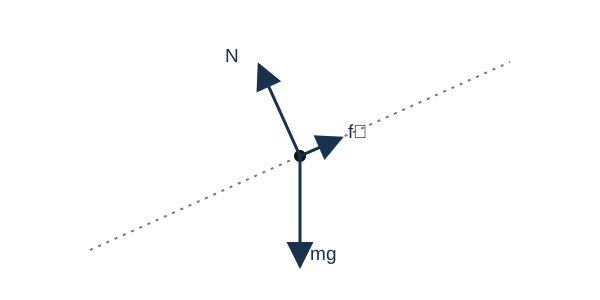
B. Choose positive perpendicular outward from the plane. Newton's second law says . The box is at rest, so . Static friction is parallel to the plane and has no component; gravity contributes . Hence , and therefore . Along the plane, , which also gives the friction length used in A.
C. Plot measured normal force (vertical axis, newtons) against (horizontal axis, dimensionless), not against angle in degrees. The seven horizontal coordinates, in table order, are approximately 0.98481, 0.96593, 0.86603, 0.81915, 0.76604, 0.64279 and 0.50000. The theoretical line is through the origin.
D. The line's slope is , the box's weight in newtons. The seven rounded observations give a freely fitted slope of about 98.9 N and an intercept near −0.6 N; the small nonzero intercept does not change the theoretical meaning of the slope. If , that slope corresponds to an inferred mass near 10.1 kg, but the original task asks for the slope's physical meaning, not a measured mass.
Evidence boundary
The workbook gives no numerical mass or angle for Part A, so the force-arrow lengths can show only the relative magnitudes , , and ; the illustration uses one example angle. The seven force readings are experimental observations, not exact points on an error-free theoretical line. A numerical fitted slope depends on the fitting convention, although its physical meaning remains .
Sources
Эти источники подтверждают изложенные выше концепции и методы.