Question
The figure represents a generic amino acid, with R denoting a variable carbon-based side chain. Explain how this structure permits amino acids to join into long peptide chains that form proteins.
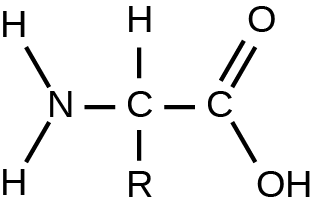
Structural notation: . Figure source: OpenStax Biology 2e, Chapter 3, Question 23.
How the structure permits linking
The illustrated alpha carbon carries an amino group, a carboxyl group, H and R. The carboxyl group of one amino acid links to the amino group of another, producing a covalent peptide bond, . R remains a side chain attached to the alpha carbon.
In the textbook’s neutral structural notation, the net condensation is:
The removed OH and H account for one water molecule. The resulting chain still has an amino end (N-terminus) and a carboxyl end (C-terminus). Further peptide linkages therefore extend the backbone into a polypeptide. A protein contains one or more polypeptide chains with an appropriate functional structure.
This net reaction explains the connectivity. It does not mean free amino acids spontaneously polymerize in cells: cellular protein synthesis uses activated amino acids carried by tRNA and ribosomal catalysis.
Evidence boundary
The single question and generic structure are from Biology 2e, Chapter 3, Critical Thinking Question 23. The neutral drawing is a structural convention; free amino acids commonly have ionized amino and carboxyl groups near physiological pH. The equation is a net condensation representation, not a complete cellular translation mechanism. No particular R group or protein sequence is specified.
Sources
Эти источники подтверждают изложенные выше концепции и методы.