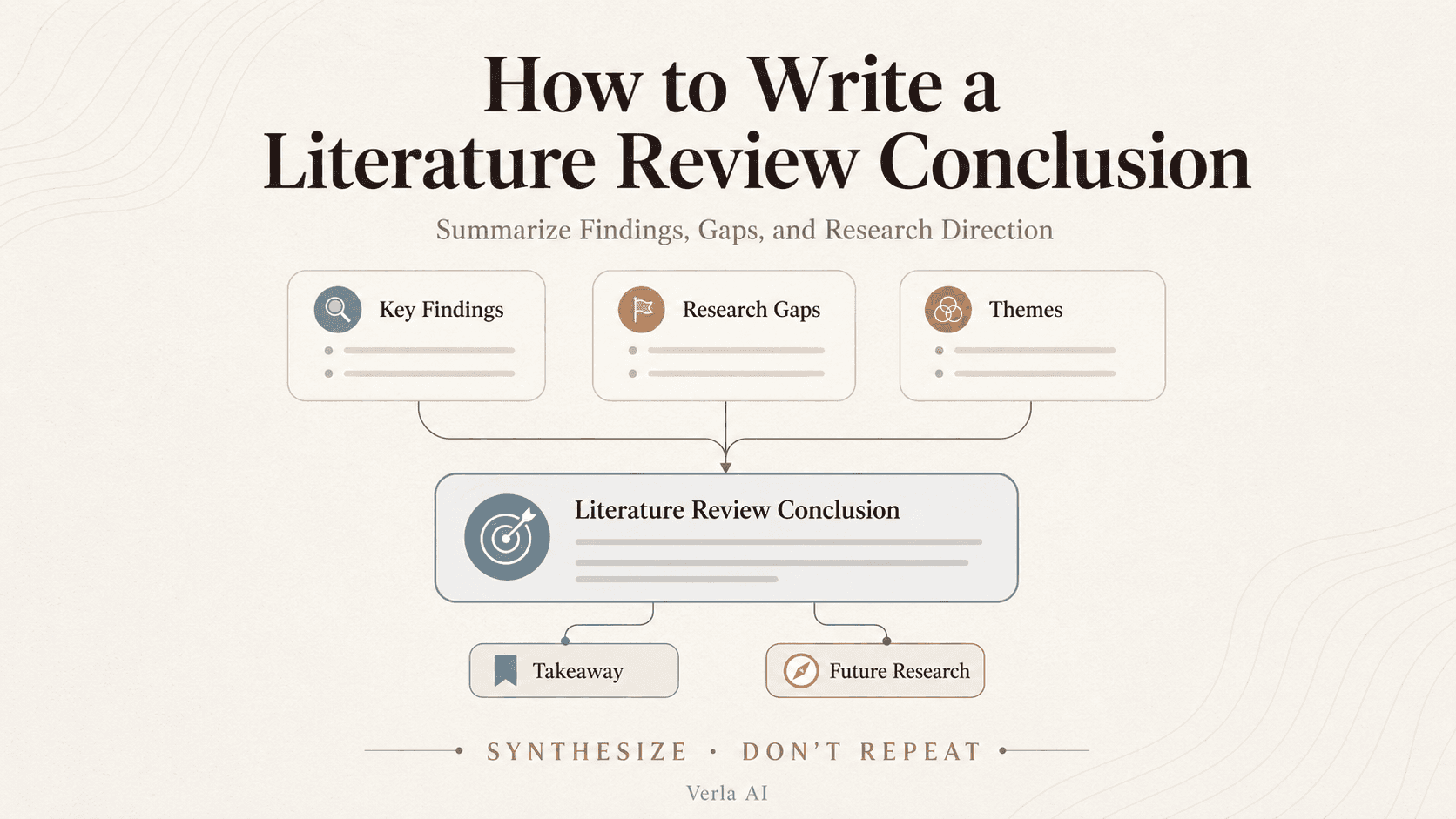
A literature review conclusion explains what the reviewed evidence supports as a whole. It identifies the overall finding, accounts for areas of agreement or disagreement, and clarifies why those patterns matter. It should also state what remains uncertain.
A conclusion draws only on material already discussed. Repeating each study in turn adds little, while introducing a new source leaves the reader without enough analysis to assess it.
The central task is to convert separate findings into a defensible statement about the literature:
After reviewing these sources, what can reasonably be said about the topic?
This guide provides a four-step structure, a complete literature review conclusion example, and adaptable sentence starters.
Key Takeaways
Summarize the overall state of knowledge rather than listing individual studies again.
Connect the evidence back to the research question.
Explain the main patterns, disagreements, limitations, and implications.
Use only studies and evidence already examined in the review.
Set the length according to whether the review stands alone or forms part of a larger study.
What Should a Literature Review Conclusion Do?
A literature review conclusion should leave readers with a clear account of what the research collectively shows. Purdue OWL recommends summarizing the main findings, explaining their significance, and relating them to the central research question. The conclusion must therefore synthesize the evidence instead of returning to a source-by-source summary.
For a broader explanation of the review's purpose, see What Is a Literature Review?.
Most conclusions address four areas:
The overall finding supported by the literature
Patterns, disagreements, and limits in the evidence
The theoretical, practical, or methodological significance
A specific unresolved question or next research step
These areas do not always require equal attention. A short literature review section may need only an overall finding and a brief account of its significance. A standalone review usually requires more discussion of limitations, unresolved questions, and directions for future research.
How to Write a Literature Review Conclusion in 4 Steps
State the Overall Finding
Open with the conclusion best supported by the literature. The first sentence should present the combined meaning of the evidence, not list authors in the order they appeared earlier.
Source-by-source wording:
Smith found that sleep affects grades, while Patel studied sleep duration and Jones examined student stress.
Synthesized wording:
Overall, the literature suggests that sleep quality and regularity are associated with academic performance among university students.
The second version gives readers a conclusion drawn from the studies as a group.
Account for Patterns and Disagreements
State where the evidence converges, then address any uncertainty or conflict. Differences among findings may result from the participants studied, the definitions used, the research methods, or the settings in which the studies took place.
Although most studies report a positive relationship between consistent sleep and academic performance, the strength of this relationship varies depending on how sleep and academic outcomes are measured.
This focus on relationships among studies separates a literature review from an annotated bibliography. An annotation evaluates sources individually. A literature review examines what several sources show together. See Annotated Bibliography vs. Literature Review for a detailed comparison.
Explain Why the Findings Matter
Connect the evidence to its theoretical, practical, or methodological significance. The conclusion might explain how the findings affect an existing theory or why they matter for policy and professional practice. It may instead identify a limitation shared across the research or show how the review informs a new project.
Keep this analysis tied to evidence already examined. A new argument requires support in the body of the review.
Name a Specific Gap or Next Step
Close with a question the current literature has not resolved. A useful research gap identifies the missing population, method, variable, or context.
Vague:
More research is needed on student sleep.
Specific:
Future longitudinal studies should examine whether sustained improvements in sleep regularity lead to measurable academic gains across students from different socioeconomic backgrounds.
If the sources point in several directions, Verla's Literature Review Generator can help organize them by shared findings, contradictions, limitations, and gaps before drafting the conclusion. Verify each suggested interpretation against the original sources.
Literature Review Conclusion Example
Consider this research question:
How do sleep patterns affect academic performance among university students?
A complete conclusion could read:
The literature associates consistent sleep quality and duration with stronger academic performance, but the available evidence does not establish a simple causal relationship. Studies using objective sleep tracking emphasize habitual sleep patterns. Survey-based research also points to the possible influence of stress, workload, and sleep disorders. Sleep therefore appears to be one part of a broader academic health system rather than an isolated predictor of grades. Much of the evidence, however, comes from short study periods and self-reported academic outcomes. Longitudinal research should test whether sustained sleep interventions improve academic performance across different student populations.
The conclusion states the overall finding, qualifies it in light of methods, identifies a focused limitation, and defines a specific next step. Additional models of introductions, body paragraphs, and synthesis appear in these annotated Literature Review Examples.
Weak vs. Strong Literature Review Conclusions
A weak conclusion reports broad findings but leaves their collective meaning unclear:
Many researchers have studied sleep and academic performance. Some studies found that sleep affects grades, while others reported different results. Sleep is important for students, and more research should be conducted.
The paragraph does not identify the overall pattern or explain why the findings differ. It also gives no indication of how reliable the conclusion is or what future research should examine.
An effective conclusion makes those judgments explicit:
Current evidence generally links consistent sleep with stronger academic performance, but differences in study design make the size and direction of this relationship difficult to establish. The frequent use of self-reported sleep and grade data also limits causal conclusions. Future studies should combine objective sleep measures with longitudinal academic records to determine whether improved sleep produces lasting academic benefits.
This version states the overall finding, qualifies it in light of the methods used, identifies a specific limitation, and defines a focused next step.
Sentence Starters for a Literature Review Conclusion
Sentence starters can clarify the role of each part of a conclusion, but they should guide the analysis rather than replace it.
To State the Overall Finding
Taken together, the literature suggests that…
Overall, existing research indicates that…
The evidence reviewed here generally supports…
Current research does not support a simple conclusion that…
To Synthesize Agreement or Disagreement
Across the studies reviewed, a consistent pattern is…
While most studies agree that…, they differ in…
The conflicting findings may reflect differences in…
Evidence remains mixed regarding…
To Explain Significance
These findings are important because…
Collectively, the evidence suggests that…
This pattern has implications for…
The review highlights the need to reconsider…
To Identify a Gap or Future Direction
However, relatively little research has examined…
An important limitation of the current literature is…
Future studies should distinguish between…
Further research is needed to determine whether…
Choose phrases that accurately reflect the relationships among your sources. Overusing standard transitions can make the conclusion sound formulaic.
How Long Should a Literature Review Conclusion Be?
There is no standard word count. Its length depends on the scope and purpose of the review. The conclusion should be long enough to explain what the evidence means, but substantially shorter than the body of the review. Follow the assignment instructions and conventions of your discipline when they call for a different structure.
The conclusion is where separate findings are brought together into a final answer supported by the evidence. Verla's Literature Review Generator can help organize the central patterns, disagreements, limitations, and research gaps in the evidence before you draft the conclusion.