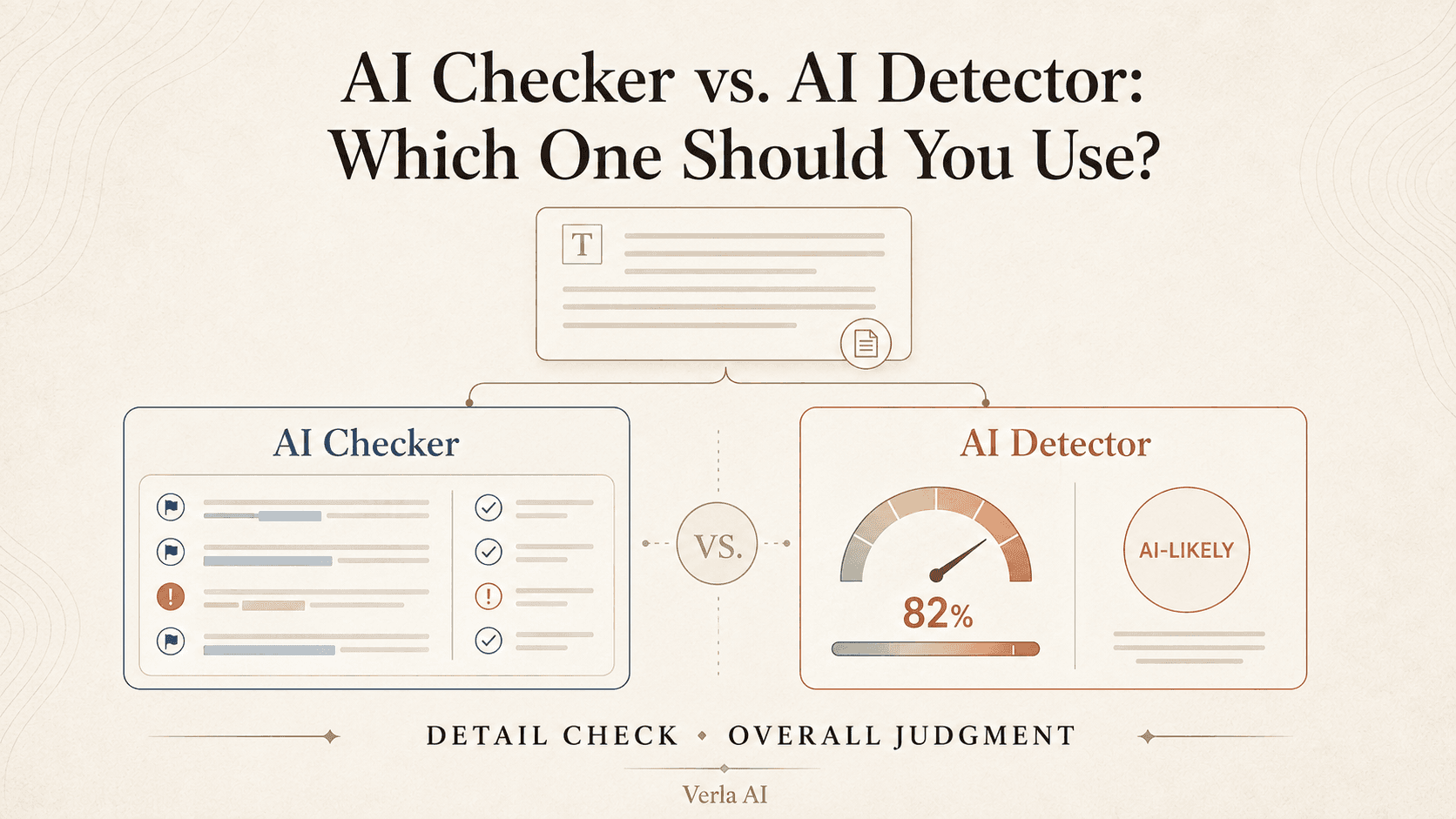
“AI Checker” sounds casual.
“AI Detector” sounds like it knows something you don't.
For text, they usually mean the same thing: a tool that analyzes writing and estimates whether it contains AI-generated patterns.
The name matters much less than the result it gives you—and what you can actually do with that result.
AI Checker vs. AI Detector: What’s the Difference?
Most of the time?
Not much.
Companies use AI Checker, AI Content Checker, AI Writing Checker, and AI Detector to describe tools doing essentially the same job.
You paste in some text.
The tool analyzes it.
Then it tells you whether the writing looks human, AI-generated, or somewhere in between.
Even major products mix the terms themselves. Copyleaks calls its product an “AI Detector” while describing it as a free “AI text checker.” GPTZero similarly describes itself as an AI Detector while using “AI checker” elsewhere in its product language.
So there is no hidden technical distinction where an AI Checker performs one kind of analysis and an AI Detector performs another.
Calling it a checker does not make it gentler. Calling it a detector does not make it more accurate.
There can be a product difference, though.
“AI Detector” usually refers specifically to AI-generated text detection.
“AI Checker” is sometimes used more broadly. A company may bundle AI detection with plagiarism checking, grammar feedback, rewriting, citations, or originality tools and call the whole thing a checker.
That is packaging.
Not a different detection technology.
This matters when you are choosing a tool because search results can make two nearly identical products look completely different.
One says:
Free AI Checker
Another says:
Advanced AI Content Detector
The second one suddenly sounds more serious.
It might be.
But you cannot tell from the name.
Look at what happens after you click Scan.
Does it give you one percentage?
Does it highlight exact sentences or paragraphs?
Does it distinguish between human, AI, and mixed writing?
Does it explain what triggered the result?
Those differences are real.
“Checker” versus “Detector” usually isn't.
How AI Detectors Actually Check AI-Generated Text
An AI Detector is not finding a secret ChatGPT stamp hidden inside your essay.
There is no tiny label saying:
Generated by GPT-5 at 11:43 p.m.
The detector is looking at patterns.
Large language models generate text statistically. AI detection systems are trained to recognize linguistic and structural signals that appear differently across human and machine-generated writing. Copyleaks, for example, says its detector looks at signals including phrase frequency, grammatical structure, syntax, and aspects of writing rhythm.
Different detectors use different models, datasets, thresholds, and methods, so you should not expect them to return identical scores.
That explains something that confuses people constantly.
You can put the same essay into three AI Detectors and get three different answers.
That does not necessarily mean two of them are broken.
They are making different statistical judgments.
And the number itself is easy to misunderstand.
If an AI Checker says:
72% AI
that does not necessarily mean it has proved that ChatGPT wrote exactly 72% of your words.
It means the system found enough patterns associated with machine-generated writing to produce that classification or probability according to its own model.
That distinction sounds technical until it happens to your own essay.
Imagine you wrote the paper yourself.
But you use very regular sentence structures.
You start several paragraphs the same way.
Your transitions are painfully neat.
You are writing a lab report where half the sentences follow familiar academic conventions.
A detector cannot watch you write.
It sees the finished text.
That is all.
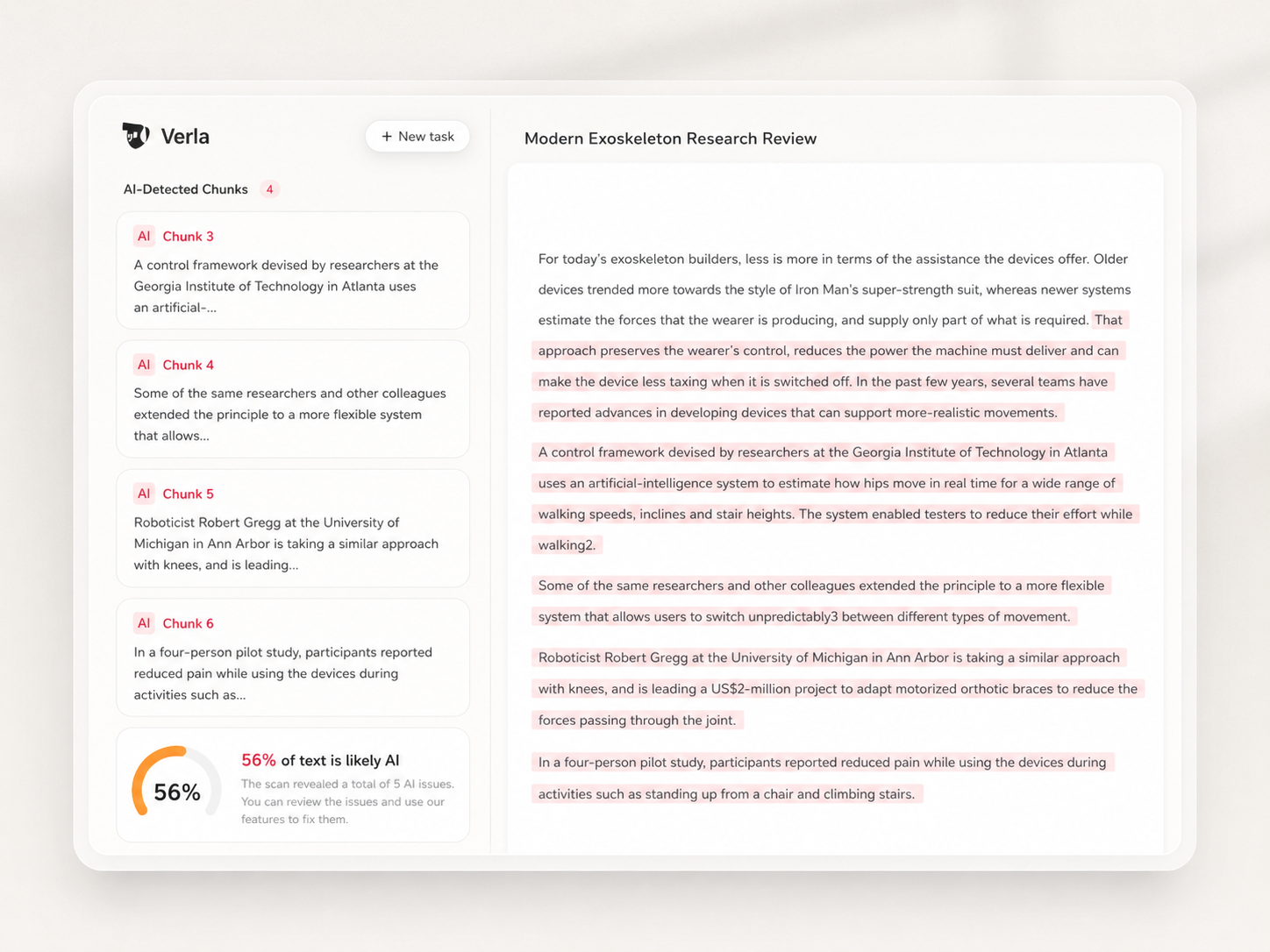
Which is why sentence-level or paragraph-level feedback is much more useful than one giant number.
GPTZero, for example, highlights parts of a document it considers suspicious, while Copyleaks offers sentence-level insights and breakdowns of patterns associated with the result.
A number tells you something happened.
A highlighted paragraph tells you where to look.
That is a much better starting point.
Are AI Checkers and AI Detectors Accurate?
Yes.
And sometimes no.
That sounds like a useless answer, but it is the important one.
Modern AI Detectors can perform extremely well under the conditions they were tested on. Companies including GPTZero and Copyleaks publish very high accuracy figures for their current detection systems.
The mistake is turning:
This detector performs very well overall
into:
Therefore this detector must be correct about my document.
Those are different claims.
RAID, one of the largest shared benchmarks built specifically to evaluate AI-generated text detection, tested millions of generations across different language models, domains, decoding methods, and adversarial modifications.
Its researchers found that detection performance can change significantly when the text comes from unseen models, uses different generation settings, or has been deliberately modified.
That is why a detector can advertise excellent benchmark accuracy and still occasionally miss AI writing or flag human writing.
GPTZero says this fairly clearly on its own student guidance: no AI Detector is perfect, and results should be treated as a guide rather than a final verdict.
The harder cases are rarely untouched ChatGPT answers anyway.
Those are relatively simple.
The messy cases look more like this:
You write the introduction yourself.
ChatGPT helps reorganize paragraph three.
Grammarly smooths several sentences.
You replace half of ChatGPT's suggestions.
Then you rewrite the conclusion from scratch.
Is that a human essay?
An AI-assisted essay?
A 17% AI essay?
There is no objective percentage of authorship sitting inside the document waiting to be discovered.
The detector is estimating patterns in the final text, not replaying its history.
That is also why human + AI mixed writing, heavily edited AI content, technical writing, short samples, and unfamiliar models can be harder to classify consistently. RAID's results show how quickly detector performance can change once the test moves outside clean, familiar conditions.
So should you ignore AI detection?
No.
A smoke alarm can be useful without being a forensic fire investigator.
The right question is not:
Can I trust this score completely?
It is:
What should this score make me inspect?
That leads to a much better use of an AI Detector.
Which One Should You Use?
Do not choose based on Checker vs. Detector.
Choose based on what you get five seconds after the scan finishes.
For occasional use, you may not need to pay at all.
GPTZero currently gives students up to 10,000 words per month on its free plan. QuillBot allows free AI Detector scans of up to 1,200 words at a time, with a limited number of daily scans. Copyleaks currently lets users scan up to 25,000 characters without logging in before pushing toward deeper reports and paid features.
That is enough to answer an important buying question:
If you are checking one essay tonight, start free.
Do not subscribe to an AI Detector because its landing page has a more intimidating accuracy percentage.
Use it first.
Then look at the limitations.
A 1,200-word cap becomes annoying when your essay is 3,000 words.
A whole-document percentage becomes frustrating when you have no idea which paragraph caused it.
Unlimited scans are less impressive if the tool gives you no useful explanation.
And a beautiful detection report still leaves one problem untouched:
What happens when your text gets flagged?
This is where many AI Checkers technically complete their job.
They tell you:
64% AI.
Then they leave.
You now own a new problem for free.
For teachers or editors who only need a detection signal, that might be enough.
For a student reviewing their own paper, it often isn't.
What to Do After an AI Detector Flags Your Writing
Three paragraphs turn red.
Do not immediately start replacing words.
That is how a clear sentence becomes:
“The empirical manifestation elucidates the multidimensional implications…”
because someone decided “shows” sounded too AI.
Read the paragraph first.
Ask what is actually wrong with it.
Maybe the writing is generic.
Maybe every sentence is almost the same length.
Maybe the paragraph uses those frictionless AI transitions—“Furthermore,” “Moreover,” “It is important to note”—until the whole thing feels assembled rather than written.
Then revise that problem.
Sometimes the detector is pointing at something genuinely weak.
Sometimes it is pointing at a completely normal paragraph.
That distinction matters more than getting every bar on the screen to turn green.
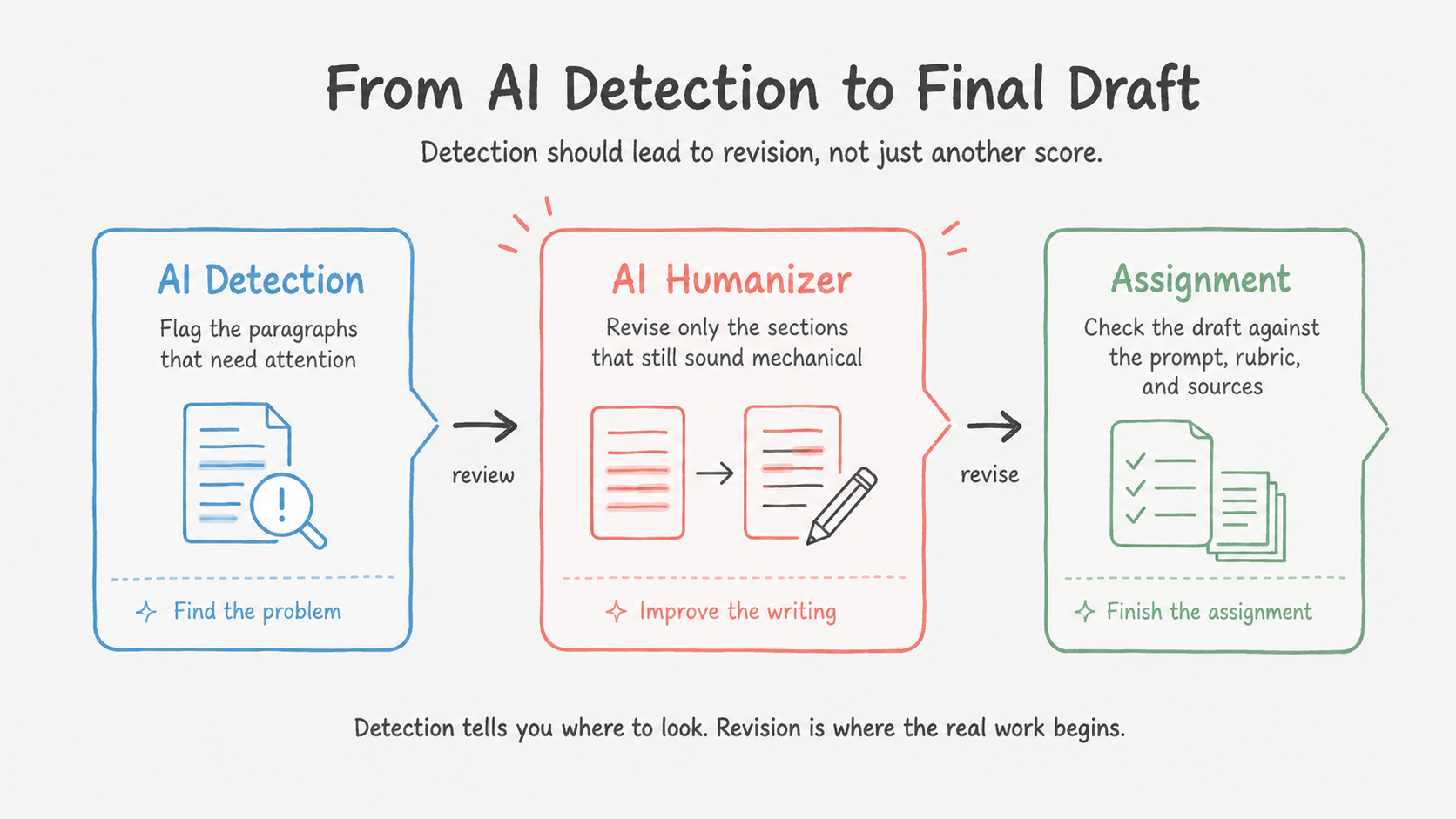
This is the philosophy behind Verla AI Detection. Instead of stopping at one document-wide estimate, Verla analyzes writing section by section and gives paragraph-level signals and review guidance so you can see where attention is actually needed.
If a paragraph really does sound mechanical, Verla AI Humanizer lets you work on the writing paragraph by paragraph and compare the revised version against the original.
That comparison matters.
A rewrite is not automatically better because an AI Detector likes it more.
You still need the same argument.
The same technical meaning.
The same evidence.
The same citation supporting the claim.
Verla's Humanizer is built around that paragraph-level rewrite-and-compare workflow rather than simply swapping the entire draft and asking you to trust the new version.
And sometimes AI Detection exposes a bigger problem.
The paragraph sounds strange because the argument itself is weak.
The evidence does not support it.
The essay drifted away from the prompt.
At that point, humanizing the sentence is treating the symptom.
Verla Assignment lets you work from the actual prompt, rubric, notes, PDFs, datasets, and source materials so revision can return to the reason the paragraph exists in the first place.
Verla Basic currently starts at $7.99 per month with annual billing and includes 10,000 AI Detection words, 5,000 Humanizer words, three Assignment uses, and file uploads.
That obviously costs more than a free AI Checker.
You are paying for a different question.
A basic detector asks:
Does this look like AI?
A useful writing workflow asks:
Why does this section need attention, and what should I do next?
Detection tells you where to look.
Revision is where the actual work begins.
Frequently Asked Questions
Is an AI Checker the same as an AI Detector?
Usually, yes. In the context of checking AI-generated writing, “AI Checker” and “AI Detector” are commonly used for the same type of tool. Some companies use “checker” as a broader label for products that also include plagiarism, grammar, or writing feedback.
Which is better: an AI Checker or an AI Detector?
The name does not tell you which tool is better. Look at detection quality, free limits, sentence- or paragraph-level feedback, supported languages, privacy, and what the tool lets you do after something is flagged.
Are free AI Detectors accurate?
Free does not automatically mean inaccurate. Some established detectors offer substantial free access: GPTZero currently provides students with 10,000 words per month, while QuillBot and Copyleaks also provide free scanning options. Paid plans generally increase limits or unlock more detailed analysis rather than turning an inaccurate detector into an accurate one.
Can an AI Detector falsely flag human writing?
Yes. No AI Detector is perfect. Human writing can sometimes resemble patterns associated with AI, while edited or unfamiliar AI-generated text can sometimes avoid detection. GPTZero itself recommends treating detection as guidance rather than a final verdict.
What should I do if an AI Detector flags my essay?
Start with the flagged passage rather than rewriting the entire essay. Check whether it is generic, repetitive, mechanically structured, or genuinely unlike your normal writing. Then revise for clarity and meaning first. Tools such as Verla AI Detection and Verla AI Humanizer can help move from detection into paragraph-level review and revision without treating the percentage itself as the final goal.